The latest installment in President Donald Trump’s tariff drama contains multiple plotlines, from lobbing new duty threats at Mexico, Canada and India while vowing to bail out American farmers whose exports have been dwindling amid the trade wars.
Following a meeting in Washington, D.C. with Mexican President Claudia Sheinbaum and Canadian Prime Minister Mark Carney on Friday in which the three North American trading partners vowed to continue conversations about the future of their relationship, Trump made the surprising move Monday to threaten Mexico with higher duties for apparently violating its water treaty with the United States.
Related Stories
In an afternoon Truth Social post, Trump accused the country of cheating drought-ridden farmers in Texas out of the water needed to raise crops and livestock. Under the Utilization of Waters of the Colorado and Tijuana Rivers and of the Rio Grande Treaty of 1944, Mexico is required to provide at least 350,000 acre-feet of water every five years, but the country has underdelivered on that promise due to its own drought conditions and water shortages.
Nonetheless, Trump went on to demand 800,000 acre-feet of water—payback for the incomplete supply seen over the past five years—and 200,000 acre-feet of water by the end of the month.
“As of now, Mexico is not responding, and it is very unfair to our U.S. Farmers who deserve this much needed water,” the president wrote. “That is why I have authorized documentation to impose a 5% Tariff on Mexico if this water isn’t released, IMMEDIATELY.”
Sheinbaum, often cool-headed and deliberate in her dealings with the American leader, said during her daily briefing Tuesday that the two countries “need to reach an understanding; we need to coordinate.” She denied any ill will on Mexico’s part, saying the country “want[s] to comply with the treaty but taking into account the current conditions.”
Trump continued in the vein of defending U.S. farmers on Tuesday, announcing at a White House roundtable that he plans to deliver $11 billion in aid for row crop farmers, including those that cultivate cotton, by the end of February.
A subsequent $1 million payout will be held in reserve for farmers of specialty crops, whose needs will soon be assessed. Many row crop farmers will know what they’re due to receive by the end of the month, the administration said.
Agriculture Secretary Brooke Rollins explained in the meeting that the country’s farmers are “facing a crisis that we inherited that most of these farmers have not seen in their lifetime.” She blamed the Biden administration for flagging exports and other challenges to farm operations.
“Profitability is down. It’s just one crisis after another,” she said, calling the newly announced funding “the bridge that is needed to get from the last administration, and what happened under the last president and the last U.S. Department of Agriculture, to this new Golden Age of farmers.”
A press release from the U.S. Department of Agriculture announcing the package reiterated that stance, saying it would address “temporary trade market disruptions and increased production costs that are still impacting farmers following four years of disastrous Biden Administration policies that resulted in record high input prices and zero new trade deals.”
However, the seismic fluctuations of the country’s trade relationships have cost farmers major profits. Most notably, Beijing, embroiled in a tit-for-tat trade spat with Washington since the spring, drew down sharply on its purchases of American soybeans—traditionally the biggest U.S. export to China.
While U.S. farmers exported about half their yield of soybeans (about 985 million bushels) to China in 2024, this year saw that number nosedive. During the first eight months of the year, just 218 million bushels made their way from U.S. farms to China.
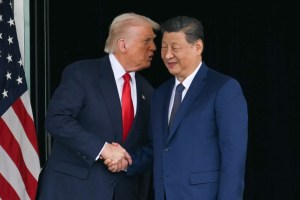
The country resumed buying soybeans partly in a show of goodwill in advance of a long-awaited meeting between Trump and Chinese President Xi Jinping in October. On Tuesday, the president said Xi had committed to purchasing more than $40 billion in U.S.-grown soybeans and might “do even more than he promised to do.”
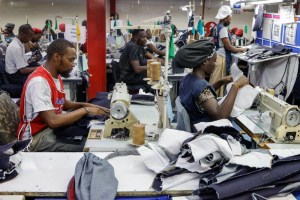
Cotton farmers, too, have seen their exports dwindle directly due to the trade war with China. Cotton shipments to the country fell by 90 percent during the first half of the year as China implemented retaliatory tariffs on the crop worth about 140 percent in April, effectively grinding trade with the country to a halt. Exports to Pakistan, Turkey and Vietnam subsequently saw major upticks, with Vietnam tripling its orders of cotton and taking on a greater share of apparel production for U.S. brands seeking to diversify away from China.
Trump on Tuesday credited his tariff regime with funding the forthcoming payments to farmers, saying, “This relief will provide much needed certainty to farmers as they get this year’s harvest to market and look ahead to next year’s crops.”
“This money would not be possible without tariffs,” he added.
Trump also said during the meeting that he is considering levying new duties on Indian rice exports as well as Canadian fertilizer bound for the U.S. after hearing from farm representatives who accused the countries of “dumping” these products into the American market. Leaders from both India and Canada have engaged Trump in hopeful negotiations in recent months as they seek relief from 50 percent and 35 percent tariffs, respectively, though those talks have largely stalled.
American Farm Bureau Federation President Zippy Duvall commended the administration for the bridge payments, which he said will help tide farmers over until relevant relief provisions from Trump’s landmark legislation, the One Big Beautiful Bill Act, reach the farm sector.
“America’s farmers have been hit from every direction during this economic storm. They face the same high prices as all of America’s families, as more of their income is going to household bills and higher operating costs, including loans, equipment and supplies,” he said. “At the same time, farmers are receiving historically low prices for most major crops—they’re expected to lose $34 billion this year alone.”
With a Supreme Court decision that will determine the future of most of Trump’s “reciprocal” tariffs pending, the president has been publicly campaigning on the efficacy of his trade strategy. He’s promised to pass on U.S. government revenue from the tariffs to the masses, including farmers and average consumers, while simultaneously paying down the national debt.
“While the United States has other methods of charging TARIFFS against foreign countries, many of whom have, for YEARS, TAKEN ADVANTAGE OF OUR NATION, the current method of Tariffing before the United States Supreme Court is far more DIRECT, LESS CUMBERSOME, and MUCH FASTER, all ingredients necessary for A STRONG AND DECISIVE NATIONAL SECURITY RESULT,” he wrote late Sunday evening.
“The biggest threat in history to United States National Security would be a negative decision on Tariffs by the U.S. Supreme Court. We would be financially defenseless,” he added, in a more subdued tone, on Monday.