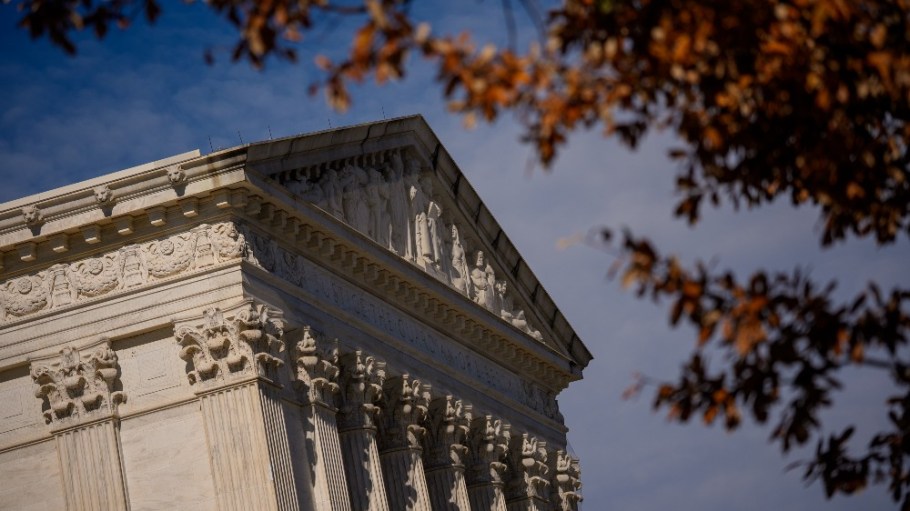
President Donald Trump’s worldwide “reciprocal” tariffs came under harsh scrutiny on Wednesday in the nation’s highest court.
Many of the Supreme Court justices, including those in the conservative majority, cast a skeptical eye on the sweeping duties as representatives for the administration and the petitioners made their cases over the course of more than three hours.
Solicitor General D. John Sauer took the floor first to assert Trump’s right to levy the tariffs under the International Emergency Economic Powers Act (IEEPA). He faced rapid-fire questioning from the justices about whether the 1977 trade law authorizes the president to regulate imports using tariffs in the event of a national emergency perpetrated upon the U.S. by a foreign force.
Related Stories
The implications of the word “regulate” were key to both the Sauer’s arguments and the judges’ questioning. “The power to impose tariffs is a core application of the power to regulate foreign commerce, which is what the phrase ‘regulate importation’ in IEEPA naturally evokes,” the Solicitor General said.
He argued that Congress does not need to specifically designate the president with the power to impose tariffs with a “consistently explicit and well-defined approach—which is to use these magic words: tariff, tax, imposed.”
“Congress is not bound to use that particular formulation when it wants to confirm this power,” he added.
Justice Katanji Brown Jackson pushed back on Sauer’s assessment of the law’s intention.
“As I understand it… IEEPA was designed and intended to limit presidential authority—that Congress was concerned about how presidents had been using the authority under the predecessor statute, [the Trading with the Enemy Act (TWEA)],” she said, referencing a 1917 law that imbued the president with the power to regulate or restrict trade with an enemy nation during wartime.
“So it seems a little inconsistent to say that we have to interpret a statute that was designed to constrain presidential authority consistent with an understanding that Congress wanted the president to have essentially unlimited authority,” Jackson said.
Behind Sauer’s claim that Congress doesn’t need to explicitly authorize the president to impose tariffs under IEEPA is an assertion that there’s precedent for the action—a frequently referenced case called the United States v. Yoshida International.
President Richard Nixon imposed a 10 percent tariff on all imported goods in 1971 to address what the government described as a major economic crisis. The U.S. government was subsequently sued by Yoshida International, which was importing zippers from Japan, saying the president overstepped his authority. The government then invoked TWEA as a statutory basis for the tariffs. That reasoning was ultimately validated in court, and the federal government prevailed.
Both IEEPA and TWEA contain identical language about the president’s authority to “regulate…importation,” and neither contains language about tariffs.
Sauer also faced pointed questions from conservative justices. Chief Justice John Roberts called tariffs a “tax” on Americans, clarifying that only Congress has the ability to enact taxes.
Sauer fought back against the implication that the full weight of the tariffs is borne by American consumers and U.S. businesses, saying sometimes foreign producers pay the duties. He also characterized the tariffs as a tool for regulating foreign trade and policy, not a revenue driver for the federal government.
“Yes, of course, there are dealings with foreign powers, but the vehicle is imposition of taxes on Americans, and that has always been the core power of Congress,” Roberts said.
“It’s been suggested that the tariffs are responsible for significant reduction in our deficit. I would say that’s raising revenue domestically,” he added.
Justice Amy Coney Barrett questioned the idea that more than 100 nations under Trump’s tariff regime represent an “unusual” or “extraordinary” threat to national security or the U.S. economy.
“These are kind of across the board,” she said of the tariffs. “And so is it your contention that every country needed to be tariffed because of threats to the defense and industrial base? I mean, Spain? France?”
Sauer pointed to Trump’s executive order on the issue that attempted to spell out the nature of the emergency: a lack of reciprocity in trade with foreign trade partners; a pervasive imbalance that has embattled the U.S. supply chain.
Neal Katyal, the lawyer for the petitioners, delivered an argument centered on whether Congress delegated tariff power to the president, and what kind of precedent it will set if Trump’s tariffs are allowed to proceed.
“It’s simply implausible that in enacting IEEPA, Congress handed the president the power to overhaul the entire tariff system and the American economy, in the process, allowing him to set and reset tariffs on any and every product from any and every country at any and all times,” he said.
“We will never get this power back if the government wins this case,” he added. “What president wouldn’t veto legislation to rein this [tariff] power in…? IEEPA is a sanction statute. It’s not a tax statute where Congress gave away the store.”
Conservative Justice Clarence Thomas asked if the same reasoning Katyal laid out wouldn’t also apply to embargoes and quotas, trade tools that have been used by multiple presidential administrations to regulate trade.
No, Katyal said, presenting a key difference: “Embargoes stop the shipment. Tariffs start the tax bill”—and only Congress has the power to implement taxes.
Should the petitioners win their case, Justice Barrett had questions about how reimbursements would be doled out to people and entities that have already paid the tariffs. “How would this work? It seems to me like this could be a mess,” she said.
Katyal said that only the businesses directly involved in the case would see refunds. The thousands of others impacted would have to file and administrative protest and likely face a long and arduous road to reimbursement. However, “serious economic dislocation isn’t a reason” that has factored into previous Supreme Court decisions, and it shouldn’t be in this case, either, he said.
“The justices had serious questions for the Solicitor General and some serious doubts about the validity of the tariffs under IEEPA,” Josh Robbins, an attorney at the Pacific Legal Foundation, told Sourcing Journal.
“They had some tough questions for the for the states and the Mr. Katyal as well. The question of whether ‘regulate…importation’ covers tariffs is one they one they seem to think is a difficult one, as is the question of how, or whether, they’re going to police the president’s determination of what is an emergency.”
“I think what they’re trying to work through is that the Constitution grants Congress the power to impose tariffs and taxes in one part of Article One, and the power to regulate foreign commerce in another part of Article One,” Robbins added. “So there’s been a big debate about whether it is significant that those are separate.”
One side—the petitioners—are arguing that those are two separate powers that can’t be conflated. “But there’s also case law that talks about how tariffs can be used to regulate foreign commerce,” the lawyer said.
“The fight about whether [the tariffs are] revenue-raising is part of this argument about where they fall; do we have to look at them as something that’s basically akin to a tax, and then bring in the ideas about Congress being the body that’s responsible for taxing? Or can you view ‘regulatory tariffs’ in a different manner?” he added.
While the Supreme Court received more than 40 “friend of the court” briefs, along with briefs from the Solicitor General and the lawyers for the petitioners, detailing the impacts that tariffs could have on the nation’s economy and industry, Robbins said he believes the justices are likely to focus heavily on whether Trump’s tariffs adhere to the law.
“I think with the current makeup of the court, the pendulum has swung much more toward looking at the letter of the law; you heard a lot today about the plain text, a lot of historical discussion,” he said. “They’re inevitably going to weigh those practical considerations—but I think they’re properly focused on determining the meaning of the text and whether it aligns with the original meaning of the Constitution.”