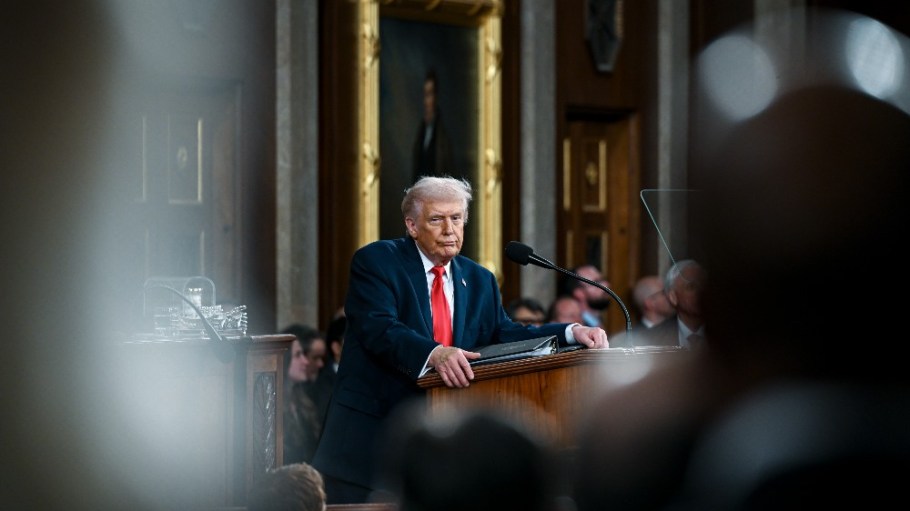
President Donald Trump delivered on the most prominent predictions about his State of the Union address on Tuesday night, making the longest speech of its kind on record and focusing heavily on tariffs—and the recent Supreme Court decision that took them down.
As he entered the House Chamber and made his way to the podium, the president greeted lawmakers, stopping at Chief Justice John Roberts for a handshake and a dour exchange of glances. Aside from Roberts, who delivered the high court’s decision on the now-defunct International Economic Emergency Powers Act (IEEPA) tariffs on Friday, only three other justices were in attendance—Amy Coney Barrett, Brett Kavanaugh and Elena Kagan.
Related Stories
All wore somber expressions, perhaps in anticipation of a tongue-lashing from Trump. Forty minutes and change into the speech, Trump still hadn’t mentioned the brutal blow to his trade agenda, taking time to tout his perceived wins—”our border is secure, our spirit is restored, inflation is plummeting, incomes are rising fast.”
Beginning his segue, Trump claimed that the “economy is roaring like never before.”
“One of the primary reasons for our country’s stunning economic turnaround—the biggest in history, where the Dow Jones broke 50,000, four years ahead of schedule, and the S&P hit 7,000, where it wasn’t supposed to do it for many years—were tariffs,” Trump said, underscoring the economic and national security benefits to the policy.
“Everything was working well. Countries that were ripping us off for decades are now paying us hundreds of billions of dollars,” he added. “And then just four days ago an unfortunate ruling from the United States Supreme Court, it just came down,” he said. “Very unfortunate ruling,” he repeated, seeming to address the culprits seated in the front row.
Turning to Treasury Secretary Scott Bessent for confirmation, Trump asserted, “The good news is that almost all countries and corporations want to keep the deal that they already made.”
Recent events call that claim into question. The European Parliament cancelled a Tuesday vote that would have ratified the so-called Turnberry Agreement brokered by Trump and European Commission President Ursula von der Leyen last July.
Meanwhile, a delegation of trade officials from India scrapped a scheduled trip to Washington this week to hash out the final terms of the U.S.-India trade pact, with a commerce ministry official saying more time was needed to “study the implications” of the Supreme Court decision.
The office of United Kingdom Prime Minister Keir Starmer expressed confusion about the state of the UK-U.S. trade agreement, saying “nothing is off the table” when it comes to addressing the Trump administration’s latest 15 percent tariff threat. The impacts of the tariffs have hit home significantly: Aston Martin, the British luxury carmaker, announced plans on Wednesday to cut 600 jobs—about 20 percent of its staff—due to deepening sales losses in the U.S., its biggest market.
Despite percolating global unease, Trump addressed trade partners with his familiar brand of threatening coercion. “Knowing that the legal power that I as president have to make a new deal could be far worse for them,” he said. “And therefore they will continue to work along the same successful path that we had negotiated before the Supreme Court’s unfortunate involvement.”
Crediting “the threat of tariffs” with settling a multitude of wars and conflicts across the globe, Trump insisted that the duties (though he didn’t specify which) “will remain in place under fully approved and tested alternative legal statutes.” The trade laws he intends to deploy, including Section 122 and Section 301 of the Trade Act of 1974 and Section 232 of the Trade Expansion Act of 1962, are “a little more complex, but they’re actually probably better, leading to a solution that will be even stronger than before,” he said.
“Congressional action will not be necessary. It’s already time-tested and approved,” Trump added. While he quickly enacted 10 percent tariffs under Section 122, which deals with balance-of-payments issues, the duty rate is capped at 15 percent under that statute and the duration is limited to 150 days, after which Congress would need to vote to extend the tariffs. The president has not yet issued the executive order that would trigger the 15 percent duty rate he threatened over the weekend.
In spite of the challenges that appear to be stacking up against his most favored economic cudgel, Trump reprised his campaign messaging: tariffs, paid for by foreign countries, will replace the modern income tax. Trillions of dollars of investment will pour into the U.S. to bolster factories, jobs and American infrastructure.
But the buck stops with investment into immigrant labor. President Trump touched on the trucking industry, calling on Congress to pass the proposed “Dalilah Law,” which would bar any state from granting commercial driver’s licenses (CDLs) to illegal immigrants.
The legislation is named in honor of Dalilah Coleman, a then-five-year-old who was severely injured in a car accident two years ago caused by an illegal immigrant in California.
In June 2024, undocumented Indian national Partap Singh was arrested for causing a multi-car pileup while driving a commercial 18-wheeler. According to a California Highway Patrol traffic crash report, Singh drove at an unsafe speed and failed to stop for traffic and a construction zone.
Despite entering the U.S. illegally throughout the southern border in October 2022, Singh had been issued a CDL in California in 2023.
Coleman attended the address Tuesday night with her father, Marcus.
Under the proposed law, all commercial vehicles will be required to have a permanent business name that is reflective, can be visible up to 100 feet and is not magnetized without a permit, according to Coleman’s X account, ran by Marcus.
Independent operators and those seeking a magnetized USDOT number can file for a permit that will be granted per vehicle identification number (VIN) and linked to their specific DOT number.