Days after a federal court ruled that President Donald Trump overstepped his authority by imposing sweeping global tariffs, the Commander in Chief has asked the Supreme Court to fast-track his appeal to keep them in place.
With double-digit duties on America’s international trading partners hanging in the balance, the petition filed by Solicitor General D. John Sauer on Wednesday contended that “The stakes in this case could not be higher.”
The president and his cabinet believe the tariffs “are promoting peace and unprecedented economic prosperity, and that the denial of tariff authority would expose our nation to trade retaliation without effective defenses and thrust America back to the brink of economic catastrophe,” the filing said, quoting Commerce Secretary Howard Lutnick.
Related Stories
“To the President and his most senior advisors, these tariffs thus present a stark choice: With tariffs, we area rich nation; without tariffs, we are a poor nation,” Sauer wrote. The administration is now asking the Supreme Court to expedite a review of the lower court’s decision and decide whether to review the case by Sept. 10, with arguments to be held in November.
The high court’s new term begins on Oct. 6. Meanwhile, the Washington, D.C.-based appeals court that ruled the tariffs illegal put a stay on its decision until Oct. 14 to give the administration time to appeal the case.
The solicitor general’s filing attempted to unravel the appeals court’s decision, which centered on what it deemed as an unlawful use of the International Emergency Economic Powers Act (IEEPA), a 1977 law which grants the president power to regulate international commerce in the face of a national emergency perpetrated by a foreign actor. Trump overstepped the bounds of the law, the court ruled after hearing oral arguments in July.
But according to Sauer, “There is nothing new or suspect about IEEPA’s broad delegation of tariff authority to address national emergencies.”
“Congress has long supplemented the President’s Article II foreign-affairs powers by delegating capacious authority to impose tariffs that, in the President’s judgment, will advance national security, foster economic prosperity, or facilitate negotiations with foreign counterparts,” the filing further stated. The solicitor general said the appeals court’s decision—which reaffirmed a ruling by a New York-based Court of International Trade in May—”eviscerates a critical tool for ad-dressing emergencies through fuzzy reasoning that improperly transforms judges into foreign-policy referees.”
Since the Friday decision was handed down, Trump has been taking to screens and airwaves to make his position known, and to apply pressure on the Supreme Court to resolve the issue. The administration’s broad and sweeping tariff regime, which took effect Aug. 7, is allowed to continue pending a final decision from the nation’s highest court.
“It’s an economic emergency,” the president said during an interview on CNN radio on Wednesday. “If we don’t win that decision, you’ll see a reverberation like maybe you’ve never seen before.”
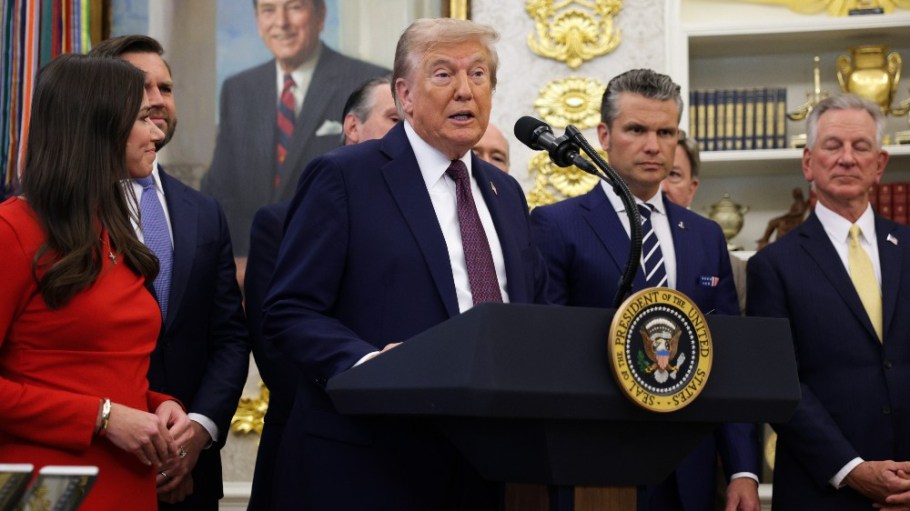
During an Oval Office meeting with Polish President Karol Nawrocki, the president addressed the press, saying, “The tariffs are vital to the success of this country. He even credited his ability to intervene in global conflicts to the leveraging of duties and economic sanctions.
“Our country has a chance to be unbelievably rich again, but it could also be unbelievably poor again. If we don’t win that case, our country is going to suffer so greatly,” he added, referring directly to the Supreme Court appeal.
The White House attempted to underscore the success of the administration’s tariff scheme with last month’s data. “In August, tariff revenues topped $31 billion—bringing the total to $158 billion this calendar year, or more than 2.5 times the revenue this time last year,” a Thursday morning memo said.
Treasury Secretary Scott Bessent tweeted the “record high” figures. “As collection continues to grow, the Trump Administration is fixing the financial shambles it inherited,” he wrote. Bessent has said that revenue from tariffs could exceed $500 billion per year.
The Yale Budget Lab’s data was slightly more muted. “New 2025 tariffs have raised $88 billion in revenue year-to-date through August so far, with the new tariffs responsible for about $23 billion in revenues in August alone,” the group wrote.
With the fate of his global tariffs undecided, Trump nonetheless remains resolute in his resistance to offering India any sort of leniency. Asked Tuesday at the White House whether he would consider lowering the 50 percent duty rate on the country’s imports that he set last month, Trump answered, “No.”
“You have to understand, for many years, it was a one-sided relationship; only now, since I came along, and because of the power that we have with tariffs—India was charging us tremendous tariffs, about the highest in the world,” he said. “And we therefore weren’t doing much business with India, but they were doing business with us because we weren’t charging them, foolishly.”
Earlier this week, as Indian Prime Minister Narendra Modi traveled to China to attend the Shanghai Cooperation Organisation summit and cozied up to Chinese President Xi Jinping and Russian President Vladimir Putin, Trump reiterated his angst about the trade relationship—and India’s choice of allies.
He claimed the country had fleeced U.S. businesses with its own steep import tariffs and criticized its government for continuing to purchase certain products, like oil, from Russia. Trump asserted that India, now desperate to remediate the deteriorating trade relationship with the U.S., had offered to drawn down duties on American-made goods completely—“but it’s getting late,” he said. “They should have done so years ago.”