President Donald Trump will not be attending this week’s Supreme Court hearing on the fate of his tariff regime, but he continues to advocate on behalf of the administration’s prevailing trade strategy in the days leading up to the landmark case, which he called “one of the most important decisions in the history of our country.”
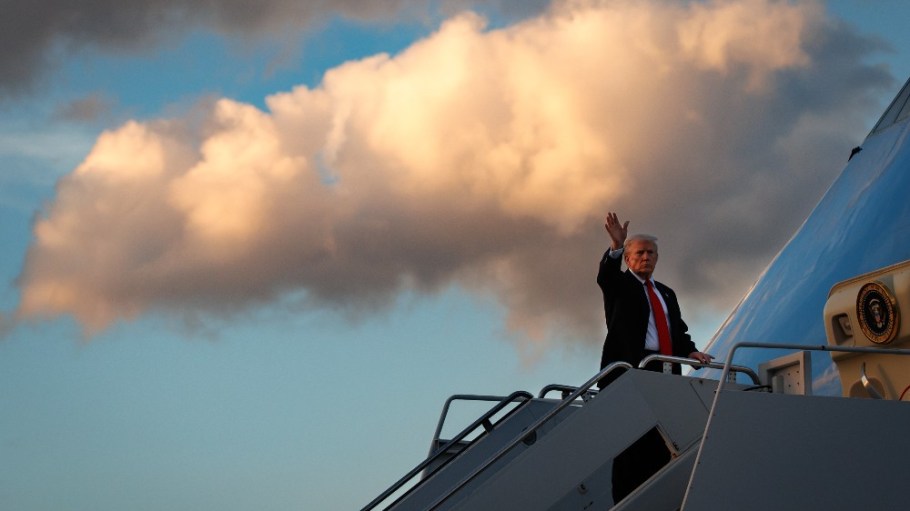
“I wanted to go so badly,” he told reporters on Air Force One on a flight back from Mar-a-Lago to The Hill this weekend. “I just didn’t want to do anything to deflect from the importance of that decision,” he added, according to a report from Fox News.
Related Stories
Instead of showing up to hear oral arguments from representatives for the federal government and the seven businesses and 12 states involved in the case, Trump plans to deliver an address to the country from Miami on Wednesday.
Reverting back to sentiments that have become familiar in recent months, the president said the country’s financial health is at stake should the tariffs be reversed. “If we don’t have tariffs, we don’t have national security, and the rest of the world would laugh at us because they’ve used tariffs against us for years and took advantage of us,” he said.
“Other countries use tariffs against us, and we weren’t able to openly and freely use tariffs against them,” Trump added. “I’ll give you an example—China. That was going to be a disaster for the world, and I was able to settle it very quickly, very easily because I was able to use tariffs. It’s total national security, and economic health is also part of national security, by the way.”
Trump’s long-awaited meeting with Chinese President Xi Jinping took place on Thursday, and tariffs were indeed central to a discussion that touched on China’s purchasing of American soybeans, its export controls on rare earth minerals, curbing fentanyl smuggling and its role in helping to facilitate an end to the Russia-Ukraine conflict.
Over the weekend, the White House released new details about the substance of the trade framework. In a fact sheet titled, “President Donald J. Trump Strikes Deal on Economic and Trade Relations with China,” the administration laid out terms that it said would rebalance trade with the economic superpower.
Most pressing in the eyes of the administration, China has committed to suspending the export controls on rare earth minerals until Oct. 9, 2026, and will issue general licenses for exports of rare earths along with gallium, germanium, antimony, and graphite “for the benefit of U.S. end users and their suppliers around the world.” In exchange, the U.S. has tabled the 100 percent tariffs Trump threatened in retaliation last month.
The country will also take significant steps to stop the flow of fentanyl precursors into the U.S., specifically through halting the shipment of certain chemicals to North America and controlling their flow to other destinations throughout the globe.
China is additionally taking action to draw down its own tariffs, ending the retaliatory duties it announced on March 4 on American agricultural products like chicken, wheat, corn, cotton, sorghum, soybeans, pork, beef, aquatic products, fruits, vegetables and dairy products. Non-tariff countermeasures taken against the U.S. since that time will also be walked back, like adding American companies to its end user and unreliable entity lists.
Trump, who has heard an earful from embattled American soybean farmers in recent weeks, secured China’s promise to purchase at least 12 million metric tons of the crop during the last two months of this year, and at least 25 million metric tons in each month of 26, 2027 and 2028.
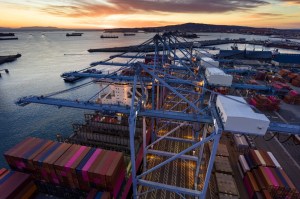
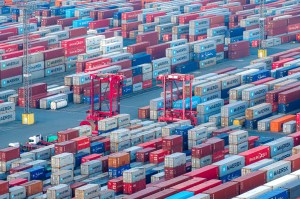
Along with walking back restrictions it imposed on certain U.S. technology firms, China will also stop certain actions it took in retaliation for the U.S. Trade Representative’s Section 301 investigation into China’s Targeting the Maritime, Logistics, and Shipbuilding Sectors for Dominance, and simultaneously remove sanctions it imposed on a number of shipping entities.
The country will extend its market-based tariff exclusion process for products imported from the U.S., and those exclusions will stay in place until Dec. 31 of next year. Meanwhile, it will stop its investigations into American firms in the semiconductor business.
In turn, the U.S. will undertake concessions of its own.
The administration announced last week that it would reduce the 20 percent tariffs levied on China as a result of fentanyl smuggling to 10 percent following Trump’s meeting with Xi, and will maintain its suspension of heightened reciprocal tariffs on China-originating imports until Nov. 10. It will extend certain exclusions for Section 301 tariffs which are due to expire on Nov. 29 until Nov. 10, 2026.
Notably, the U.S. is also suspending implementation of the responsive actions to the Section 301 investigation into China’s Targeting the Maritime, Logistics, and Shipbuilding Sectors for Dominance, and the two countries’ governments have committed negotiating with China on the matter while the U.S. pursues collaborations with South Korea and Japan.
Taking into account the 10 percent reduction of tariffs related to China’s commitment to curbing fentanyl, the country’s duty burden currently stands at 47 percent—lower than that of India (50 percent) and identical to neighboring Hong Kong.