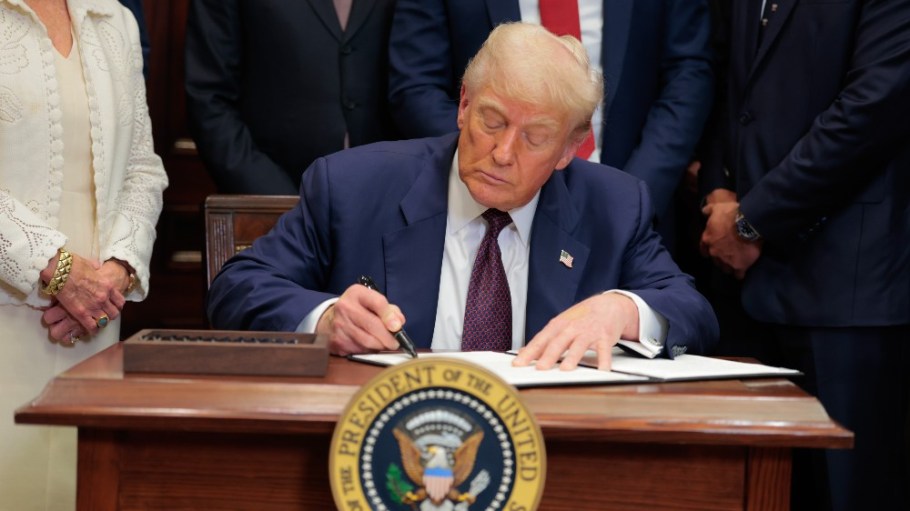
Hours before the pause on “reciprocal” tariffs was due to expire, President Donald Trump released an executive order modifying the duty rates for dozens of U.S. trade partners.
Ranging from 10 percent to 41 percent, the new tariffs will go into effect on Aug. 7, the order indicated. Goods that are found to have been transshipped—or rerouted through third countries to evade higher duties—will be subject to an additional 40-percent tariff. These rates will replace those announced by Trump on “Liberation Day” in early April.
Related Stories
According to the White House notice, trading partners that “have agreed to, or are on the verge of concluding, meaningful trade and security agreements” with the U.S. will be subject to Thursday’s modified rates until those agreements are concluded.
Meanwhile, countries that weren’t listed, and import more American-made products than they export to the U.S., will be subject to 10-percent duties—the same universal baseline tariff that was announced April 2.
“I found that conditions reflected in large and persistent annual U.S. goods trade deficits constitute an unusual and extraordinary threat to the national security and economy of the United States that has its source in whole or substantial part outside the United States,” the president wrote in the executive order. “I declared a national emergency with respect to that threat, and to deal with that threat, I imposed additional ad valorem duties that I deemed necessary and appropriate.”
A Washington, D.C.-based Court of Appeals for the Federal Circuit heard oral arguments for and against that justification earlier in the day.
Trump wrote that information and recommendations from senior cabinet officials regarding the country’s trade relationships and foreign trading partners’ existing tariff barriers informed his decisions on the modified rates. Heightened duties are designed to prioritize America’s domestic manufacturing base and supply chains, and its defense industrial base, he wrote.
While Trump has often said in recent weeks that there would be no delays to his tariff scheme, they will take effect one week later than he initially planned. Shipments that have been loaded onto vessels to the U.S. before that date, arriving by Oct. 5, will not be subject to the new duties, giving importers a small window to rush orders.
Notably, the president made good on his threat to hit Canadian imports to the U.S. market with steeper tariffs, raising the country’s rate from 25 percent to 35 percent, beginning Friday (aside from goods covered by the U.S.-Mexico-Canada Agreement (USCMA), which include clothing, footwear and textiles). Mexico was not featured on the list, as Trump announced earlier in the day that he and President Claudia Sheinbaum had agreed to extend the current deal for 90 days while they pursue a long-term agreement. The country is currently subject to 25-percent tariffs on goods not covered by USMCA.
The president also walked back his threat to hit Brazil with 40-percent duties earlier this week, bringing the South American nation’s rate down to just 10 percent.
The hardest hit nations were Switzerland at 39 percent, Myanmar and Laos at 40 percent, and Syria at 41 percent.
The full list is as follows:
- Afghanistan: 15 percent
- Algeria: 30 percent
- Angola: 15 percent
- Bangladesh: 20 percent
- Bolivia: 15 percent
- Bosnia and Herzegovina: 30 percent
- Botswana: 15 percent
- Brazil: 10 percent
- Brunei: 25 percent
- Cambodia: 19 percent
- Cameroon: 15 percent
- Chad: 15 percent
- Costa Rica: 15 percent
- Côte d`Ivoire: 15 percent
- Democratic Republic of the Congo: 15 percent
- Ecuador: 15 percent
- Equatorial Guinea: 15 percent
- European Union: Goods with a Column 1 Duty Rate over 15 percent: 0 percent
- European Union: Goods with Column 1 Duty Rate less than 15 percent: 15 percent minus Column 1 Duty Rate
- Falkland Islands: 10 percent
- Fiji: 15 percent
- Ghana: 15 percent
- Guyana: 15 percent
- Iceland: 15 percent
- India: 25 percent
- Indonesia: 19 percent
- Iraq: 35 percent
- Israel: 15percent
- Japan: 15percent
- Jordan: 15percent
- Kazakhstan: 25percent
- Laos: 40 percent
- Lesotho: 15 percent
- Libya: 30 percent
- Liechtenstein: 15 percent
- Madagascar: 15 percent
- Malawi: 15 percent
- Malaysia:19 percent
- Mauritius: 15 percent
- Moldova: 25 percent
- Mozambique: 15 percent
- Myanmar (Burma): 40 percent
- Namibia: 15 percent
- Nauru: 15 percent
- New Zealand: 15 percent
- Nicaragua: 18 percent
- Nigeria: 15 percent
- North Macedonia: 15 percent
- Norway: 15 percent
- Pakistan: 19 percent
- Papua New Guinea: 15 percent
- Philippines: 19 percent
- Serbia: 35 percent
- South Africa: 30 percent
- South Korea: 15 percent
- Sri Lanka: 20 percent
- Switzerland: 39 percent
- Syria: 41 percent
- Taiwan: 20 percent
- Thailand: 19 percent
- Trinidad and Tobago: 15 percent
- Tunisia: 25 percent
- Turkey: 15 percent
- Uganda: 15 percent
- United Kingdom: 10 percent
- Vanuatu: 15 percent
- Venezuela: 15 percent
- Vietnam: 20 percent
- Zambia: 15 percent
- Zimbabwe: 15 percent