Amid a Thanksgiving week filled with more talk of trade and tariffs than turkey, Trump has tapped a new U.S. Trade Representative with ties to his first administration.
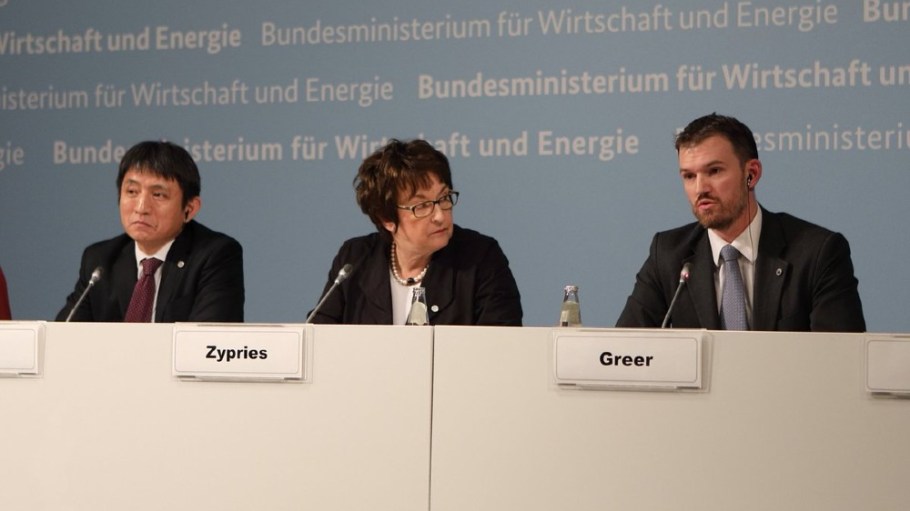
Jamieson Greer, who served as chief of staff to former USTR Robert Lighthizer, has been selected to fill the role.
On Tuesday evening, the president-elect took to Truth Social to announce the pick, saying that Greer, a California native, Air Force veteran and partner at King & Spalding LLP “played a key role” during his first term when it came to imposing Section 301 duties on China and facilitating the negotiating process that replaced the North American Free Trade Agreement (NAFTA) with the U.S.-Mexico-Canada Agreement (USMCA).
Related Stories
During his second term, Trump said Greer would be focused on “reining in the Country’s massive Trade Deficit” as well as defending U.S. manufacturing and “opening up Export Markets everywhere.”
If confirmed, Greer’s role in the Trump 2.0 regime will be central to carrying out the incoming president’s ambitious and unorthodox trade agenda.
Throughout his campaign, Trump vowed to hit China with significant new duties ranging from 60 percent to 100 percent—a promise he appeared to walk back this week when he announced that he would instead implement 10-percent duties “above any additional Tariffs” already in place on day one of his administration.
But the president-elect appears to be holding fast to his plan to implement a universal baseline tariff of 10 percent to 20 percent to offset the cost of proposed income tax cuts for the wealthy. And this week, he took aim at the nation’s North American neighbors and free-trade partners, calling for 25-percent tariffs on goods from Mexico and Canada.
These rapidly evolving machinations have inflamed relationships with Canadian Prime Minister Justin Trudeau and Mexican President Claudia Sheinbaum, who both strongly advised Trump to reconsider.
While Greer hasn’t commented on these recent plans, he did testify in front of the U.S.-China Economic and Security Review Commission to the efficacy of Trump’s original tariff strategy.
At a hearing in May, he said the Section 301 duties implemented during Trump’s first term were successful in reducing America’s dependence on China for critical technologies, slowing down China’s exploitation of the U.S.’ open economy and increasing the value of domestic production.
During the testimony, Greer gave several glimpses into his attitude toward China trade and provided recommendations that he’s likely now bringing to the attention of the incoming president.
He advised revoking China’s permanent normal trade relations (PNTR) status, raising tariffs on Chinese products, ending the country’s access to the de minimis trade exception, and establishing new sanctions based on human rights concerns and international security.
“Speaking for myself, I view China’s stated ambitions and observed actions as a generational challenge for the United States,” he said. “Trade and investment with China not only have failed to live up to expectations, but they have also actively harmed U.S. economic and national security interests.”
“Any policies enacted to rise to the challenge posed by China will have costs and benefits,” he added. “There is no silver bullet, and in some cases the effort to pursue strategic decoupling from China will cause short-term pain. However, the cost of doing nothing or underestimating the threat posed by China is far greater.”
Josh Teitelbaum, senior counsel for the international trade policy practice of D.C. law firm Akin Gump, said he was buoyed by Trump’s choice of a USTR veteran to lead the department.
“Having already served at USTR, Jamieson is a professional and clearly knows his way around the building as well as the laws that will allow him to implement the President-elect’s tariff wishes,” he told Sourcing Journal, noting that “the President-elect also chose more market-oriented leaders for his National Economic Council and Treasury Department.”
“One of the most important dynamics to watch will be how the Trump economic team can reconcile the President-elect’s desire for tariffs and a growing economy at the same time,” he added. “I expect the tariffs are coming, the tariffs are coming.”
Nicole Bivens Collinson, managing principal of the operating committee of international trade and government relations at Sandler, Travis & Rosenberg P.A. also expressed confidence in Trump’s pick given Greer’s prior experience crafting and implementing trade policy.
“I also believe that he understands that tariffs have a limit,” she said. “Just layering tariffs on tariffs to all countries ultimately could defeat the purpose of the tariffs initially, which was a reduction in dependence on a single source.”
If it costs brands tens of millions of dollars to move their supply chains away from China, but they’re still facing duties wherever they go, they may come to consider the objective moot, she indicated.
Moving forward with the very likely implementation of new duties, Bivens Collinson said “the allowance for notification, public comments, and opportunities to seek exemptions for those goods that are not available elsewhere is essential, especially as more manufacturers move to the U.S. and other countries.”
“The vertical supply chains will follow, but we need to allow sufficient transition time, thus inputs may need to continue to have exemptions until such time as the supply chain has shifted out of China,” she added. “I believe that Greer and Lighthizer understand these principles and I am hopeful that my expectations will be realized.”