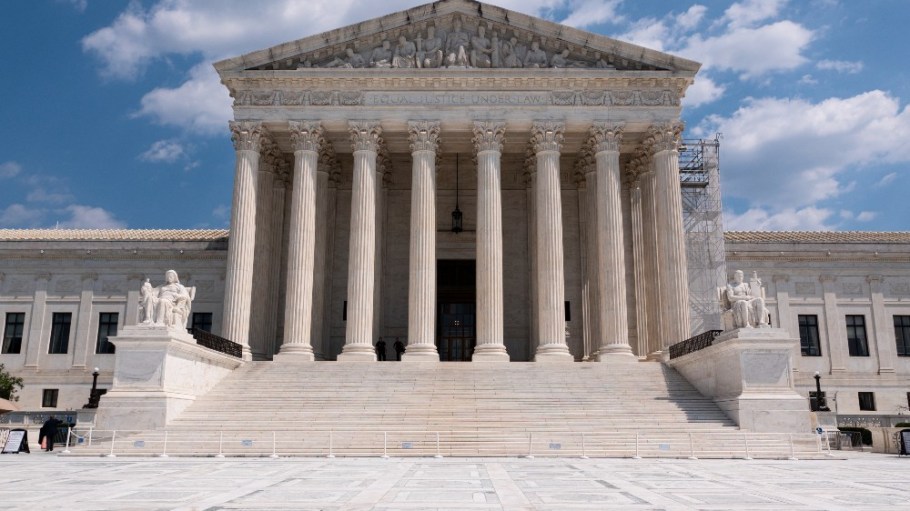
The high-stakes Supreme Court hearing that will determine the fate of President Donald Trump’s sweeping tariff regime will take place on Wednesday morning at 10 am.
The high court’s nine justices are slated to hear 80 minutes of oral arguments about whether the Commander in Chief lawfully leveraged a 1977 trade law, the International Emergency Economic Powers Act (IEEPA), in implementing double-digit duties on America’s trading partners across the globe.
Two separate cases, Learning Resources, Inc. v. Trump and V.O.S. Selections, Inc v. Trump, which each saw favorable rulings from lower courts last spring and summer, were combined into a single case at the behest of the Supreme Court, which agreed to hear the case in September following an appeal from the administration. Small and medium-sized businesses (SMBs) and a dozen state attorneys general make up the petitioners.
Related Stories
Oral arguments, typically constrained to an hour (allocating 30 minutes for each side), will be expanded, underscoring the gravity and complexity of the case. Solicitor General D. John Sauer will present the president’s argument on behalf of the IEEPA tariffs over 40 minutes. Three lawyers will present the plaintiffs’ arguments, with 20 minutes reserved for the business petitioners and 20 minutes reserved for the states.
In the weeks leading up to the landmark hearing, the Supreme Court has received and weighed the contents of more than 40 “friend of the court” briefs. Among them was an amicus curiae signed by 200 Members of Congress urging the court to uphold the findings of the lower courts—namely, that the president overstepped his executive authority in enacting the tariffs using IEEPA. Then, there was a plea from more than 700 U.S. SMBs to invalidate the duties, which they said represent an “existential threat to survival.”
At the core of the case is the argument from the petitioners that IEEPA does not grant the president the power to impose tariffs.
Signed into law by President Jimmy Carter, the law authorizes the president to “regulate” international commerce and imports in the instance of a foreign-born national emergency defined as an “unusual and extraordinary threat” to the country’s security and foreign policy. When the president declares a national emergency under IEEPA, they may block transactions with other nations and freeze assets.
The statute does not mention the words “tariffs” or “duties,” but the administration has argued that because tariffs are the most common tool used to regulate imports, the president’s authority to leverage them is implied in the law. Since its inception, IEEPA has been invoked 69 times, and no president has ever used it to impose tariffs.
Judges will consider historical precedent, but also real-world implications, in their decision.
The brief filed by Solicitor General Sauer to the Supreme Court parrots much of the president’s familiar rhetoric regarding the tariffs. “To the President, these cases present a stark choice: With tariffs, we are a rich nation; without tariffs, we are a poor nation,” it said.
“The President has stated that ‘[o]ne year ago, the United States was a dead country, and now, because of the trillions of dollars being paid by countries that have so badly abused us, America is a strong, financially viable, and respected country again,’” the brief added, underscoring the president’s view that tariffs represent a critical economic cudgel.
And by contrast, if the U.S. was forced to pay back the “trillions of dollar committed to us,” the country could find itself in dire straits. “In short, President Trump and his advisors have determined that erroneously invalidating the IEEPA tariffs ‘would have catastrophic consequences for our national security, foreign policy, and economy,’” the brief stated.
Meanwhile, the petitioners argued that the mercurial nature of the administration’s tariff strategy has injected massive uncertainty into their operations. It could amount to a $3 trillion-plus tax on Americans over the course of the next 10 years as businesses are forced to pay more for foreign products and imports and they, in turn, pass those price increases along to their customers.
“Here, the government contends that the President may impose tariffs on the American people whenever he wants, at any rate he wants, for any countries and products he wants, for as long as he wants—simply by declaring longstanding U.S. trade deficits a national ‘emergency’ and an ‘unusual and extraordinary threat,’ declarations the government tells us are unreviewable,” a brief from petitioners in the V.O.S. Selections case said.
“The President can even change his mind tomorrow and back again the day after that. That is a breathtaking assertion of power, and one would expect to see an unequivocal grant of authority from Congress to support it—if the Constitution permits it at all,” it added.
There are no further hearings scheduled following Wednesday’s oral arguments, and it is unclear when the Supreme Court is expected to deliver a ruling on the case, though it will have to happen before the Court recesses in late June or early July of 2026. There are no rules on when a decision must be reached or released, though the Court did agree to the administration’s request to “expedite” the hearing based on the pressing nature of the issue.
The president and his cabinet have been advocating across airwaves and screens for the viability and necessity of their tariff scheme as the date of the hearing approaches. On Tuesday, Treasury Secretary Scott Bessent, who plans to attend the hearing, indicated that the administration has already been exploring other avenues, like Section 232 of the Trade Expansion Act of 1962 and Section 301 of the Trade Act of 1974, to impose duties should Trump’s IEEPA tariffs be invalidated.
“There are lots of other authorities that can be used, but IEEPA is by far the cleanest, and it gives the U.S. and the president the most negotiating authority,” he told CNBC. “The others are more cumbersome, but they can be effective.”
With hours to go before the tariff showdown, the president was more circumspect.
“Tomorrow’s United States Supreme Court case is, literally, LIFE OR DEATH for our Country,” he Truthed Tuesday afternoon. “With a Victory, we have tremendous, but fair, Financial and National Security. Without it, we are virtually defenseless against other Countries who have, for years, taken advantage of us.”