Tariff terror has gripped consumer goods sectors. But couched within President Donald Trump’s April 2 announcement about reciprocal duties was another trade action that has the potential to upend global e-commerce and drastically alter the way products enter the U.S. market.
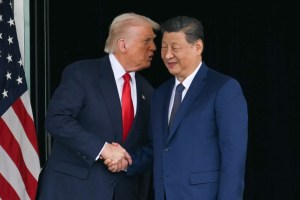
After announcing a slew of new tariffs in the White House Rose Garden last week, Trump appeared to be leaving the stage before signing an executive order ending de minimis treatment for packages originating in China.
Related Stories
In the moment, it looked like an afterthought. But its implications will be momentous, given that de minimis trade has ballooned to nearly 4 million packages each day, reaching nearly 1.4 billion for the whole of 2024. At least half of those duty-free parcels—each worth $800 or less, and most ringing in at about $50—come from China.
One thing is for certain: U.S. Customs and Border Protection’s (CBP) job just got a whole lot bigger, according to Felicia Pullam, former executive director of the Office of Trade Relations at CBP. “That’s massive growth, and CBP is not resourced to handle that,” Pullam, who left her post earlier this year, told Sourcing Journal. “They need people, but you can’t hire your way out of this, so they also need better technology and better data.”
Under the president’s executive order, shipments sent through means other than the international postal network—like commercial air freight and ocean freight—that would normally qualify for de minimis treatment will now be subject to all applicable duties. Parcels sent through the international postal network that would usually qualify for de minimis will, after May 2, be subject to a duty rate of either 30 percent of their value or $25 per item (a fee that will increase to $50 after June 1). CBP can also determine that any parcel be assessed through the more stringent Formal Entry process at its discretion.
The White House tried a similar move in February, but with fewer details and no grace period for implementation, sending CBP into a frenzy. The move was quickly reversed to give Customs and the Commerce Department a grace period to develop adequate systems for processing the staggeringly high volume of small shipments and collecting tariff revenue.
While the administration and relevant agencies have kept mum so far on many of the finer points of the plan, Pullam already foresees some challenges, especially with regard to the U.S. Postal Service’s (USPS) ability to assess and process tariffs.
“Because USPS relies on data provided by foreign counterpart post offices, which is limited for several reasons, they aren’t able to require the 10-digit HTSUS codes that are necessary to determine what tariffs apply,” she explained. “The compromise method of requiring a duty of 30 percent or a flat dollar figure per item for postal shipments, while allowing CBP to require formal entry for any individual postal shipment, is interesting. That gets around the HTSUS problem, but I’m curious to see how it will be implemented.”
It’s tough to put a number on de minimis shipments currently being processed by the government-owned mail carrier, but it’s been estimated that USPS handles about 75 million parcels per year, around 5 percent of total de minimis volume.
Express shippers like UPS, FedEx and DHL, by contrast, are well-versed in de minimis, and they handle a ton of it. “Generally speaking, CBP works very closely with the express industry, and vice versa. My understanding is that their processes are exceptionally efficient,” Pullam said.
However, “The speed with which the new trade actions are moving is a huge lift for both industry and CBP. Giving businesses time to figure out the right (and most efficient) way to comply, train personnel, and adjust systems is important for smooth implementation.”
There’s not much time to be had with just over a month before Trump’s China de minimis ban takes effect. But CBP has been gearing up, in some ways, for a scenario like this, as the de minimis exception has been thrust into the spotlight with the explosion of firms like Shein and Temu. Lawmakers on both sides of the aisle have been calling for its elimination for years, saying that it gives Chinese corporations a leg up to the detriment of American makers.
Pullam explained that two CBP pilot programs, the “Entry Type 86 Test” and the “Section 321 Data Pilot” have helped the agency learn what works and what doesn’t when it comes to collecting data on low-value packages. “CBP needs to know ‘what’s in the box’ and the data helps them gauge risk,” she said. That data includes the 10-digit HTSUS code and country of origin, which is also necessary for determining tariff rates.
“E-commerce and low-value packages won’t go away with the end of the de minimis exemption, so the lessons, experience, and systems from these pilots will still be useful,” she said. It seems likely that most shipments that would have previously qualified for de minimis will enter the country using Entry Type 11, “which is an ‘informal’ entry type for low-value shipments that requires payment of all duties, taxes, and fees. She believes this “should be manageable.”
“The pilots have helped lay groundwork for CBP and industry, but there will certainly still be an adjustment period,” she added.
Industry has a major role to play in complying with the new legislation. “Major e-commerce companies are super sophisticated and some of them can move very quickly, she said, referring to the aforementioned behemoths. “The highest profile companies have the resources to adjust their systems, and they are also incentivized to comply voluntarily,” she added.
“The nimblest importers, carriers, and brokers have likely been thinking about this for a while,” she said.
Small businesses utilizing de minimis at a more limited scale—to bring in samples, for example—will “need to rely on their service providers to help them understand and adjust,” she believes. “I think some U.S. small business may not even be aware that they are using the de minimis exemption, so brokers, express companies, and electronic payment companies will need to step in to assist.”
Pullam pointed the evolution of cross-state commerce—which has grown exponentially with the advent of e-commerce—as an example of a similar evolution. “E-commerce companies have to collect and pay sales tax across the United States, but small businesses obviously don’t have the resources to monitor sales tax in every jurisdiction,” she said. “That was a complex adjustment, and it will be similarly complex to adjust to tariffs.”
Despite these new hurdles, ending the de minimis exemption won’t stop the growth of e-commerce, Pullam said. “Low-value packages will still continue to flow, so resources for trade facilitation and enforcement will remain important.” Meanwhile, smugglers and bad actors are perpetually advancing their methods for disguising illicit goods, unsafe products and narcotics. “CBP needs to talk to industry while they’re doing the retooling, so that they understand the technical challenges and full range of scenarios to create a system that actually works,” she added.
Angela Santos, partner and Customs Practice leader for Los Angeles-based law firm ArentFox Schiff, said she’s skeptical about the administration’s ambitious timeline for a ban on de minimis shipments from China.
“I think there will be delays, especially in the beginning. I don’t think this is going to be seamless. It can’t be; this is new, and it’s millions of packages,” she told Sourcing Journal.
Santos, who works with fashion and apparel firms on import compliance, said some firms “did rely on the de minimis program almost exclusively”—and not just the oft-mentioned bogeymen, Shein and Temu.
Most companies have “known this was coming for a while” and have been “actively working on solutions for this for some time now,” but it’s going to be an adjustment, she said. “Even companies that just used it for a portion of their business are now having to determine how to handle this and build it into the cost of their goods.”
Firms will now have to factor the cost of new tariffs, processing fees and brokerage fees into their business models, she said.
“I think it’ll have to be built into the cost of the item, because at the end of the day, Billy or Sarah in the United States are not going to fill out a 7501 or Customs Entry and put in a tariff classification and value; it’s still going to have to be the marketplace or the seller that handles all of that,” she said. “The only way to practically do that is to raise the price to the final customer and then incorporate those charges in that value.”
All told, those new line items will almost inevitably lead to much higher prices for consumers. “If you look at some of these e-commerce sales, many of them are really low value, so a shirt that costs $10 or $20 could double” in cost in certain instances, she estimated. “This could invalidate that business model.”
Santos also anticipates that there could be a major pileup of packages, leading to a CBP backlog and delays for shoppers who have become accustomed to fast shipping. “Before, they were clearing off the manifest and processing things pretty quickly,” she said. “Now, because there’s an actual process and they have to collect duties, there’s going to be delays and it won’t be as fast as it was in prior years.”
The lawyer said she’s advising clients to ship some goods to the U.S. “as quickly as possible” to get ahead of the May 2 deadline, but that’s only a temporary fix. If their business model is reliant on drop-shipping from China, it’s unlikely that they have the capacity to shell out on frontloading orders and storing the merchandise in the U.S.
“I understand the reasons why the administration is concerned with de minimis, but I think it’s also going to close a lot of options for consumers because small businesses that were selling direct to consumers may not be able to afford to anymore,” she said. “The selection is going to narrow—they may not be able to buy from these small shops anymore, or it’s going to be much more expensive.”
And in Santos’ estimation, this is only the beginning of the end. When the Commerce Department and CBP get a handle on this process, de minimis’ days are numbered. “I think there’s going to be a little bit of a period where they see if this works for the China-origin imports, and then if it does work, I wouldn’t be surprised if all de minimis was terminated.”
Erik Rosica, sales supervisor at Asia-to-North-America logistics provider OEC Group, said that until last week, the firm was intent on capitalizing on the growth of de minimis, but that dream may be fading.
“We came up with the program in the middle of last year to combat the ball hogs, if you will—FedEx, DHL and UPS—on the small parcels. We tried to come up with our own de minimis program to help customers bring in shipments and it was proving very good and cost efficient,” he said.
Rosica believes the closure of the de minimis “loophole” for products originating in China will likely alter the way the firm’s customers move their goods moving forward. While OEC’s fashion customers mostly utilize de minimis shipments for sampling (not as the main ballast of their business models), he said he could see more of them making greater use of ocean freight and standard air freight.
“We were basically consolidating everything that fit the criteria for the de minimis program and airing it in on a charter so that we could clear the whole plane, and nothing held up the customs process,” he said.
But now, logistics may be in for a reshuffling. “I do think the de minimis [ban] will cause customers to shift to ocean, or for the fashion industry—which usually needs faster transit times—consolidated air programs where we have a block space agreement. We can ship things at a much lower rate than the regular market, while the rest goes by ocean,” he said.
Under the executive order, carriers like OEC, which operates its own brokerage arm, will play a major role in assessing tariff rates and remitting those duties to CBP. Many such firms are likely to bear the burden of outlaying duties, or fronting the government agency the money for tariffs and fees on behalf of their customers.
Once the de minimis program ends, “customers’ total duties will obviously go up, and depending on if we’re outlaying duties, we might have more money out on the street,” he said. “If all the duties are going up 50 percent, and more from the de minimis program is getting added to that pool of [shipments] that now have to be tariffed, it just means there’s more money that we’re outlaying as a company,” he said.
That’s a troubling responsibility when certain customers appear to be losing their cool under the weight of the new tariffs and trade stressors, he said. Some have questioned whether they’ll be able to pull through at all with costs mounting. “It’s a scary thought,” he said—but nothing is certain under this administration’s trade regime. “Hopefully, in the next week, this will all be like a bad dream.”