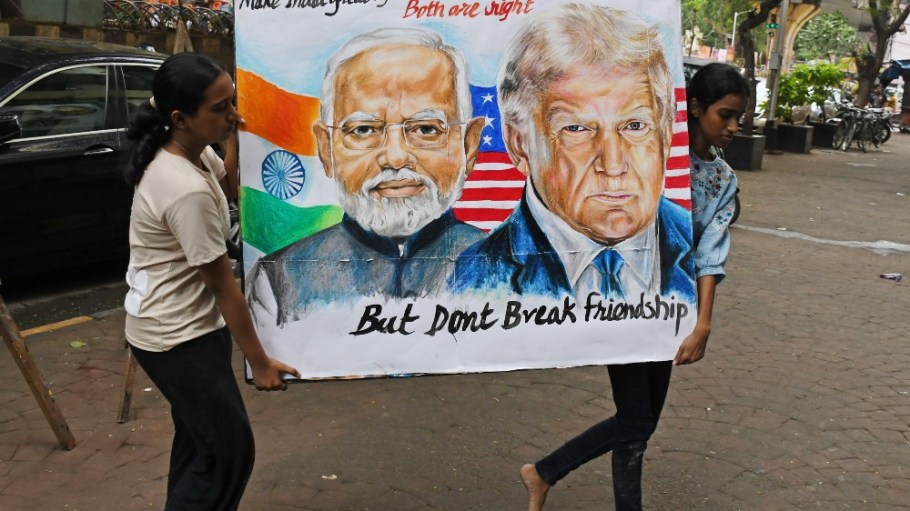
President Donald Trump and Indian Prime Minister Narendra Modi appear to be mending frayed lines of communication after their once warm relationship turned rocky over trade tensions.
On Tuesday, the American president spoke to Modi by phone to wish him a happy birthday, detailing the exchange on Truth Social. “He is doing a tremendous job. Narendra: Thank you for your support on ending the War between Russia and Ukraine!” Trump said.
Trump also said this week that he feels “certain” there will be no difficulties in coming to a “successful conclusion” in trade negotiations that stand to benefit both countries, hinting that a deal could be imminent.
Related Stories
Modi thanked Trump for the outreach and “warm greetings” on his 75th birthday, saying, “Like you, I am also fully committed to taking the India-U.S. Comprehensive and Global Partnership to new heights. We support your initiatives towards a peaceful resolution of the Ukraine conflict.”
Modi and other Indian officials have expressed eagerness to find consensus with their American counterparts in light of the taxing 50 percent duties on India-made imports into the U.S. which were levied by the Trump administration last month.
Trump tacked on a 25 percent tariff to an existing 25 percent duty rate, citing India’s purchase of Russian oil as the impetus. Last week, he urged the European Union and the G7 to impose tariffs worth up to 100 percent on India for the same reason.
On the same day as the leaders’ cordial phone call, a team of officials from the U.S. Trade Representative’s (USTR) Office led by chief negotiator Brendan Lynch flew to India to meet with representatives from India’s Department of Commerce about the prospect of a bilateral trade agreement.
“Acknowledging the enduring importance of bilateral trade between India and the U.S., the discussions were positive and forward looking covering various aspects of the trade deal,” a press release said. “It was decided to intensify efforts to achieve early conclusion of a mutually beneficial Trade Agreement.”
Trump’s tariff regime, which has driven up anxieties amongst global trade partners, has also faced manifold challenges at home.
On Tuesday, the House of Representatives voted by the slimmest of margins to cede power to the president on the issue of tariffs after Gregory W. Meeks (D-N.Y.), the leading Democrat on the Foreign Affairs Committee, introduced a surprise motion to block the administration’s tariffs on Brazil.
GOP stalwarts including House Speaker Mike Johnson were forced to wrangle three conservative dissenters who planned to vote to check the president’s power to impose the tariffs, which the Congressional Budget Office said have pushed inflation beyond its projections. Representatives Don Bacon (R-Neb.), Tom McClintock (R-Calif.) and Jay Obernolte (R-Calif.) changed their votes, handing Republicans a narrow win.
However, Representatives Thomas Massie (R-Ky.), Victoria Spartz (R-Ind.) and Kevin Kiley (R-Calif.) remained pitted against the measure, which essentially prevents Congress from taking action to remove the tariffs until March 31.
“If we’re saying that Congress is not going to be able to assert itself on this issue, that, in my view, is a problem,” GOP Congressman Kiley said, according to Axios. “I think this is a misuse of what rules are for, and I think it’s bad for the representative process,” he added, referring to the president’s application of tariffs, according to Politico.
Senate Democrats were plotting their own challenges to the administration’s tariff scheme within the coming weeks, but their efforts have been effectively thwarted by Johnson’s intervention.
Sen. Tim Kaine (D-Va.) plans to introduce two bipartisan bills that would halt Trump’s tariffs on Canada and Brazil. Along with other Democrats in the upper chamber, Sen. Rand Paul (R-Ken.) signed onto the effort.
While the law allows Congress to reintroduce legislation challenging the president’s imposition of tariffs every six months, the resolution in the House will block those movements until next year.
Kaine tweeted Wednesday that Trump’s trade war with Canada has caused U.S. product sales into the country to plummet along with Canadian tourism to the U.S., which damaging a relationship with one of America’s closest allies. “I urge my colleagues to support my bill to end these new taxes and protect the American people,” he wrote.