The Trump administration’s tariff policies remain consistently in flux.
On Monday, the president took aim at China for its continued export restrictions on seven rare earth minerals and magnets, despite a shaky trade truce extended earlier this month.
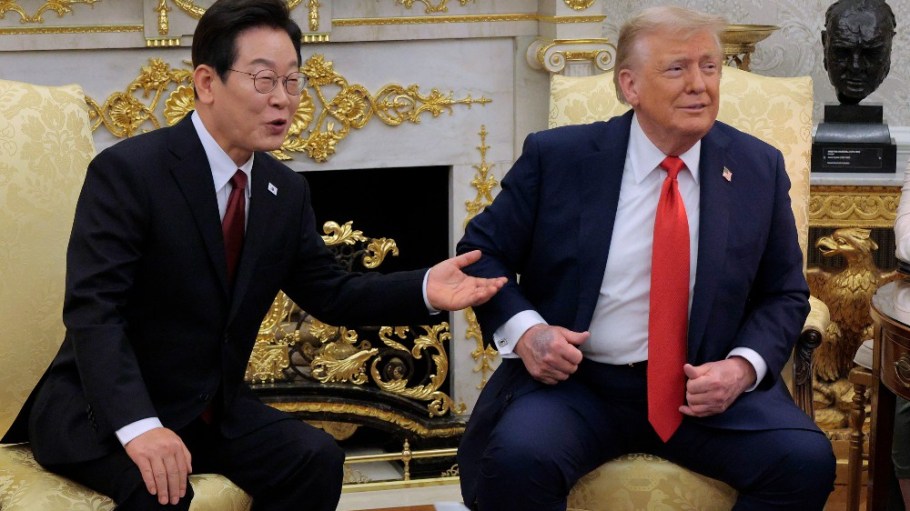
“They have to give us magnets. If they don’t give us magnets, we have to charge them 200 percent tariffs or something,” Trump said during a White House meeting with South Korean President Lee Jae Myung. The two leaders discussed a nascent shipbuilding agreement wherein the U.S. will purchase South Korean vessels, and Lee’s government will invest $150 billion in U.S. enterprise, including domestic ship construction.
Related Stories
Swinging back to China, Trump accused Beijing of wrongdoing, saying Beijing “intelligently went and took a monopoly of the world’s magnets. It’ll probably take us a year to have them.”
Tensions between Beijing and Washington continue to simmer even in the wake of a 90-day extension of the trade framework negotiated in Geneva in May, in which China-originating imports to the U.S. see duties of 30 percent.
But with China maintaining restrictions on its valuable rare earth exports, Trump has vowed to stem the outbound flow of microchips and semiconductors from American tech firms like Nvidia and Broadcom. Retaliatory measures taken by both sides do little to suggest that negotiations are moving forward, and it’s unclear whether a three-month respite from tariffs will be long enough for Beijing and Washington to quash their beef.
Taking a break from targeting specific countries, Trump recently fixated on furniture imports into the U.S. market from countries across the globe. The president said Friday that he’s directed the administration to investigate the pipeline for couches and décor with a possibility that tariffs on such goods could increase by October.
“Within the next 50 days, that Investigation will be completed, and Furniture coming from other Countries into the United States will be Tariffed at a Rate yet to be determined,” Trump Truthed. “This will bring the Furniture Business back to North Carolina, South Carolina, Michigan, and States all across the Union.”
At the same time, the administration is looking into raising tariffs on industrial goods like copper and semiconductors, as well as pharmaceuticals.
As Trump takes aim at overseas trade partners and specific sectors, Canadian Prime Minister Mark Carney appears to be pulling levers to appease the tariff-wielding president.
Ottowa announced Friday that it intends to drop many of its retaliatory tariffs on U.S.-made goods, matching tariff exemptions covered under the United States-Mexico-Canada Agreement (USMCA), which allows a large range of products to flow freely between the North American nations without incurring duties.
Carney said the decision will buffer the majority of American products against the harshest Canadian tariffs, reversing course on his entrenched stance earlier this spring. While some of the prime minister’s detractors—as well as union leaders from throughout Canada—decried the walk-back as giving in to Trump, Carney said he believes the country stands a strong chance of negotiating a good deal with the U.S. Trump levied 35-percent duties on Canada on Aug. 1.
“Canada currently has the best trade deal with the United States. And while it’s different from what we had before, it’s still better than that of any other country,” Carney said.
Trump, who spoke to the prime minister by phone on Thursday ahead of the public drawdown of Canadian duties, praised Carney’s leadership. “We had a very good call,” he told reporters from the Oval Office. “We are working on something. We want to be very good to Canada. I like Carney a lot. I think he’s a very good person.”
The mutual easing of tensions reverberated through the political sphere quickly, and on Monday, Canadian Cabinet Minister Dominic LeBlanc, who has led trade negotiations with the U.S., announced he would be traveling to Washington to meet with Commerce Secretary Howard Lutnick.
“We are looking, I hope, for an agreement that will put us in a better position than we are right now,” LeBlanc said Monday on Canadian public radio. He will fly to Washington Monday evening, with a meeting to take place in the course of the coming days, his office said.