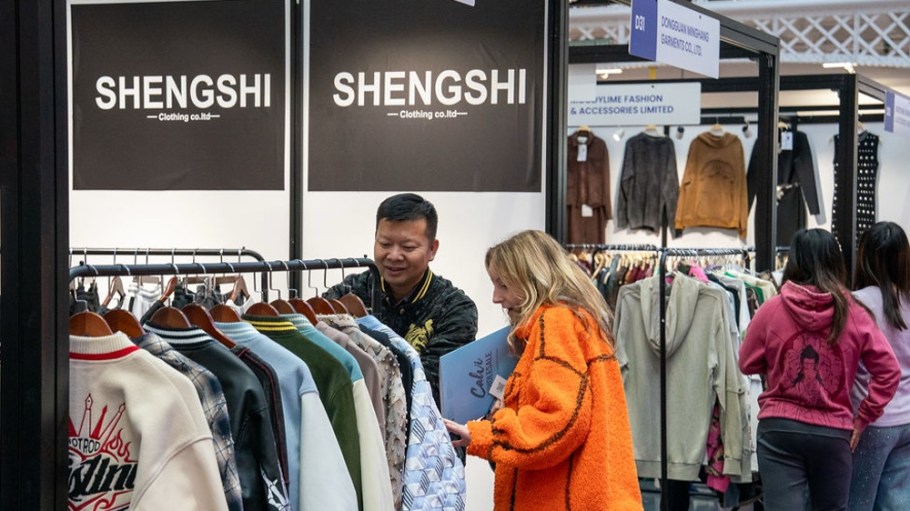
The suppliers who converged at the Source Fashion trade show in London last week flew in from disparate corners of the world—China, India, Sri Lanka, Nepal, Tanzania and Turkey, just to name a few—yet many of them had the same goal in mind: to wean themselves off their reliance on the United States.
The issue was most acute for manufacturers from India, whose exports were already burdened by a so-called 25 percent “reciprocal” tariff imposed by the Trump administration. They took an additional 25 percent hit last August when the White House sought to punish the South Asian nation for importing Russian oil. And earlier this month, the president backed a bill slapping countries such as India with up to 500 percent tariffs if they failed to halt that flow.
Related Stories
While the U.S. retail market remains the largest in the world, some suppliers are hoping that the United Kingdom can provide, if not a life raft, then at least a buoyant alternative to keep them afloat. The India-U.K. free trade deal, which will soon zero out tariffs on apparel and textiles, as well as put India on a more even keel with neighboring Bangladesh, has been a boon, but the scramble to replace lost U.S. buyers has also intensified competition among suppliers serving the United Kingdom and other more hospitable markets.
“A lot of Indian factories are trying to expand the U.K. market because there are favorable conditions here,” said Soman Titin Shankar, director of business development at Vyshnavi Apparels, a boutique clothing manufacturer in South Delhi. “The majority buyer from India is the U.S., so there’s a huge number of people right now underselling their stock to other places.”
Nithin Sivaram, director of Royal Classic Mills, which produces polos and shirts across multiple facilities in and around India’s knitwear capital of Tiruppur, counts himself relatively lucky—if barely—given that exports to the United States comprised 80 percent of the business. Although he “feels blessed” that his buyers took ownership of the orders they had already placed—albeit with a few concessions on price—Royal Classic Mills has struggled to field new orders.
For any factory, continuity is king, Sivaram said. “We are now trying to just keep the show running by working for four days a week, or working for six hours a day,” he added. “We cannot completely replace U.S. business with U.K. business because the markets are of different sizes and the U.K. doesn’t have the same buying power as the U.S. But with the free trade agreement coming through, we thought it was the right time to approach the U.K. market and expand our presence here.”
No business likes to run with large amounts of risk, agreed Suzanne Ellingham, Source Fashion’s event director.
“It makes complete sense that people are looking to diversify their base because having that strong, robust customer pipeline just makes sense,” she said. “We’re fortunate that, as a show, we’re able to offer the opportunity to let people build that pipeline.”
Chinese manufacturers, too, are searching for an off-ramp. At the height of the U.S.-China trade war last year, the combined tariff on many of their goods went as high as 145 percent. While this has since fallen to a less eye-watering 30 percent, President Donald Trump recently threatened to inflict an additional 25 percent duty if Beijing doesn’t cut business ties with Iran.
Figuring out what the precise tariff at any moment is an endeavor in itself, especially since it can change in an instant, said Christine Chow, managing director of Winner Co., a Hong Kong-based manufacturer of woven apparel, and founder and creative director of Tove & Libra, a sustainable women’s wear label. Winner Co. once drew half its clientele from the United States. Now that number has plummeted to 10 percent.
“Having lost a lot of American buyers, it’s hard to find new business,” Chow said. “And there’s a lot of price pressure on the market and focusing less on quality. We’re not doing fast fashion, so it takes a long time for us to amass orders. But the uncertainty is really bothersome.”
Mark Weng, director of business development at Shengshi Clothing Co., a Guangzhou-based jacket and hoodie manufacturer, feels like he has no choice but to make the rounds at as many expos as he can. (It was his first time at Source Fashion.) The United States accounted for 30 percent of the supplier’s output. Finding customers to replace that business has proven nearly impossible.
“When decisions are so random, we cannot proceed long term,” he said. “One day the tariffs go up, another day they go down. It makes our customers crazy.”
But even suppliers from countries that got off relatively easy, U.S. tariff-wise, were eager to broaden their portfolios at Source Fashion.
They included Jeevith Senaratne, director of operations at Star Garments Group in Sri Lanka, where the U.S. duty on exports has held steady at 20 percent. U.S. brands, he said, take up 85 percent of the production line, followed by U.K. ones at 10 percent. Some business has crept over from India because of the higher rate, but he also wants to grow the U.K. side now that new liberalized rules of origin allow for more Sri Lanka-produced garments to enter England, Scotland, Wales and Northern Ireland tariff-free.
“While the U.S. will remain [an important market], it’s healthy to want to diversify risk from a company standpoint,” he said.
Next to him on the catwalk-slash-stage, Marguerite LeRolland, senior global insight manager at data analytics firm Euromonitor, spoke about the shifting political landscape and encroaching economic pressures.
Filiz Dagdelen, CEO of Kreateks Tekstil in Istanbul, said she knew about this all too well. Factories in Turkey are shuttering and relocating to Egypt, where the U.S. tariff rate is lower—10 percent versus Turkey’s 15 percent—and, more notably, operational and labor costs are cheaper. She’s been “following all the fairs” to drum up more business: Première Vision in New York, Texworld in Los Angeles and now Source Fashion in London. The United Kingdom followed its free trade agreement with Turkey—when the former was still part of the European Union—with a post-Brexit “continuity” deal.
“Orders and prices are going down,” Dagdelen said. Her minimum order quantity is 300 pieces, but many startups that have approached her are asking for one-tenth of that. Kreateks Tekstil isn’t competing on price, she said, because that would be a fool’s errand. Instead, it’s focused on quality and certified organic and recycled textiles, both increasingly important to buyers as the European Union hones its ecodesign for sustainable products regulation.
“A lot of basic producers that make things like T-shirts and hoodies have gone bankrupt because everyone says that Turkish garment costing is the highest,” she said. “But in my mind, if you do things differently, like using different materials, you can be a success.”