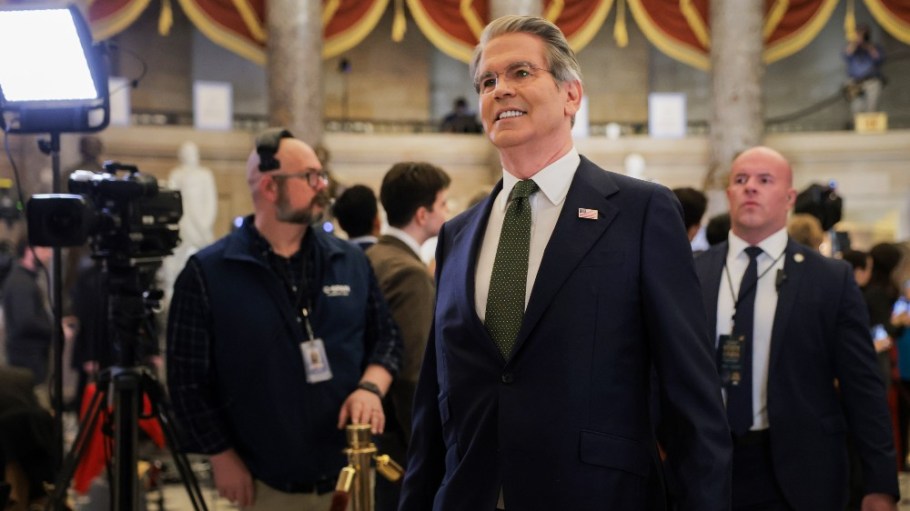
The 10 percent global tariffs imposed by President Donald Trump in the hours following the Supreme Court ruling against his International Emergency Economic Powers Act (IEEPA) duties will increase to 15 percent “likely sometime this week,” according to Treasury Secretary Scott Bessent.
Trump turned to Section 122 of the Trade Act of 1974—a never-used statute that deals with balance-of-payments issues—to impose blanket duties on Feb. 20. Soon after the executive order was released, the president took to Truth Social to say that he planned to increase the rate to 15 percent, though no further official documentation on the change has been released.
Related Stories
Section 122 allows the Commander in Chief to impose duties of up to 15 percent for a period of 150 days, beyond which Congress must intervene to extend the tariffs.
“And during that time, during the 150 days, we will see studies from USTR on Section 301 tariffs, from Commerce on Section 232, and it’s my strong belief that the tariff rates will be back to their old rate within five months,” Bessent said in an interview with CNBC on Wednesday, indicating that the federal government plans to use the statutes to try to reconstitute its previous tariff structure.
“Those are very fulsome authorities that provide they have survived more than 4,000 legal challenges. They are more slow moving, but they are more robust,” he said.
While the tariffs will impact all U.S. trading partners, the European Union expects to be exempt from the 5 percent rate hike. Anonymous sources familiar with the matter said that the U.S. has assured the trade bloc that it will continue to face 10 percent tariffs.
That hasn’t stopped Trump from ruffling feathers with individual EU member states, however.
During a meeting with German Chancellor Friedrich Merz on Tuesday, the president threatened to sever relations with Spain, calling the country “terrible” for refusing to allow U.S. forces to use joint bases at Morón and Rotafor to launch strikes on Iran. “We’re going to cut off all trade with Spain. We don’t want anything to do with Spain,” he said.
“The Spanish have been very uncooperative regarding the U.S. bases and what we could do with our aircraft right as we were launching the operation,” Bessent clarified during his CNBC sitdown. Any policy that “slows down our ability to engage and prosecute this war in the fastest, most effective manner” is a threat to American lives, he added.
Merz did not push back on Trump during the meeting but said later that he told the president that he could not complete a trade deal with the EU—or with Germany—without including Spain.
Spanish Foreign Minister Jose Manuel Albares expressed “surprise” at Merz’ muted reaction to Trump’s threats against a fellow EU member. “When you share a currency, a common trade policy, and a common market with another country, you expect… solidarity,” Albares told national broadcaster RTVE.
Following the comments, Spanish Prime Minister Pedro Sánchez gave a televised address, telling Spanish citizens and the world that Spain will “not be complicit in something that is bad for the world, and that is also contrary to our values and interests, simply out of fear of reprisals from someone.”
EU leaders are rallying behind Spain in opposition to Trump’s threats.
Spokespeople for the Élysée Palace said French President Emmanuel Macron called Sánchez “to express France’s European solidarity in response to the recent threats of economic coercion,” while European Council President António Costa said he spoke with the Spanish leader “to express the EU’s full solidarity.”
“We stand in full solidarity with all member states and all its citizens and, through our common trade policy, stand ready to act if necessary to safeguard EU interests,” EU Commission deputy chief spokesperson Olof Gill said.
EU internal market commissioner Stéphane Séjourné said during a press conference Wednesday that “Any threat against member state is by definition threat against the EU.”
“I want to be very clear here, from this point of view, the EU’s competency on trade is actually dealt with by the Commission,” he added. “If you threaten one particular country… well, that’s we’ve seen that about Greenland. I think we saw that there was a lot of unity.”