April 2, 2025 may well become a day that lives in infamy in the minds of many American importers and exporters across the globe.
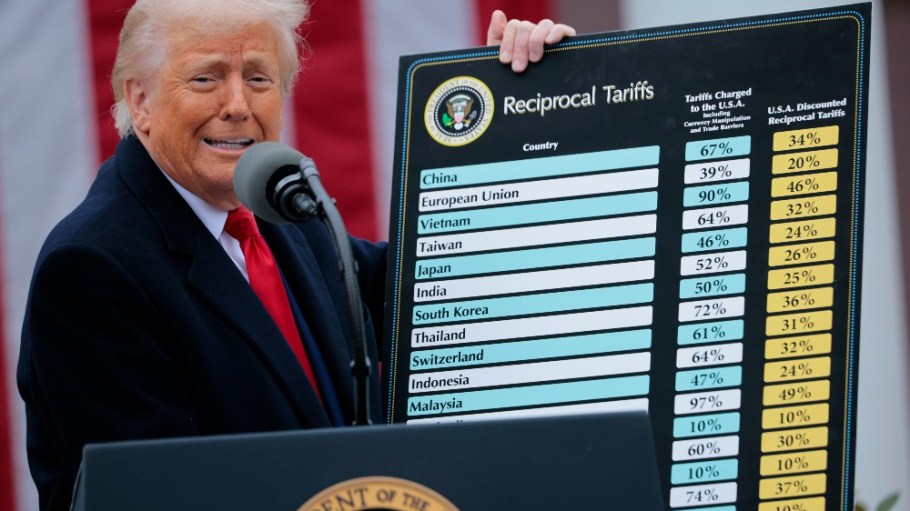
Touted by President Donald Trump as “Liberation Day,” the address from the White House’s now paved-over Rose Garden was framed as an act of freedom, but has proven in retrospect to have been a shot across the bow at about 90 of the United States’ closest trading partners.
From that day forward, the global economy has been strapped into a rollercoaster of America’s making, with tit-for-tat tariff escalations seeming to break weekly, if not daily. The unprecedented announcement of a new U.S. tariff strategy changed, perhaps forever, the country’s trade relationships with adversaries and allies alike.
Related Stories
It also reframed entrenched dynamics and norms, calling into question the viability of trade agreements (do tariffs invalidate established free trade deals?) and throwing longstanding regional alliances to the wind.
“For decades, our country has been looted, pillaged, raped and plundered by nations near and far, both friend and foe alike,” Trump said at the time. “Foreign cheaters have ransacked our factories, and foreign scavengers have torn apart our once beautiful American dream.”
The president also introduced the idea of the chronic trade deficit as a national emergency, using the unequal state of trade between America and its peers as justification to invoke the International Emergency Economic Powers Act (IEEPA). “Chronic trade deficits are no longer merely an economic problem. They’re a national emergency that threatens our security and our very way of life,” the president claimed.
Never in the nation’s history has a little-known trade statute, especially one decades old, become a topic of household discussion, the acronym beamed into living rooms via televisions and tablets on a weekly basis.
Eight months later, Trump’s use of IEEPA to invoke sweeping tariffs is at the center of a landmark Supreme Court case. Dozens of businesses and states have called his authority into question, spurring conversations about executive versus congressional powers and the deteriorating state of federal checks and balances. Hundreds of plaintiffs have sought relief through lawsuits aimed at stopping the liquidation of duties and ensuring access to refunds.
While Trump’s tariff ambitions were publicized long before April—the president slapped China, Mexico and Canada with duties intended to curb mass migration and fentanyl smuggling days after he took office—the sheer scale of the punitive measures unveiled in the spring indicated that the president’s second term would be a different animal from his first, when China was enemy No. 1, No. 2 and No. 3.
Instead, Trump’s target became the world. And as America began to treat its friends indiscriminately from its enemies, global alliances that don’t feature the world’s largest economy at their center have started to solidify.
The BRICS Alliance—which counts Brazil, Russia, India, China and South Africa among its foundational members, but has grown to include Ethiopia, Indonesia, Iran, Egypt and the United Arab Emirates—has been more aggressively promoting itself as a counterpoint to Western influence, including the power of the U.S. dollar, since Trump took office. Meanwhile, talks between the European Union and the South American Mercosur nations including Brazil, Paraguay and Uruguay have accelerated, with both sides pushing forward to finalize a deal that would establish the largest free-trade area on the planet.
Trump has repeatedly indicated his displeasure at these developments. But he’s also pulled back from traditional leadership engagements that would give him the opportunity to interface with other heads of state and find some common ground. He skipped the G20 Summit in South Africa this November over unsubstantiated claims that the country is committing a genocide of white Afrikaners, for example. And he abruptly departed the G7 Summit, hosted by Canada, to focus on the escalating tensions between Israel and Iran in June.
The tariffs have, in limited cases, served as a catalyst for negotiations—most notably with China and the European Union.
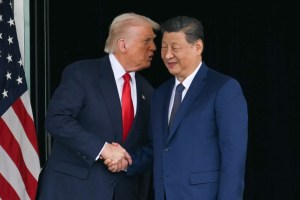
After escalating and de-escalating bilateral duties and sanctions for months, Trump met with Chinese President Xi Jinping in October, effectively ending (or at least pausing) the seemingly interminable lobbing of threats. Xi agreed that China would make a greater effort to tackle the smuggling of chemical precursors used in the making of fentanyl and that it would resume buying U.S. soybeans. Trump pulled back on his threat to hit the country with 100 percent duties, though the country’s duty rate still stands at a whopping 47 percent.
Chinese exports to the U.S. market have fallen sharply amid the tariff drama, declining 18.9 percent to $385.9 billion over the first 11 months of 2025. But despite those losses, the World’s Factory has rebounded through its burgeoning business with other partners, especially those in Asia. In November, the country’s global trade surplus surged past $1 trillion for the first time in history.
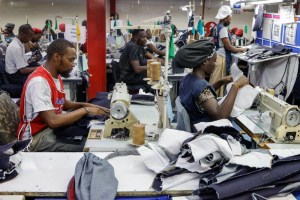
By contrast, efforts at spurring production in the U.S.—one of Trump’s stated goals with the imposition of tariffs—have been middling at best. Many domestic producers have reported increased interest, but few commitments, from American brands. What’s more, the imported materials, components and machinery U.S. apparel and footwear producers rely on is being heavily taxed, forcing some to forfeit their businesses altogether.
Despite the unintended consequences of his America First outlook and legal challenges to the tariffs, the president is holding firm on his strategy. With days left until 2026, Trump made an unorthodox address to the nation proclaiming victory on almost all his initiatives, including securing $18 trillion in investment commitments from foreign nations and companies into U.S. industry as a part of his trade strategy. Those investments will be rolled out over time and through a number of avenues.
“Much of this success has been accomplished by tariffs—my favorite word, tariffs—which for many decades have been used successfully by other countries against us, but not anymore,” he said Wednesday evening. “One year ago our country was dead. We were absolutely dead. Our country was ready to fail, totally fail. Now we’re the hottest country anywhere in the world.”