The European Union and the United States seem to be at a technology-focused impasse.
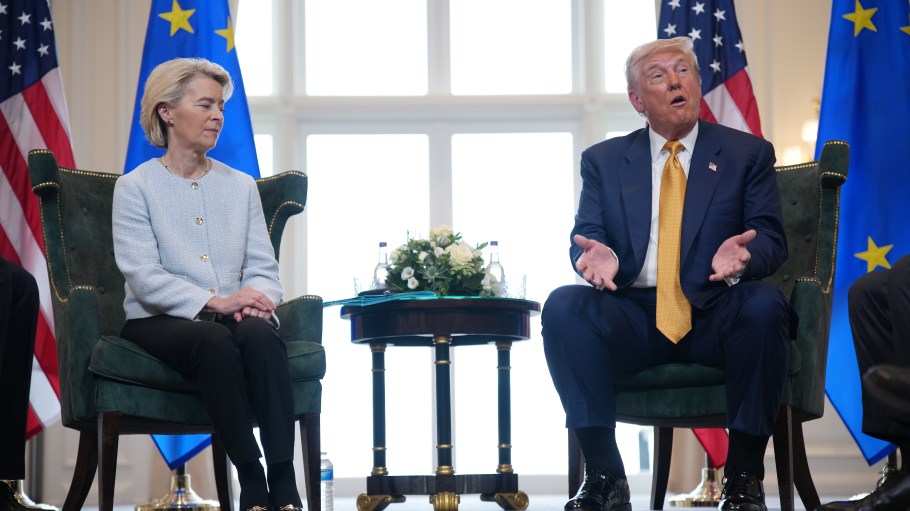
Leaders expected to see a finalized trade agreement or statement come down mere days after U.S. President Donald Trump’s meeting in Scotland with European Commission President Ursula von der Leyen on July 27, but the final details have yet to be agreed upon, according to a report from the Financial Times.
Trump and von der Leyen’s meeting yielded a 15-percent tariff on many goods inbound from the bloc, a higher rate than initially hoped for by EU leaders, but still down from the higher levies Trump threatened to institute. Still, EU officials cited by the FT said “non-tariff barriers” continued to hold up discussions.
The newspaper reported Sunday that the formalized trade agreement between the two nations has been stalled because of the EU’s Digital Services Act (DSA). While leaders in Washington hoped to see a relaxation of the regulation in the name of innovation, EU leaders have no interest in that possibility.
Related Stories
Despite the EU’s supposed hard stance against leniency in the DSA, U.S. officials reportedly told the outlet that the bloc had agreed to discuss digital laws.
“We continue to address digital trade barriers in conversations with our trading partners and the EU agreed to address these barriers when our initial agreement was struck,” the U.S. official reportedly said.
For some companies, a purported barrier to further growth has been the regulatory environment outside the U.S., or the rising concern from state governments about artificial intelligence, privacy and other technologies. Washington’s stance has been that the DSA and the EU AI Act, which the report did not mention, are two specific examples of regulations that can stifle innovation and force U.S.-based companies to add unnecessary costs into the equation.
The DSA is a landmark EU legislation that aims to create a safer digital environment for citizens of the bloc, including children. It places special restrictions on what it calls very large online providers (VLOPs), demanding that those companies comply with harsher provisions of the regulation than their smaller counterparts. Current VLOPs, which are companies that have garnered more than 45 million monthly users in the EU, include Amazon, AliExpress, Google, TikTok, Shein, Temu, Zalando and others.
Some companies that are included as VLOPs, including Amazon, Apple, Google, Meta and Microsoft, are U.S.-founded companies that have grown rapidly on an international scale. Despite their primary footholds being in the U.S., the companies are required to comply with applicable laws globally. Amazon has publicly disputed its status as a VLOP, asking an EU court to scrap the designation, primarily focusing on the argument that retail platforms should not be categorized as VLOPs. When Amazon went before the court in June, a spokesperson told Sourcing Journal that the marketplace “does not pose any such systemic risks; it only sells goods, and it doesn’t disseminate or amplify information, views or opinions.” Amazon’s fate in the matter remains to be seen.
That the U.S. reportedly has an interest in loosening laws that impact the administration’s allies in Big Tech coincides with some of the announcements that have come from Trump in recent months. Specifically, the president and his allies have set forth pathways for continued growth of AI in Trump’s AI Action Plan; called for general deregulation of technologies as the U.S. aims to become a leader in the industry; dismantled an executive order from former President Joe Biden related to the trustworthy and safe development of AI models; introduced their intent to allow technology players to access permits with disregard for the environment and more. As far as Trump is concerned, the U.S. remains in a technology war with China—and the president has been unrelenting in his stance that the U.S. can, and should, win the race.