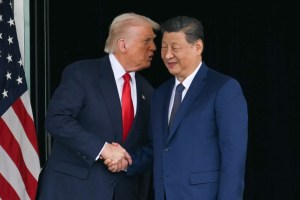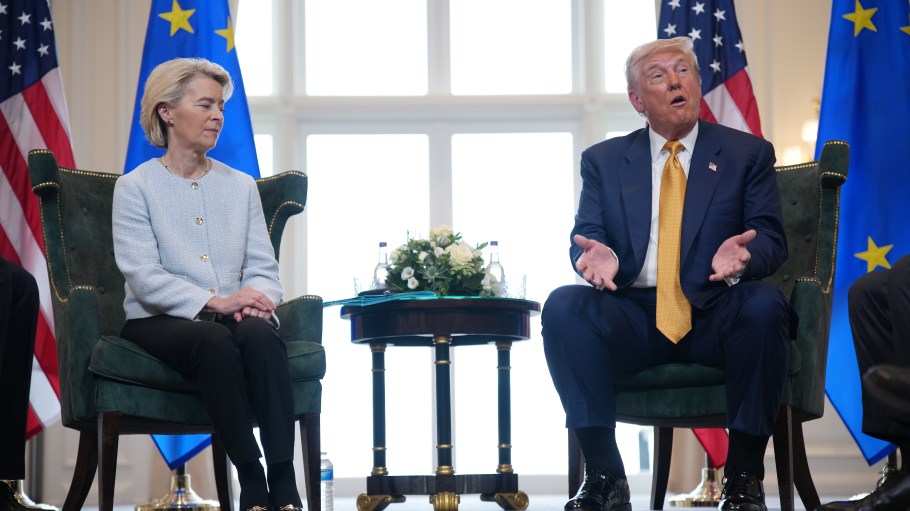
Following President Donald Trump and European Commission President Ursula von der Leyen’s announcement Sunday that the U.S. and the European Union had negotiated a trade deal (which will see EU countries subject to 15-percent tariffs), EU leaders have started weighing in on the new way forward for the transatlantic trade agreement.
While von der Leyen praised the trade agreement sitting alongside Trump in Scotland, other leaders seem to have a less rosy outlook.
François Bayrou, France’s prime minister, expressed his disappointment for the trade agreement.
Related Stories
“It is a dark day when an alliance of free peoples, united to affirm their values and defend their interests, resolves to submission,” Bayrou wrote on his X account.
Still, other major leaders said the agreement helped divert what could have been a much more serious threat to countries in the 27-member bloc and their respective businesses.
Giorgia Meloni, Italy’s prime minister, told reporters Sunday at a press briefing in Ethiopia that while she still needed to “study the details” of Trump and von der Leyen’s deal, it’s promising that the two nations came to an agreement, noting that “trade escalation between Europe and the United States would have had unpredictable and potentially devastating consequences.”
German Chancellor Friedrich Merz shared a similar sentiment.
“This agreement has succeeded in averting a trade conflict that would have hit the export-orientated German economy hard,” he said in a statement.
Trump had previously threatened a 30-percent tariff on goods inbound to the U.S. from EU countries; last week, he stated that the U.S. had “a 50-50 chance of making a deal with the EU.” That von der Leyen—who had originally fought to see a 10-percent flat tariff rate on most EU goods—kept up negotiations with a frustrated Trump can be considered a win, some EU leaders, including Portuguese Prime Minister Luís Montenegro, believe.
“The EU-U.S. trade agreement brings predictability and stability, vital for Portuguese companies and the economy. It avoids escalation but places new demands on the pursuit of more trade agreements, the reduction of barriers, and the transformative agenda of simplification and cost reduction,” Montenegro wrote in an X post.
Maroš Šefčovič, EU trade commissioner, called on both parties to “keep strengthening our transatlantic ties,” thanking U.S. Trade Representative Jamieson Greer and U.S. Secretary of Commerce Howard Lutnick for their collaboration on the newfound agreement.
Some leaders in the EU continue to focus their attention on a free trade environment.
Bart De Wever, prime minister of Belgium, called Sunday’s understanding “a moment of relief but not of celebration.”
“I sincerely hope the United States will, in due course, turn away again from the delusion of protectionism and once again embrace the value of free trade—a cornerstone of shared prosperity,” he wrote in an X post.
Petteri Orpo, prime minister of Finland, said this agreement should not mark the end of future trade discussions between the bloc and the U.S.
“Work must continue to dismantle trade barriers. Only free transatlantic trade benefits both sides the most,” Orpo wrote in a translated X post.
The Trump administration doesn’t appear amenable to the prospect of free trade with almost any country across the globe. Much of the president’s economic strategy has been built around negotiating new trade deals that guarantee U.S. access to other markets, and bolstering American manufacturing across a variety of industries he sees as key to the country’s future success.
While Trump heralded last week’s deal with Japan as “the largest deal ever made,” the agreement with the EU has the propensity to impact myriad industries, including fashion and apparel. A lower-than-threatened tariff will see U.S. companies importing European goods—like luxury apparel, footwear and leather—paying less than some may have expected.
Still, any increase in cost per unit could deal a blow to companies already struggling to reach price-conscious consumers. According to data from 7thonline, U.S. retailers have shown anxiety about their ability to absorb price hikes brought on by tariffs. Just over one-third of retailers said the only way they could avoid price hikes is with a 0-percent tariff increase, and a further 43 percent said the highest tariff increase they could afford to absorb was 25 percent.