Days after signing a landmark trade deal with India, the European Union has forged an expanded trade agreement with Vietnam.
The 27-member trade bloc and Asia’s second-most-prominent sourcing locale for textiles and apparel forged a comprehensive strategic partnership—the highest diplomatic tier available in Vietnam, currently also held by the United States, Russia and China—that will upgrade the existing relationship to bolster bilateral trade and investment.
“Both sides will explore, develop and deepen trade and investment opportunities in sectors of mutual interest,” including but not limited to critical raw materials, energy, the circular economy, logistics and transport infrastructure, semiconductors and artificial intelligence, according to a joint statement. The partners have also agreed to a mutual focus on the diversification of supply chains and sustainable agriculture.
Related Stories
“Both sides identify priority areas for action to expand market access for goods, services and public procurement, create business opportunities, in order to capitalize on each side’s strengths, needs and conditions, on the basis of openness, transparency and fairness,” the statement said.
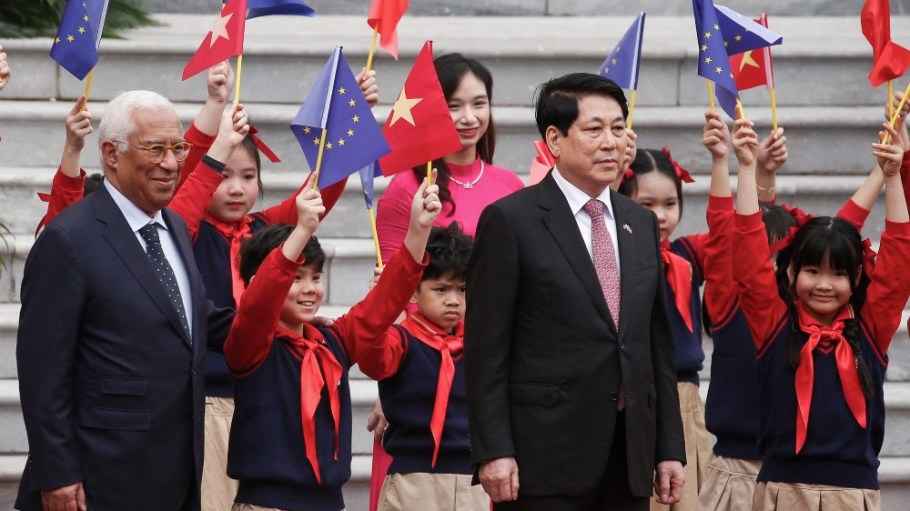
The deep but unspoken impact of sweeping U.S. tariffs loomed over the press briefing that followed a meeting between Vietnamese President Luong Cuong and European Council President António Costa on Thursday in Hanoi.
“At a moment when the international rules-based order is under threat from multiple sides, we need to stand side-by-side as reliable and predictable partners,” Costa said, adding that “developing spheres of shared prosperity” was the goal of the Vietnam pact.
Calling the development a “historic milestone,” Cuong said that Vietnam regards Europe as “one of its most important partners in the world and wishes to continue promoting and deepening its relationship with the EU.”
The EU and Vietnam first established diplomatic relations 35 years ago, with bilateral trade increasing steadily. The EU–Vietnam Free Trade Agreement, signed into law in 2020, accelerated the two-way flow of goods and services and prompted trade to balloon by 40 percent.
Europe now represents Vietnam’s third largest export market. From January through November last year, trade between the EU and Vietnam grew 6.6 percent from the same period in 2024, reaching $66.8 billion.
The EU has made significant headway over the course of the past month in establishing and expanding trade relationships beyond the U.S., having completed a deal with India this week and finalizing an agreement with the Mercosur nations—Argentina, Brazil, Paraguay and Uruguay—earlier this month. Both deals were decades in the making. However, the EU-Mercosur Partnership Agreement appears to have hit a roadblock, with the Court of Justice of the EU now reviewing its compliance with existing EU treaties—a process that could take up to two years.
With many of its trade partners seeking to form new connections, the U.S. has made moves this week to strengthen established regional ties.
On Thursday, El Salvador’s ambassador to the U.S., Milena Mayorga, announced that the country signed a new deal with the U.S.
“We express our gratitude to U.S. Trade Representative Ambassador Jamieson Greer, for his close collaboration with the Government of El Salvador in finalizing this historic Reciprocal Trade Agreement, the first of its kind in the Western Hemisphere,” she wrote on X.
The framework for the agreement, first released in November, includes provisions related to the drawing down of non-tariff barriers on U.S. products. It called for the streamlining of regulatory requirements on American pharmaceuticals and medical devices, as well as the removal of trade restrictions on agricultural products grown by U.S. farmers.
In turn, Washington agreed to remove the reciprocal tariffs on El Salvadorean exports to the U.S. for certain products that can’t be sufficiently grown or mined in the country, as well as products like textiles and apparel that originate under the Dominican Republic-Central America Free Trade Agreement (CAFTA-DR).
“President Trump’s vision is building a new trade order for partnership and prosperity in Latin America, further advancing the economic and national security interests of the American people,” Greer said Thursday.
“This Agreement is an important step in the deepening of our strategic partnerships in Latin America,” he added. “This Agreement builds on our longstanding trade partnership and recognizes important supply chain linkages.”
The move hasn’t hit the newswires with the same impact as other larger frameworks finalized recently, but for American firms with ties to the regional supply chain for textiles and apparel, it represents a significant win.
National Council of Textile Organizations President and CEO Kim Glas applauded the administration’s actions on qualified textile and apparel goods for El Salvador under CAFTA-DR, saying, “These steps will help fortify a critical export market for the U.S. textile industry and our workforce.”
“El Salvador is part of the CAFTA-DR region that forms a vital co-production chain with the American textile supply chain. This production chain facilitated $11.3 billion in two-way trade in 2024 and supported more than 470,000 U.S. workers in the domestic textile sector alone,” she explained.
“Today’s action will reinforce the strength of the U.S. textile industry. The U.S.–Western Hemisphere supply chain is a strategic bulwark against China and other Asian competitors. We welcome the opportunity to work with the Trump administration to further fortify this vital region and strongly appreciate this important announcement.”