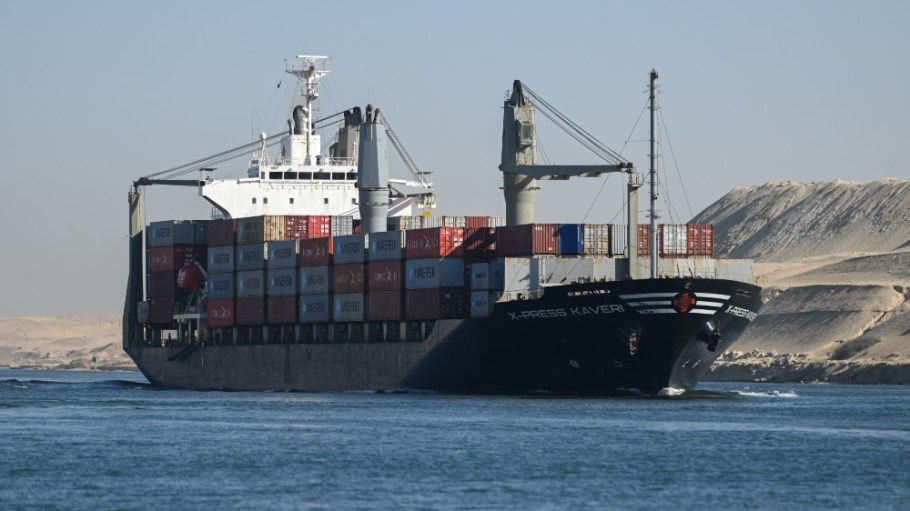
Suez Canal traffic dropped precipitously in January, nearly halving Egypt’s revenue from waterway fees as Houthi rebels continue to attack transport vessels.
Egypt took in just $428 million last month, compared to $804 million during the same period in 2023, according to Lieutenant General Osama Rabie, chairman of the Suez Canal General Authority. On Friday, he spoke on Egyptian news program “Every Day,” telling anchor Khaled Abu Bakr that 1,362 ships passed through the canal in January—a 36-percent drop from the year-ago period.
Related Stories
Vessels from the world’s leading shipping firms like Maersk and MSC have rerouted around Africa’s Cape of Good Hope, causing major delays and heightening costs for shippers and consumers. Still, Rabie maintained that the Suez Canal is still the “best, fastest and safest” means of moving goods, as the Cape of Good Hope is “unsustainable, without services, and navigation on it is very difficult.”
U.S. and UK forces have launched air strikes on Yemen, but the Houthi attacks on the Red Sea have not abated. The rebel group, which has been attacking ships in the Red Sea since October, dug in its heels Sunday, with official spokesman for the Yemeni Armed Forces Brigadier General Yahya Saree saying the air strikes “will not deter us from our moral, religious and humanitarian stance in support of the steadfast Palestinian people in the Gaza Strip, and will not go unanswered and unpunished.”
The continued disruption to Suez Canal operations has been a major blow to Egypt’s embattled economy. Egypt’s currency dropped to a record low of 72 pounds to the U.S. dollar in the parallel market last week—significantly below the official exchange rate, which hovers around 31 pounds, according to local news outlet Middle East Eye (MEE).
On Monday, though, traders reported that the rate declined to about 57 pounds after government took measures against the black market—a move that could clear the path for a currency devaluation.
Egypt is said to be on the precipice of finalizing an agreement with the International Monetary Fund (IMF). Last week, Cairo reached a preliminary agreement with IMF to revise an existing loan program from $3 billion to over $10 billion. The country has received little of its existing loan package due to the sluggish sale of state assets and exchange rate flexibility, MEE wrote.
On the ground, inflation remains desperately elevated for Egyptian citizens, having hit an unprecedented 38 percent in September before declining to 34 percent by end of year. In addition to the loss of revenue from the Suez Canal, the country has seen increased costs on wheat imports due to the Russia-Ukraine war and its tourism sector, once a major economic driver, has not recovered since the pandemic.