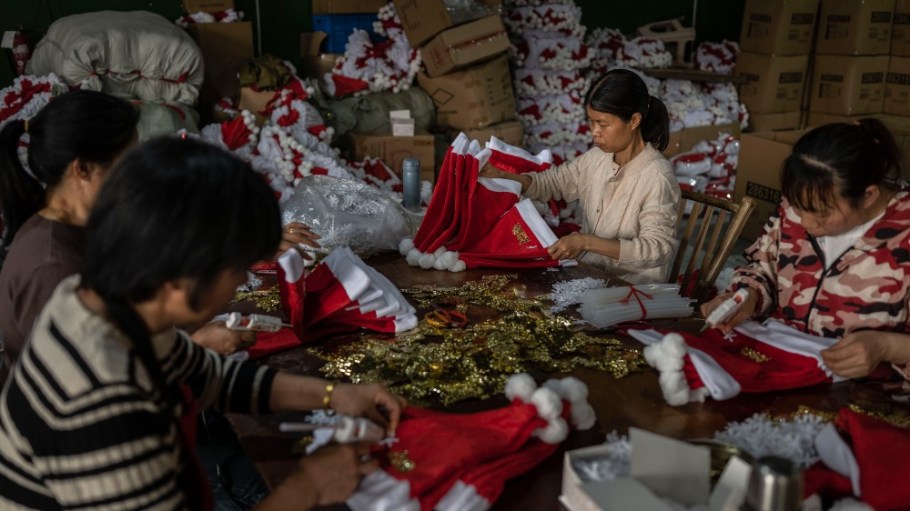
Children hoping for dolls—and all manner of holiday gifts and merch—may indeed be disappointed come December.
The first vessels carrying goods from China that are subject to President Donald Trump’s 145-percent “reciprocal” tariff rate began to arrive in Los Angeles this week, and the cargo is much sparser than in seasons past.
In fact, ships carrying tariffed goods from across the globe to U.S. are arriving half empty and holiday shipments are being cancelled at an alarming rate—amounting to a 56-percent drop from last year, according to data from Interos.
Related Stories
The automated supply chain mapping firm’s latest report indicated that the biggest impact will likely be felt by the 457,000 U.S. companies that import common holiday goods like apparel, jewelry, candy, and of course, toys. With inventory already dwindling, the president has intimated that kids should readjust their expectations for the holidays, saying that they should be satisfied with “three or four dolls” this year instead of dozens.
But there may not even be enough inventory to go around at all, never mind multiples. With 90 percent of global trade moving by sea, it’s safe to infer that these initial disruptions in maritime shipping are a bellwether of what’s to come, the group’s report showed.
“Retailers planning for the holidays know the clock starts ticking in June but if you’re placing orders then, you’re already late,” analysts wrote. Maritime lead times range from two to 10 weeks, and production times vary significantly. Ergo, brands and retailers that fail to order their goods during this critical window are likely going to miss out on holiday sales.
But many are paralyzed as they try to make business sense out of their current conundrum. According to Interos’ data, maritime trade of holiday goods nosedived following Trump’s “Liberation Day” tariff announcements on April 2. For the four weeks including the week of the announcement and after, maritime trade of holiday goods declined by well over half the historical averages from the same period in 2022, 2023 and 2024.
The group acknowledged that the data is preliminary and could be subject to reporting lags. However, initial trends showed a drop of 18 percent from historical values after Trump’s first executive order regarding trade on Feb. 1, and before the April 2 announcements. Nearly 50 percent of the goods are from China, India and Hong Kong, with China representing almost 30 percent of the products.
And as the last boats without tariffs arrived from China in the beginning of May, shipments of holiday goods were 16 percent lower than historical averages. If that trend continues unabated—or the losses in trade mount—the economic impact could exceed $8 billion in holiday goods from China alone, according to Interos.ai’s Tariff Explorer.
Notably, pre-tariff-announcement shipping levels were lower than historical levels for the U.S.’ top five trading partners, not just China. In fact, the United Kingdom and Mexico have seen the most pronounced pullback in holiday orders from the U.S., with exports falling 31 percent and 23 percent respectively. Interos’ preliminary shipping data shows an “intensified decline” moving forward, though there are some reporting lags for India and Mexico that could alter outcomes.
Asked about the sharp decline in maritime trade and port activity on Thursday, the president indicated that he doesn’t see the contraction in global commerce as a negative for American businesses and consumers. “That means we lose less money… When you say it slowed down, that’s a good thing, not a bad thing,” Trump said.
But many retailers would tend to disagree as they contend with the prospect of stockouts and squandered opportunity, Interos analysts wrote. For the hundreds of thousands of companies engaged in holiday selling, there’s no choice but to bring in inventory from overseas, and they’re coming down to the wire in revising their sourcing strategies.
Other Asian countries, like Vietnam, which will be subject to high (but still lower-than-China) tariff rates, may benefit from the uncertainty. The country’s Customs data from this week showed much higher than usual exports in April, with shipments to the U.S. increasing by 34 percent year over year to $12 billion. Meanwhile, more goods from China are flowing into Vietnam, including parts and components used to make the exports ending up on U.S. store shelves.
It’s highly unlikely that companies will be able to avoid paying more for the goods they usually source, as the 90-day pause on reciprocal duties comes to an end on July 9, but they may be able to preserve some margin with the right strategy.
“Retailers are weighing the cost of early orders against the risk of missed sales or empty shelves, and for many, peace of mind may be worth the premium,” Interos analysts wrote. “With tariff volatility driving supply chain disruptions and unpredictable delays, retailers who are betting on their typical holiday playbook may come up short.”