The outcome of the Supreme Court’s decision on the Trump administration’s tariff regime is “one of the key uncertainties of the economy” in 2025, according to Congressional Budget Office director Phillip Swagel.
President Donald Trump’s duties have accelerated inflation at a higher rate than the agency expected since he first took office, the CBO lead said in an interview on CNBC. Part of that impact stems from the unpredictability of the Commander in Chief’s trade policy, which is “changing day by day” and causing tremors within the national economy.
Related Stories
“The economy has been weakening over the course of the year. You’d expect that to lower inflation, but the tariffs have probably been pushing up inflation,” the non-partisan agency director said.
While Swagel said the CBO estimates that the collection of tariffs (and subsequent averted debt costs) could have a profound impact on the national deficit—to the tune of a $4 trillion reduction over the next 10 years—he said the impacts on consumers could also be significant.
Tariffs will lead to higher government revenue, yes, but also heightened inflation and slower economic growth, he said. “Whether that’s good or bad is up what to the Congress, to the president, and now, to the Supreme Court.”
The high court’s decision will have implications that stretch far beyond U.S. borders, with shakeups in policy reverberating across the economies of trading partners globally.
That’s according to Brazilian President Luiz Inácio Lula da Silva, who penned an op-ed in the New York Times seemingly directed at Trump himself.
Lula, who beat out Trump ally and newly convicted former president Jair Bolsonaro in the 2022 election, called the 50 percent tariffs levied on Brazil in August “not only misguided but illogical.” This, after accusing the the U.S. of “tariff blackmail” during a BRICS Alliance summit last week.
The Brazilian president implied that Trump meddled in the country’s politics by imposing the punishing duties, which he views as a nod of support to Bolsonaro. The erstwhile leader heads to prison this week after being found guilty of orchestrating a coup to overturn the results of the election that he lost.
Trump’s “reciprocal” tariff scheme was devised as a means of rectifying trade imbalances with global partners, many of which sell far more goods into the U.S. market than they purchase. But that’s not the case with Brazil.
“The United States is not running a trade deficit with our country, nor is it subject to high tariffs. Over the past 15 years, it has accumulated a surplus of $410 billion in bilateral trade in goods and services,” Lula said. “Nearly 75 percent of U.S. exports to Brazil enter duty-free. By our calculation, the average effective tariff on American products is just 2.7 percent.”
Now, Lula is calling upon Trump to come back to the negotiating table with Brazil to hash out a deal “that can bring mutual benefits.”
“But Brazil’s democracy and sovereignty are not on the table,” he added—a warning to the U.S. president not to leverage trade tools like tariffs to influence the South American nation’s politics.
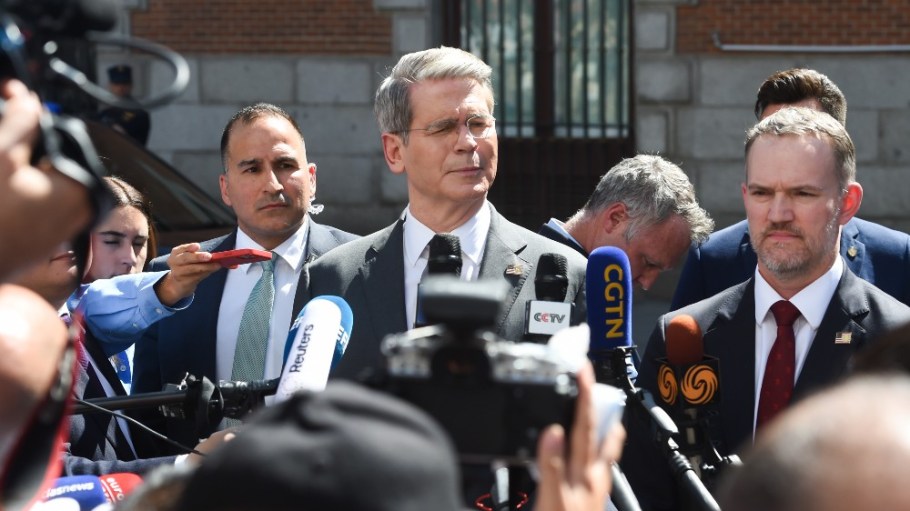
Trade tensions with several global superpowers remain rocky, but Treasury Secretary Scott Bessent said Tuesday that he believes negotiations with China are headed in the right direction.
After traveling to Madrid on Friday to meet with Chinese trade officials (and talking mostly about the future of social media platform Tik Tok), Bessent told CNBC that Trump and Chinese President Xi Jinping are slated to have a phone call on Friday.
He noted that the discussions in Spain about the future of the China-founded tech giant ended on the precipice of an agreement, which he appeared to believe would be hashed out before a broader trade truce. Just last week, however, Trump pushed G7 leaders to impose higher duties on both China and India over their purchasing of Russian oil.
“Each one of those talks has become more and more productive. I think the Chinese now sense that a trade deal is possible,” he said, expressing optimism that an agreement could be brokered before the Nov. 10 deadline, when reciprocal tariffs worth 30 percent will be levied on China-originating goods.
Asked whether he believes the Supreme Court will uphold the duties, which were stuck down by a Court of International Trade as unlawful (a ruling that was validated by a Washington, D.C.-based appeals court last month), Bessent said, “I’m confident that the Supreme Court will rule in favor of the administration.”
“I think the law is on our side. I think historically, that Supreme Court is very reluctant to overrule a president’s signature policy,” he added.