Under new leadership, Canada has effectively nixed all retaliatory duties on the U.S. in an effort to cool trade tensions that burned red hot just months ago.
“Canada has effectively paused its counter tariffs” on the U.S., which stood at 25 percent in March, according to Oxford Economics director of Canada economics Tony Stillo. Had they remained in place, about $60 billion in American-made products like apparel, footwear, motorcycles, cosmetics and alcohol would be subject to the duty rate hike.
Related Stories
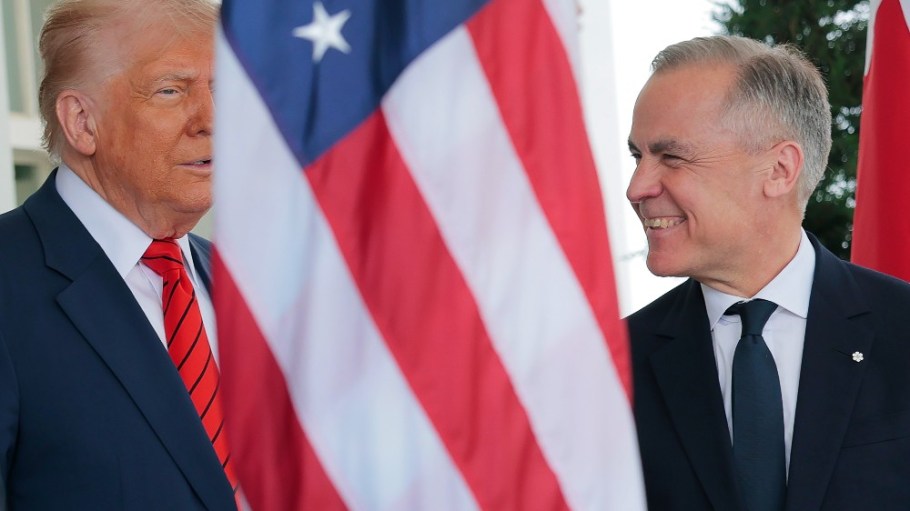
Newly elected Canadian Prime Minister Mark Carney has tried to walk a fine line between capitulating to President Donald Trump’s whims and demands and standing up for the North American nation’s sovereignty—a tightrope tread where his predecessor, Justin Trudeau, couldn’t manage to find balance.
In a visit to the White House last week, Carney flattered Trump, calling him “a transformational president” for his focus on the economy, the U.S. workforce, border security and the fight against fentanyl trafficking. But he also took the opportunity to dispel any notion the president still harbors about Canada becoming the 51st U.S. state. Canada “won’t be for sale, ever,” he said.
Despite the public show of strength, Carney’s government has implemented a suspension of duties for six months, as well as exemptions, that Oxford’s Stillo said bring the tariff rate on U.S. goods and services effectively down to zero (0.4 percent, to be exact). That strategy could help tamp down rising inflation and fuel economic growth, he said during a webinar hosted by the global economic advisory firm this week.
“U.S. President Trump’s tariffs are sparking a global trade war that no one will win,” Stillo explained. In the near-term, tariff rate hikes could trigger a slowdown in global GDP growth, bringing the 2.8-percent rate seen in 2024 down to a “sluggish” 2.3 percent in 2025 and 2026. Prolonged tariff uncertainty has the potential to lower global GDP growth by about 0.7 to 1.7 percentage points by 2028, mostly due to declines in business investment.
“And we’re already seeing signs of that paralysis taking place in a lot of advanced economies, including Canada’s, where firms are holding back on CapEx plans, holding back on hiring,” he said. The firm’s analysis showed that the U.S. and China stand to be the most acutely impacted because of their exposure to tariff threats (lobbed at each other), but Canada faces significant impacts, too, “if this uncertainty also were to depress financial markets and consumer sentiment.”
It’s not in Canada’s best interest to remain at the center of the fray, Stillo said, noting that the nation is “heavily reliant on trade” with exports to the U.S. making up about 20 percent of the country’s GDP.
Following the six-month pause on duties on American goods related to manufacturing, food and beverage packaging, public safety, health, which represent about 97 percent of the $60 billion in products previously facing counter tariffs, duties are slated to increase in the later part of 2025 unless Carney’s government decides otherwise.
Oxford Economics economist Michael Davenport said that on the U.S. side, a 12.6-percent average effective tariff rate on Canadian goods will likely remain in place between May and the renegotiation of the U.S.-Mexico-Canada Agreement (USMCA) in July 2026. The firm arrived at that rate by combining Trump’s duties on autos, energy, steel and aluminum and taking into account the deferrals and exemptions for USMCA-compliant goods.
“We do anticipate a renegotiation of the USMCA, which will see most tariffs be removed between Canada and the U.S.,” he added. According to the group’s research, the overall effective U.S. tariff rate will average 18 percent in 2025 before “settling” at 15 percent with the renegotiation of the free trade agreement.
Until that time, though, all three North American neighbors are exposed to significant risk, the group said. “Mexico are quite exposed to U.S. in terms of trade, so will be significantly hit as well,” Stillo said.
Notably, though, the economist doesn’t believe the extreme volatility seen in 2025 will knock the U.S. off its economic pedestal. “On the global scale, increases in U.S. tariffs followed by subsequent pauses make the exact path of tariffs here from here highly uncertain,” he explained. “But one thing we will point out is that we don’t think the U.S. tariff hikes spell an end to U.S. economic exceptionalism. By 2026, the U.S. is likely to head back towards the top of the growth pack and in line with its potential growth.”