After taking a stand this week against tariffs on Brazil and Canada, the Senate has rallied a bipartisan majority to strike down President Donald Trump’s duties on more than 100 countries.
On Thursday, the upper chamber voted 51-47 to nullify the president’s “reciprocal” tariffs on trading partners across the globe, which he levied using the International Emergency Economic Powers Act (IEEPA).
Four Republicans, including Senators Susan Collins (Me.), Mitch McConnell (Ken.), Rand Paul (Ken.) and Lisa Murkowski (Alaska) joined the Democrats in taking on the tariffs, which many of the lawmakers said have been injurious to their constituents, from consumers to American businesses.
Related Stories
The same four GOP defectors crossed the aisle Wednesday to reject Trump’s tariffs on Canada in a vote that totaled 51-46, and separately voted to end the administration’s staggering 50 percent tariffs on Brazil earlier this week. Trump raised tariffs on Canada from 25 percent to 35 percent over the weekend, enraged over an anti-tariff ad aired in the Ontario province featuring President Ronald Reagan.
“I’m against tariffs generally, unless they’re used very specifically. But I’m also against letting presidents just invent a reason to use emergency powers to do all kinds of things without coming to Congress,” Sen. Tim Kaine, who introduced the resolution alongside Senators Ron Wyden (D-Ore.), Chuck Schumer (D-N.Y.), Jeanne Shaheen (D-N.H.), Peter Welch (D-Vt.) and Elizabeth Warren (D-Mass.), told reporters following the vote, according to CNN.
While the broad resolution invalidating the tariffs—like the two resolutions on Canada and Brazil earlier this week—is unlikely to make it through House of Representatives and even less likely to reach the president’s desk for a signature, Kaine said the bipartisan show of support could rattle the Commander in Chief or at least prompt him to consider the issues lawmakers are bringing to the table.
“I did learn in the first Trump term that the president is responsive to things like this. When he sees Republicans starting to vote against his policies, even in small numbers, that makes an impression on him and can often cause him to alter his behavior,” Kaine said.
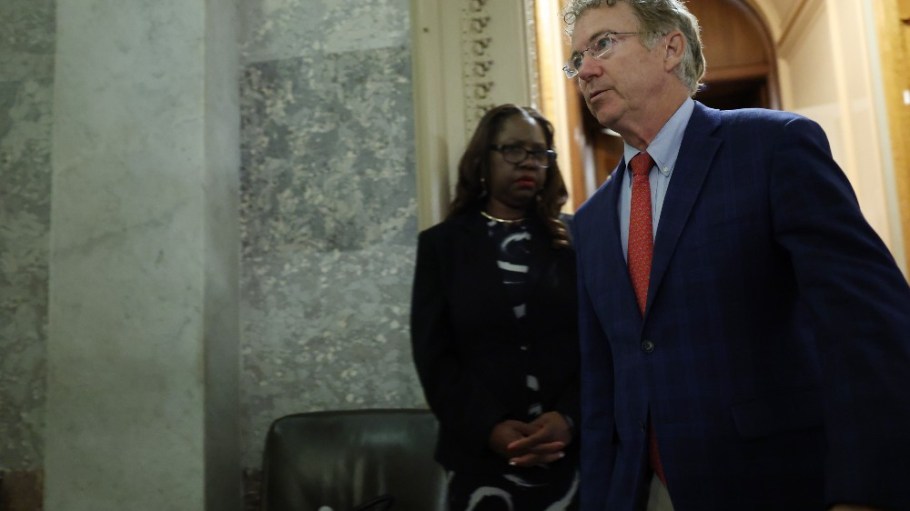
Paul, a co-sponsor on all three resolutions who has been unafraid to break with the GOP on the matter of tariffs since Trump began imposing new duties, said he doesn’t think this week’s measures will succeed in reining in the tariff scheme due to the ever-deepening partisan divide in Washington.
“It would take an economic calamity” to wrangle two-thirds of Congress to vote to dismantle the tariff machine, he said, according to Politico. “Which I don’t wish on anyone, or particularly our country.”
Nonetheless, the Kentucky Senator continues to rally against the tariffs, which have become a core tenet of the president’s economic and foreign policies.
He spoke about the issue Wednesday evening at an event hosted by the Peterson Institute for International Economics, saying he doesn’t believe IEEPA, a 1977 trade law that gives the president the power regulate economic transactions and impose sanctions in response to ‘unusual and extraordinary threats’ originating abroad, has been leveraged legitimately by the Trump administration.
The president has repeatedly referred to America’s trade imbalances with other nations as a national emergency worthy of such intervention. “I think that it’s a fallacy that it means anything,” Paul said. “I think it’s meaningless. I think it’s a completely meaningless accounting of trade that sends no real signals of value or use.”