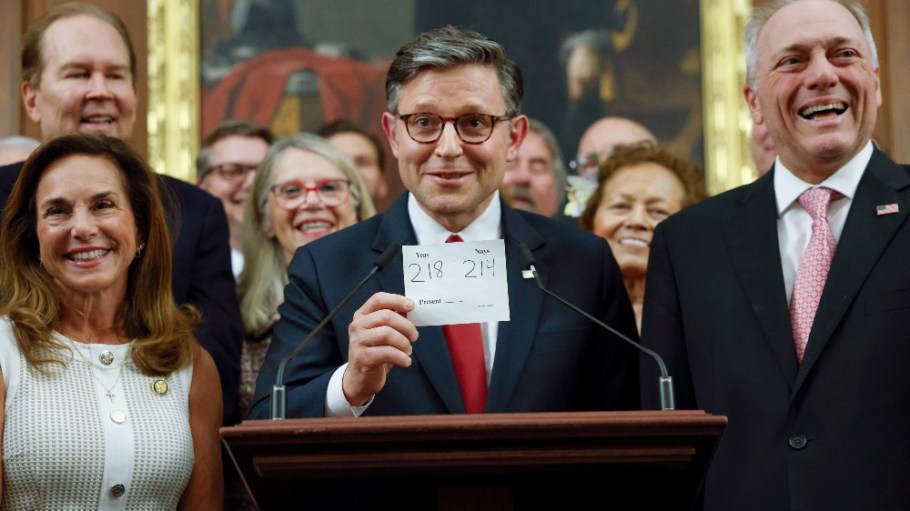
The landmark piece of legislation that has become the centerpiece of President Donald Trump’s second term passed in the House of Representatives and will now head to his desk for a final signature.
Thursday afternoon saw a final vote of 218 in favor and 214 opposed to the budget reconciliation bill, which has been dubbed the “Big, Beautiful Bill” by the president and Republicans in Congress.
Representatives Brian Fitzpatrick (R-Penn.) and Thomas Massie (R-Ken.) were the only members of the House GOP to oppose the legislation, which fiscal conservatives in the Freedom Caucus have said will balloon the deficit to untenable proportions (about $3.4 trillion, according to Congressional Budget Office estimates) by slashing taxes and increasing spending on a wide range of Republican party objectives.
Related Stories
The soon-to-be law will extend the president’s 2017 Tax Cuts and Jobs Act, which was due to expire at year’s end. Instead, the sweeping tax cuts for individuals and businesses will be made permanent. It also increases spending on areas like military defense, energy production and border security, and will pull funding from public health programs like Medicaid and the Supplemental Nutrition Assistance Program (SNAP) to supplement the GOP agenda.
While trade was not the primary focus of the controversial bill, Trump’s trade regime—which has focused on the leveraging of tariffs and other trade barriers to address what he characterizes as an unacceptable deficit with global trading partners—was mentioned throughout the 940-page text.
Most significant is the bill’s total nixing of de minimis entry privileges for commercial shipments, a provision laid out in Section 231 of the Tariff Act of 1930 that allows foreign shippers duty-free access to the U.S. market for packages worth $800 or less.
The president, by executive order, halted de minimis access for China and Hong Kong on May 2, effectively choking off the thoroughfare for small, cheap shipments of apparel products from e-commerce megafirms like Shein and Temu to American consumers’ doorsteps. That action, which prompted a nosedive in Asia-to-U.S. trade in May, was largely viewed as a precursor to more expansive regulatory action against de minimis.
Now, worldwide duty-free access to U.S. consumers will face a similar fate, with the de minimis exception set to end for countries across the globe in June of 2027. Parcels will be subject to more stringent inspection and different entry processes, with the administration expected to provide details at a later time.
The Congressional Budget Office has estimated that unraveling de minimis could generate $39 billion in U.S. government revenue over the course of the next decade, and many American producers and purveyors of domestically manufactured products agree that it will benefit their bottom lines, too. The National Council of Textile Organizations (NCTO) and the Alliance for American Manufacturing (AAM), which represent U.S. supply chain players, have lauded the president’s bullishness around de minimis reform and pushed for a total end to the provision.
“Today was really significant, and we are very grateful for the House and Senate leadership for including this provision in the bill, and we understand the President will be signing that shortly,” NCTO president and CEO Kim Glas told Sourcing Journal after the bill’s passage in the House.
“We are pleased that the Trump administration has used its executive authorities to address de minimis shipments. It codifies this into law, and that’s extremely important for decades to come; it will be closed forever, unless Congress decides to re-legislate, and I doubt that there’s any political will in opening up this disastrous loophole again,” she added.
Glas said that over the years de minimis has “hurt domestic manufacturers like the textile industry, hurt fentanyl families, has facilitated illegal and illicit products into the United States and has become a black market for cheap stuff coming in” with little scrutiny and zero duty burden.
While the inclusion of de minimis reform in the bill will be a certain boon to U.S. producers, Glas acknowledged that with a 2027 start date, “We still have quite a road ahead.” But with 28 textile plants forced into closure over the past 23 months, relief can’t come soon enough, in her estimation.
“De minimis shipments last year totaled 1.4 billion individual packages, up from the previous year of 1 billion. So as long as the loophole exists, people are going to take advantage of it to gain duty free access to the United States market and avoid paying any tariffs or reciprocity tariffs,” Glas said, noting that the administration has hinted at taking action to limit de minimis sooner.
“De minimis has contributed significantly to the economic headwinds faced by our industry and also by our Free Trade Agreement countries,” the NCTO lead added, noting that half of all de minimis shipments that enter the U.S. are textile and apparel goods. “Our industry is one of the most global and competitive industries in the world, competing on one of the most unlevel playing fields.”