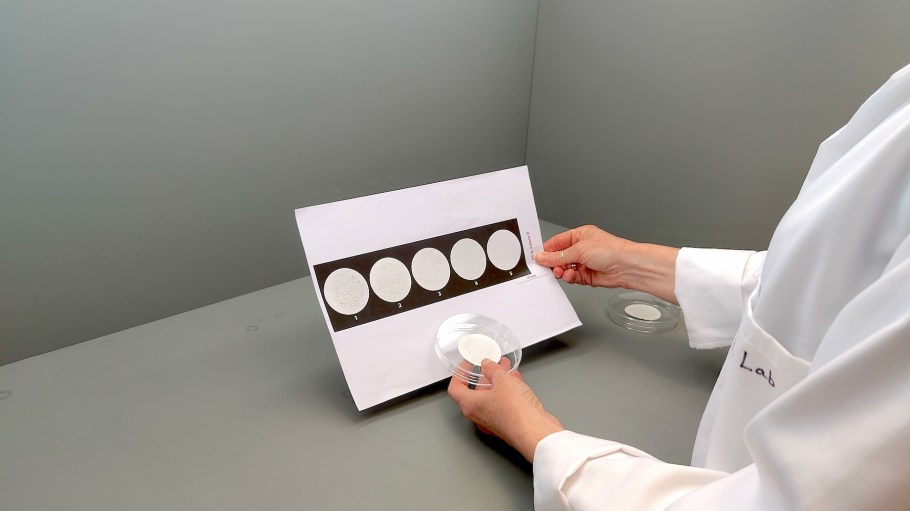
Microplastics are a massive—albeit microscopic—problem. That’s why researchers at Scotland’s Heriot-Watt University developed what they claim to be the very first visual grading system.
The project’s findings, backed by a group of textile experts out of the global research-led university in the Scottish Borders, were recently published in the peer-reviewed journal “Cambridge Prisms: Plastics,” titled “Low-cost, high-throughput quantification of microplastics released from textile wash tests: introducing the fiber fragmentation scale.”
Related Stories
“Visual scales are already used in the fashion industry to measure how much bobbling a material may suffer on its surface, for example or, perhaps the most well-known is the greyscale, which measures color fading or staining, but there was no such tool for fiber shedding,” said Dr. Lisa Macintyre, associate professor of textiles at Heriot-Watt University’s School of Textiles and Design in the Galashiels campus and co-author of the paper. “This project aims to change that and allow manufacturers to not only make better choices in production but also to communicate to their customers in a very simple and straightforward way, the typical amount of fibers shed from a garment.”
Macintyre and co-lead Sophia Murden spent four years researching and developing what came to be the maiden visual fiber fragmentation scale in an attempt to make both brands and consumers aware of what goes down when manufacturing garments. Namely, that fast fashion is a key reason why some 14 million metric tons of microplastics are lining the ocean floor, per research out of Australia’s national science agency.
“The microplastics problem is massive. Fashion and textiles are one of the biggest sources of secondary microplastics in the environment with fragments of plastic fibers—like polyester and nylon—being shed from clothing,” Macintyre said. “There are fiber fragments absolutely everywhere, from icebergs to the deepest ocean to human lungs and our food; they’re in everything.”
The five-point scale asses the volume of fiber fragments shed from various materials, like polyester and nylon. Using white filters with black fiber fragments, observers visually “grade” each of those fragments on a scale between one (most shedding) and five (least shedding). Compared to current techniques—including the International Organization for Standardization’s ISO 4484-1 or ISO 4484-3 methods—this visual scale offers increased efficiency and speed when processing significant amounts of fibers. And it’s cheaper.
“Time is money,” Macintyre said. “If you want the industry to adopt, then you best make it easy and you best make it quick.”
So, the team used a “rotawash” machine with eight separate canisters, commonly used for determining precision colorfastness and conducting accelerated laundering tests. The samples were put into said canisters and filled with water before being churned, not unlike a washing machine cycle. The team could visually grade the shed fibers against the five points by filtering the wastewater.
“Our methodology is simple and cost-effective. The filters used to collect fiber fragments from laundry wastewater can be graded against our five-point scale, which surprisingly is more accurate at assessing very low levels of fragmentation than the equivalent method of weighing fibers,” project co-lead and PhD student Murden said. “The ultimate aim is for manufacturers to choose materials that are going to have the least impact on our environment but also allow consumers to make an informed decision when they buy their clothing.”
Nearly 50 industry players, students and gen-pop volunteered, grading around 100 samples over two years.
Helly Hansen, for one, has expressed interest in the scale. So has the Lochcarron of Scotland, a leading producer of tartan. The following steps include locking in some form of an industry agreement, per Macintyre. If that were to happen, she continued, the scale could—and should—function just like a nutrition facts label.
“Currently, we don’t have an ‘acceptable fragmentation’ rate for clothing, but that’s not unusual,” she said. “The environment is an important issue; we want to get key industry leaders and policymakers to sit down and start agreeing [to] standards—perhaps even legislating against high-shedding materials.”