Oil and water don’t mix—not on a salad and not on the seafloor.
Around 33 billion pounds of plastic enter the ocean every year—the rough equivalent of dumping two garbage trucks full of plastic into the oceans every minute, ocean conservation advocacy organization Oceana reported. The United States is the No.1 generator of plastic waste worldwide, a separate report from the National Academy of Sciences found—ranking the U.S. as high as third among countries contributing to ocean plastic pollution. In 2021, the World Wildlife Fund reported 72 percent of Americans were “very frustrated” with plastic waste entering waterways.
Related Stories
A 2024 study by Ocean Conservancy revealed that nearly 80 percent of Americans deem plastic pollution the most pressing problem for the health of Earth’s oceans.
Now, the Washington, D.C.-based advocacy group has published a “first-of-its-kind report” analyzing the country’s state-level efforts to mitigate plastic pollution on a five-point scale. Within “United States of Plastics,” states scored an average of 1.5 stars. Of the 50 states, 44 (88 percent) scored below three stars.
“Overall, the results are disappointing,” said Anja Brandon, Ocean Conservancy’s director of plastics policy. “Four in five Americans consider plastic pollution to be the most pressing issue facing our ocean, yet only six states ranked as ‘good’ or above in our study. We hope that the United States of Plastics report inspires policy change and gives a benchmark for states to measure their progress in combating plastic pollution in the years to come.”
For Albert Douer, the 123-page report validated the work that he, a plastics industry veteran of 20 years and original PET bottle recycler, has been quietly conducting with UBQ Materials for the past 14 years.
“I think if you ask anyone in the United States, they’ll tell you that recycling is not particularly working,” Douer, chairman and CEO of UBQ Materials, told Sourcing Journal. “Anyone who’s been to a food court at the mall and seen those nice bins that say, ‘put this here’ and ‘put that there,’ but they’re overwhelmed by 1,000 other things that aren’t supposed to be in there—I think that sort of explains it all.”
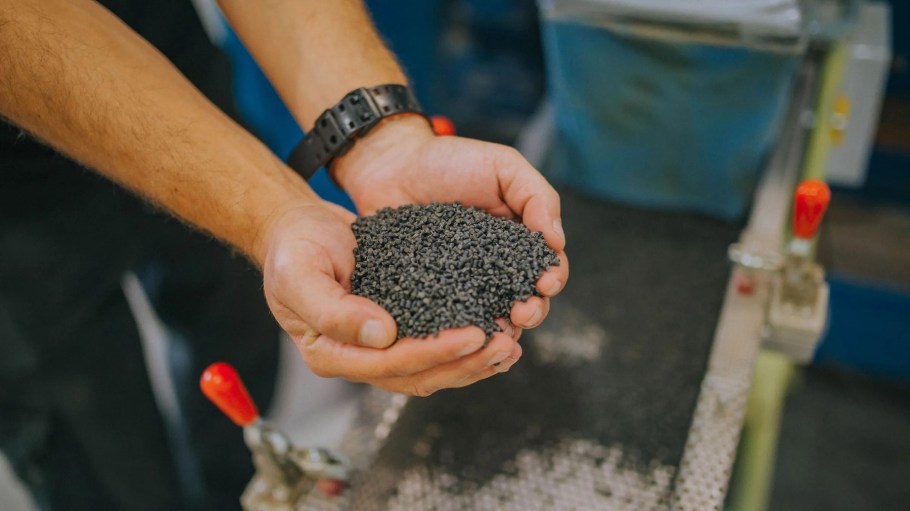
For context, global manufacturer UBQ Materials developed a climate-positive, thermoplastic composite made from household waste—including all organic materials, chicken bones and all—called UBQ in the early 2010s.
“There’s definitely something wrong with the system that we have today; that’s definitely part of what UBQ has been solving for; I think we’ve fixed a lot of the issues that are involved with recycling,” Douer said. “The fact is that most of the things we throw away, we are throwing them away with other things, right? And by definition, recycling requires every material be separated and, hopefully, clean; no organics, no T-shirts, none of the other things that we tend to throw away.”
By 2018, the Israeli cleantech company began the commercial development of its alternative to fossil-based resins. Now, McDonald’s, Mercedes-Benz and PepsiCo are among the companies using UBQ. The material was recognized on Time’s 2023 list of the best inventions within the reuse and recycle category, honored for addressing overconsumption challenges and reducing reliance on plastics.
“One of the biggest difficulties, I think in the U.S. more so than in many other regions, has been this issue that we’re expected, as consumers, to be very judicious,” Douer said. “All those things that we didn’t do in school, we’re expected to do now.”
That was evidenced in Ocean Consultancy’s report, which graded states using a 5-point scoring system with points weighted based on the estimated impact of a policy on reducing plastic pollution across five key categories. That includes single-use plastics, microplastics and plastic foams, among others. The report revealed that despite progress made, the country’s plastic recycling rate is below 9 percent. This, according to Ocean Consultancy, illustrates a clear need for increased action to address the plastic pollution crisis with the urgency it demands.
“States are on the frontlines of tackling our plastic pollution crisis—they bear the costs of cleanup, recycling operations, and the consequences of plastic pollution in our communities,” Brandon said. “That’s why state-level action is not only appropriate, it’s essential. When we pass policies that reduce plastic waste at the source, we save taxpayer dollars, protect public health and deliver immediate, tangible benefits to local communities and ecosystems.”
This is where UBQ Materials can come in. The company’s proprietary solution converts municipal household waste (which includes organic and hard-to-recycle materials) into a cost-competitive composite that reduces reliance on conventional plastics and minimizes the extraction of fossil fuels. Essentially, UBQ uses a “mishmash from the garbage of garbage,” removes the abrasive inputs and spits out a thermoplastic-behaving material that can replace oil-based polymers.
“UBQ is a technology that can affect every single human being,” Douer said. “It’s something that makes everyone in our company proud; everybody that works with UBQ Materials—including our investors—is because they believe in it, I think. It’s not simply a question of money.”
Speaking of money, bio-investments are (re)heating up. Data from network platform i3 Connect revealed that investments in bioplastics reached $500 million in the first quarter of 2022—surpassing the previous high of $350 million from the fourth quarter of 2021—with dough from both companies and venture capitalists. Zion Market Research, meanwhile, calculated that the bioplastic market would grow from $10.5 billion in 2021 to nearly $30 billion in 2028.
All’s to say, the current resurgence in bioplastics curiosity isn’t lost on anyone—including Big Plastic.
Earlier this month, the Plastics Industry Association (PLASTICS) commended president Donald Trump for signing the budget reconciliation bill—dubbed the One Big, Beautiful Bill Act—into law on July 4. The organization, which has reportedly represented over one million workers in the eighth largest stateside manufacturing industry (around $519 billion) since 1937, expressed enthusiasm over the anticipated innovation gains and investments made within the plastics value chain and the broader U.S. manufacturing industry.
The organization’s president and CEO, Matt Seaholm, called the package a “major win for the plastics industry.”
“At the start of his term, President Trump made a promise to put American manufacturers first—and together, with decisive action from Congressional leadership, this marks a critical step in delivering on that promise,” Seaholm said in a statement. “The package includes many pro-growth provisions we’ve advocated for—measures that promote long-term investment, encourage innovation and provide the economic stability our industry needs to thrive.”
And while notable strides have been taken in the development and manufacturing of bioplastics, growth has been slow. Current volumes account for only 1 percent of the total global plastics production—roughly 2.11 million tons per year, according to a presentation Fraunhofer-Gesellschaft’s Dr. Stephan Kabasci shared during a South American biorefineries conference in January 2019.
Trade in bioplastics—including biopolymers and natural polymers—increased in 2024, per preliminary data from the U.S. International Trade Commission (USITC). The independent agency found that trade volume rose 6.2 percent to $990.5 million. Exports grew 10.7 percent to $494.8 million—up from $446.8 million in 2023. Imports rose 2 percent to $495.7 million. According to PLASTICS chief economist Perc Pineda, the U.S. trade deficit in bioplastics “narrowed significantly,” from $39.3 million in 2023 to $833.11 thousand in 2024.
“The rebound in 2024 suggests a renewed momentum in investment, as the bioplastics industry—characterized by capital-intensive research and development and the need to scale production—continued to expand to meet return-on-investment targets,” Pineda said in a statement. “In sum, every $1 billion increase in bioplastics output is associated with a total economic impact of $2.9 billion and supports 5,215 jobs, along with $496 million in labor income—all expressed in 2025 dollars.”
Advocacy group As You Sow, meanwhile, is applauding Amazon’s 28 percent drop in North American shipments containing single-use plastic packaging.
In 2024, Amazon Web Services (AWS) augmented its circular economy strategy through efforts such as enabling repair and reuse, avoiding excess materials and integrating recycled content from the start. Those efforts also included using 30 percent recycled or biobased plastics in server rack components. The Jeff Bezos-founded firm also began early-stage testing on biobased bags made from organic sources with Amazon Fresh in Spain, per the company’s 2024 sustainability report.
For context, the e-tail Goliath’s plastic packaging—think plastic mailers, plastic shrink-wrap, plastic bags and plastic bubble-wrap—totaled 709 million pounds in 2021, an 18 percent uptick from 2020, according to Oceana.
“As You Sow began engaging Amazon to set plastic use reduction goals in 2020; we’re proud to see that engagement translated into real, measurable impact,” said Conrad MacKerron, senior vice president at As You Sow. “Eliminating 134 million plastic bags represents serious progress towards reducing plastic pollution. While the company has declined to set a time-bound public reduction goal, it has responded by reducing plastic use significantly.”