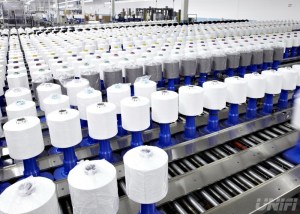
As Europe tightens rules on single-use plastics, fiber producers are making the case that regenerated cellulose could become a cornerstone of the region’s fossil-free materials strategy.
The Lenzing Group hosted a Brussels roundtable with policymakers and industry leaders to discuss how biobased materials could support Europe’s transition away from fossil-based inputs.
The Vienna-based cellulosic fiber supplier argued that cellulosic fibers are a viable, fossil-free alternative for nonwoven products. Europe could scale up production. However, the sector’s costs and regulatory asymmetries reportedly pose a threat to competitiveness.
Related Stories
That’s why, per Lenzing, policy clarity could “unlock investment.”
“Maintaining and expanding European production capacity is essential for supply‑chain resilience and strategic autonomy,” said Patricia Sargeant, executive vice president of nonwovens commercial at the Lenzing Group, noting that the Austrian producer also operates major integrated pulp and fiber sites in Czechia and the UK, with “Europe‑based R&D supporting jobs, innovation and technological know‑how within the region.”
The discussion focused on the role of cellulosic fibers—specifically, those made from wood pulp—as alternatives to synthetic materials in applications (like wet wipes) and other nonwovens (like blood-absorbing undergarments). Participants raised concerns about cost and regulatory imbalances that could slow adoption compared with fossil-based products.
“Biobased materials are not a future vision—they are a practical, scalable reality today,” said Georg Kasperkovitz, member of the management board at Lenzing Group. “Europe has set ambitious goals for a clean‑industry transition…Lenzing helps strengthen industrial resilience while accelerating the shift away from fossil‑based synthetic fibers.”
Speakers included Sargeant as well as Aurel Ciobanu-Dordea, director for competitive circular economy and clean industrial policy at the European Commission’s DG Environment, and Daniel Bradley, deputy counsellor and head of climate and environment at the UK Mission to the EU.
The Circ Fiber Club partner said its regenerated cellulose fibers come from renewable wood and are certified biodegradable and compostable, positioning them as lower-emission alternatives to synthetics. Clear, coherent policy signals—including possible SUPD updates—were identified as essential for investment certainty and broader market uptake.
For context, the EC said the Single-Use Plastics Directive (SUPD) aims to prevent and reduce the environmental and human health impacts of certain plastic products, specifically in the marine environment. The 2019 EU policy is designed to combat marine pollution. It bans or restricts the top 10 plastic items frequently found on European beaches: packets and wrappers, cutlery and cigarette butts, wet wipes and sanitary items.
“Cellulosic fibers play a critical role in single-use products for hygiene applications—underscoring the need to redesign products toward biodegradable material solutions that address SUPD concerns and microplastic pollution,” Sargeant said.