Toad&Co has always wanted to keep its clothes out of landfills, but recently employed a new way to do so in a bid to stay relevant with eco-minded customers.
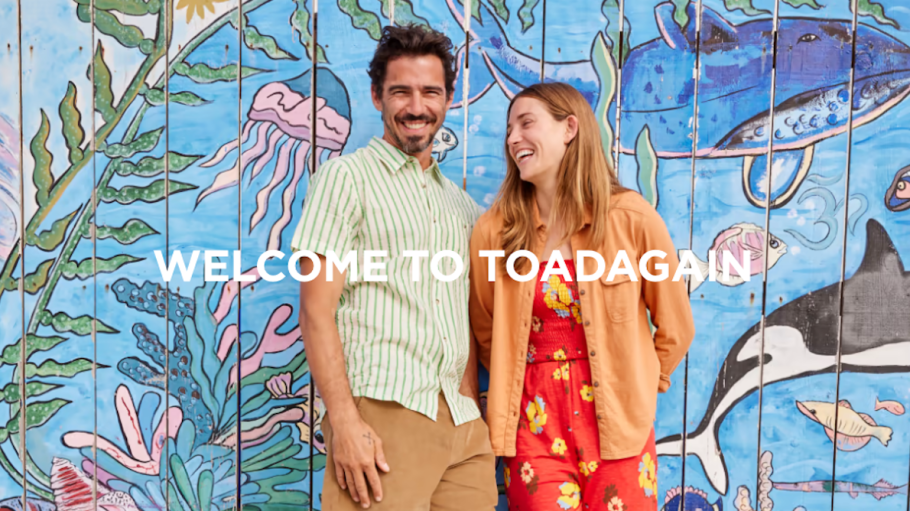
The eco-friendly outdoor apparel brand that believes “slow fashion is the future” is getting into the secondhand apparel game with the launch of ToadAgain, a peer-to-peer resale marketplace where consumers can buy and sell pre-owned gear from the Santa Barbara, Calif.-based company. The initiative builds on sustainability efforts such as using eco-conscious inputs like Tencel, hemp, organic cotton and recycled fibers for “clean manufacturing,” according to the company founded in 1991.
Related Stories
“Since the beginning, Toad&Co has been committed to creating sustainable clothing and giving back,” Gordon Seabury, Toad&Co’s CEO, said. “The launch of ToadAgain takes this commitment a step further by promoting a circular economy, limiting waste and encouraging the funneling of clothing back into the system so it can live a new life, again and again.”
Roughly 350 products for men and women were listed on ToadAgain as of Wednesday morning. And in its first four months, Seabury reported that the platform and 773 user signups, 200 unique sellers and 690 unique buyers.

Powered by Archive, Toad&Co is leveraging the retail tech start-up’s full suite of solutions to provide multiple channels for customers to keep the activewear brand’s items in circulation.
“We had pitches from many resale platforms, but really liked the omni-channel options that Archive could offer us,” Seabury said. “Typically, brands will choose one selling option and stick with that, but we wanted to include peer-to-peer sales because of our loyal fan base as well as sales from our own brand, and the auction functionality which will be launching in the fall. With [Archive], we continue to develop improved software that is very well-fitted to our needs.”
And Toad&Co is the first company to take its resale logistics in-house, using Archive’s proprietary resale warehouse software in its own facility.
“Toad&Co is committed to ensuring their products remain in circulation and out of landfill,” Emily Gittins, Archive’s co-founder and CEO, said. “Like all brands Archive works with, Toad&Co is focused on providing their customers with on-brand, premium experience through resale.”
ToadAgain lets consumers send their good-condition garments for credit back to Toad&Co, where employees evaluate what’s worthy of resale and what should be donated to other channels. Items accepted for trade-in give sellers a per-item payout of $5-$20, depending on its original price.
Customers can also “opt in” to the marketplace, select the items they want to sell online by accessing the Toad&Co catalog and list their products after they determine the condition, add photos, and set a price to make the listing go live. Though the company recommends a price, customers can make their own price determination. Once the item sells, the company sends out a prepaid USPS shipping label and sellers can then redeem their sales for cash (70 percent of the resale price) or credit (100 percent), though the credit cannot be used on ToadAgain as “this is not a functionality with Archive,” Seabury said.
“It is a limitation we are actively working on and hope to have a solution in the future,” he continued. “In the meantime, if customers choose to take their credit in cash, they can use that to buy pre-loved items.”
Product unfit for resale is dispatched to Toad&Co’s new dedicated processing center in Portland, Maine, to “ensure the product finds the highest value next life,” which could mean being recycled into new items, getting repaired or being donated to a local nonprofit. This facility is also where the resale shopping experience is making its debut. The mixed retail space features new clothes, resale items, and an assortment of hand-selected vintage pieces as well as some third-party brand offerings. The company won’t be accepting non-Toad&Co listings on ToadAgain, however.
ToadAgain launches in a global fashion resale market on track to reach $350 billion by 2027, according to ThredUp’s 2023 Resale Report. In the U.S. alone, the secondhand market is expected to reach $70 billion by 2027, up from $39 billion in 2022.
Archive has launched resale programs for 15 brands this year alone, including DVF, Faherty, and Sam Edelman in recent months. In line with ThredUp’s report, Gittins predicts that in the next few years, resale will grow to become a significant business unit for the majority of brands who haven’t yet tapped into this space; the customer experience is “far superior,” Gittins said, when brands own their own resale and in turn, those brands benefit from a new revenue stream.