Global sustainability legislation is getting more and more demanding that companies clean up both their products and their marketing tactics.
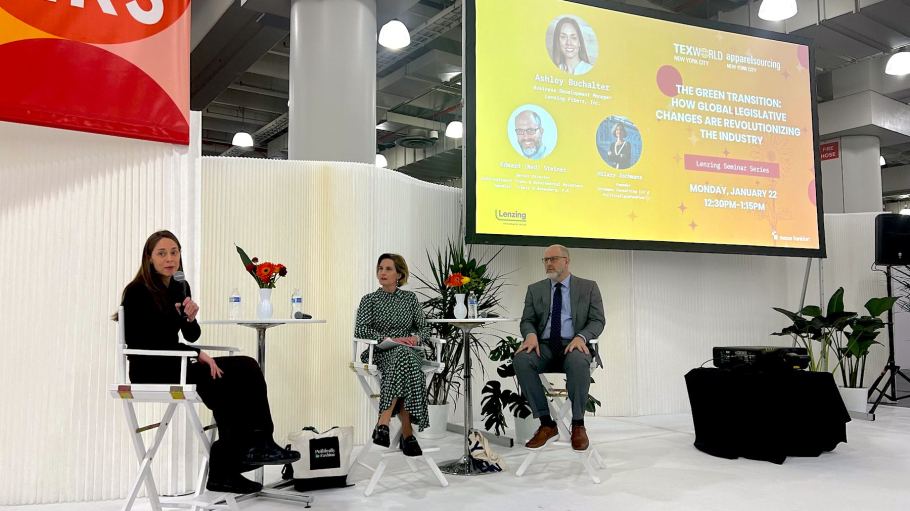
During the “Green Transition: How Global Legislative Changes are Revolutionizing the Industry” panel at Texworld NYC, moderated by Lenzing business development manager Ashley Buchalter, speakers discussed the impacts of international regulations and initiatives on the industry’s sustainability efforts.
“Supply chain visibility and being able to trace product and understand where it comes from—not just where it’s shipped from, but where the components are coming from—is going to be a key element to whatever kind of environmental-related legislation will come out,” Ned Steiner, senior director of international trade and governmental relations at Sandler, Travis & Rosenberg, said to a packed audience at the Jacob K. Javits Convention Center on Monday. “We can see what Congress has done in the past, and that may give us an idea of where it might go with respect to environmental legislation [in the U.S.].”
Related Stories
Steiner was referring to the forced labor issue, which has been “handled” through withhold release orders (WROs) and the Uyghur Forced Labor Prevention Act (UFLPA). “What’s happening in the labor center is a good indicator of what we might see in environmental policy,” he said.
It’s essential to take a step back and remember that 2024 is an election year for not only the U.S. but for more than 50 countries including Russia, the U.K. and Taiwan, according to Hilary Jochmans, founder of the public policy community PoliticallyInFashion.
“In an election year, there’s impetus to get things done,” she said. “You’ve got to have something, some sort of deliverables. So maybe you see a little bit more movement on some legislation.…I think we’re going to see some movement this year on Green Guides.”
The FTC’s Green Guides are “due to be released at any moment,” Buchalter said. Europe’s version of these rules, the E.U. Green Claims Directive, came out in March and is already affecting policymaking and legislation to be rolled out in 2026.
“This is not a theoretical public policy conversation. This is what you can and cannot say about your product,” Jochmans said. “Just last week, the EU got one step closer to effectively banning greenwashing. It’s going to be interesting to see how that’s implemented, and to the extent that impacts U.S. businesses; even if we don’t have our own rules on the books in the U.S. yet, my guess would be that they’re not going to have two different sets of standards.”
All that to say, don’t let marketing get ahead of compliance.
“Compliance people are always seen as a pain… but guess what, compliance people are keeping you out of danger because if you get too far over your skis, someone’s going to come back and bite you,” Steiner said. “Green Guides, I think, is a continuation of that—it’s going to specify when you can say something is using recyclable material. Or it won’t.”
Using language like “sustainable” and “eco-friendly” may “kick the can,” Jochmans said, as the Green Guides may rule those words and phrases out entirely. Regardless of what is ultimately released, legislation and regulations are taking shape, and the best way to make sure that the industry has a voice is for stakeholders to call on elected officials.
“It’s great that we’re having these conversations amongst practitioners, but you noticed that here, I don’t think there are any elected representatives. We need to make sure that they are hearing what these conversations are, and that’s where I’m seeing a disconnect,” Jochmans said. “Think about all the different issues legislators work on; this is just one of 20, 50, 100. You need to make sure that your message is getting out there so they can figure out how to write the legislation, how to make it workable. If you write something you can’t possibly implement, that’s worse than nothing. That’s like going backwards.”