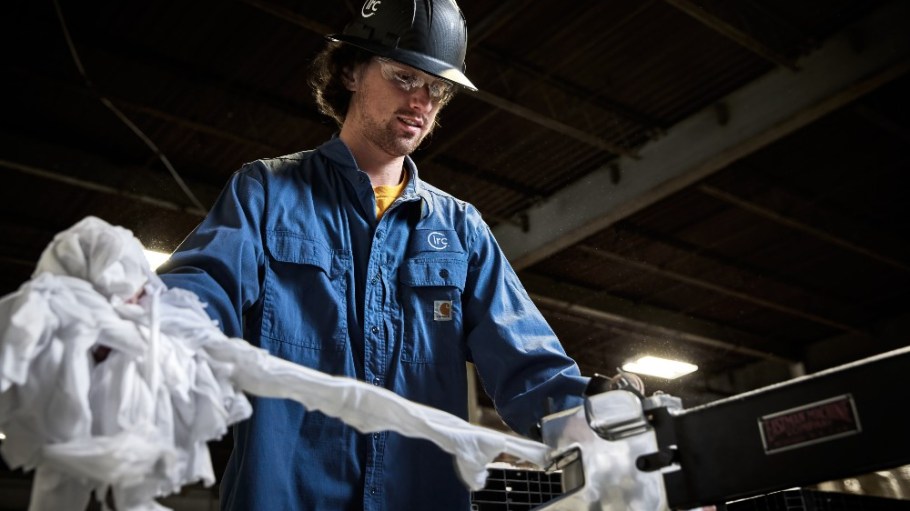
Virginia-based textile-to-textile innovator Circ is scaling up with the help of a new offshore partner.
The Danville operation—which touts a proprietary chemical process that reclaims polyester and cellulose from discarded poly-cotton blended textiles—announced a new investment from Drive Catalyst, the venture capital division of Taiwan’s Far Eastern Group, a leading virgin and recycled polyester producer.
According to Circ, the undisclosed investment, as well as the Asian manufacturer’s capacity for large-scale production, will propel the creation and reach of Circ Polyester. Far Eastern’s support will help Circ address the growing pains that come with commercializing next-generation materials to meet the demands of larger fashion brands. The announcement comes nearly a year after Circ announced a partnership with Acegreen Eco-Material Technology Co. to offtake its cellulose content for use in lyocell production.
Related Stories
“It is crucial that leaders in the polyester supply chain, like ourselves, set an example by establishing a foundation for collaborative models,” Juliana Pidner Hsu, managing director of Drive Catalyst, said this week.
Hsu added that Far Eastern’s investment arm is committed to advancing the circular economy and feels textile-to-textile recycling will play a pivotal role in decarbonizing the raw material supply chain. “Our dedication to supporting innovative solutions aligns with our customers’ strong demand for sustainable fashion,” she said.
“To drive significant systemic changes may take time and require collaboration. With Circ‘s high-quality materials and the growth potential of its technology, we believe this partnership is a meaningful step towards scaling circularity,” Hsu added.
Far Eastern will integrate the recovered monomers—the building blocks of polyester—into its existing production infrastructure. It’s important “to build out the supply chain in such a way that these materials can flow naturally, so you’re not disrupting the system from that regard—you’re disrupting it only in replacing oil with recycled materials,” Luke Henning, Circ’s chief business officer, told Sourcing Journal.

“The monomers that we’re producing, when they repolymerize them, they would use a standard process to do that,” he said. “They may be using some of their batch assets versus their continuous assets for scale in the beginning, but these are equipment they already have.”
Like many material innovators, Henning knows that friction is the enemy of adoption, and brands are looking for a drop-in solution that doesn’t require them to rebuild the wheel, or chain, so to speak.
“You want to try and make it as easy as possible for people to transition to a more sustainable solution, so getting in with partners who have deep supply chain access, who have a lot of vertical integration, is often very powerful,” he added.
Henning said Circ has worked with Far Eastern on projects in the past, and was compelled to deepen the partnership for several reasons, including the firm’s geographic proximity to important supply chain partners and its status as a top-tier supplier to global brands.
The Taiwanese textile producer has also been able to meet Circ where it is at this stage of its growth and development. “I would say that there is a significant the lack of piloting assets left in the world for polyester; this is a molecule that we have optimized around for decades, and so most of the facilities run at really massive scale these days,” Henning explained.
Many Asia-based facilities pump out thousands of tons of polyester content each day, highlighting a common “mismatch” between a nascent innovator’s capabilities and their partner’s astronomical capacity, he added. “There aren’t that many players out there who have the ability to scale new innovations like this within a commercial process.”
According to Henning, Far Eastern recognizes the need for the existing textiles and apparel supply chain to play a “much more active role in the transition” to recycled materials. “They seem to be looking at the landscape and trying to identify innovators who can support their core business, but also help carry that core business forward.”
Asked what he’s most excited about seeing unfold over the next six to twelve months of the budding partnership, Henning said it would be optimizing processes and “smoothing out” the supply chain for recycled polyester production. It’s not a “big and flashy” objective, but one that he believes is necessary to taking Circ to the next level. “It’s the important work that needs to be done, because that will allow us to flow those materials through to brands so they can see that we can make high-quality materials from recycled content.”