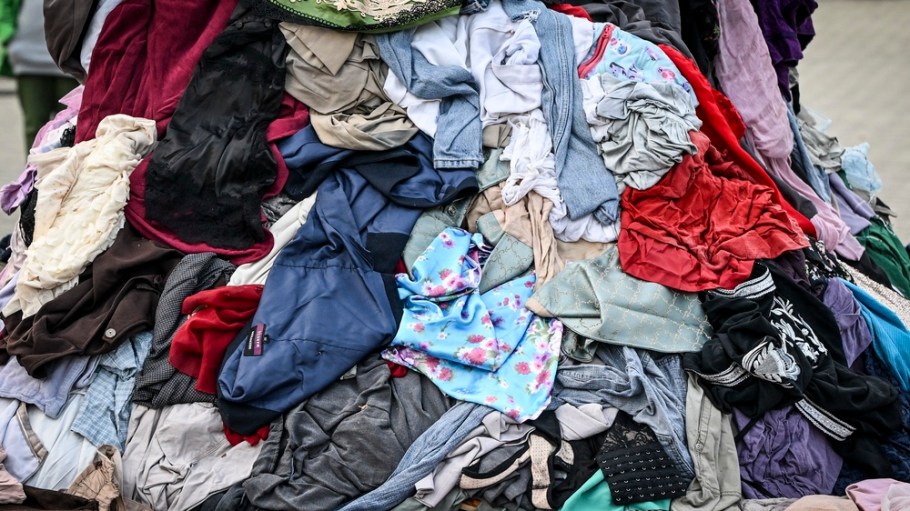
One of the biggest impediments to scaling textile-to-textile recycling, a new position paper says, is that most jurisdictions classify textile waste as, well, waste.
Semantics, surely? Not really, said Dolly Vellanki-Seijger, sourcing and public affairs manager at Circ, a Virginia-based materials innovator that banded together with Circulose, Re&Up Recycling Technologies, Syre, Samsara Eco and, most recently, Recover, this year to form the European Union lobbying group known as the T2T Alliance—T2T standing in for textile-to-textile, of course.
Related Stories
Current draft criteria for the 27-member bloc’s actively percolating Circular Economy Act defines the point of “end of waste,” meaning when waste-derived materials stop being waste, as after the recycling process. When recyclers’ feedstock—the preferred term—is viewed as not having any intrinsic value, Vellanki-Seijger said, it becomes subject to strict waste legislation that obliges permit requirements, site-level restrictions for storage and handling and miscellaneous transportation rules. This creates “unintended barriers” for trafficking recycling feedstock and recycled outputs.
“We really want the EU to champion global alignment when it comes to end-of-waste criteria and waste classification so that we can move feedstock across borders at the EU and global levels,” she said. “It’s really crucial that feedstock is recognized as a resource and not waste, because otherwise circularity is dead on arrival.”
Poised for adoption in 2026, the Circular Economy Act, as envisioned by the European Commission, aims to increase the supply of high-quality recycled materials while at the same time driving their demand within the EU. Europe’s so-called circularity rate is roughly 12 percent, the Commission said, using a measure of how much of the materials on the continent are recycled or reused instead of becoming grist for the landfill. The idea behind the act, which builds on the 2020 circular economy action plan, itself a tentpole of the European Green Deal, is to double the figure to 24 percent by 2030.
Something the T2T Alliance is advocating for as a collective is for the circular economy act to not only explicitly include textile recycling in its scope but also to ensure that recyclers are regarded as a “very critical part of the solution and not to exist as waste handlers, because that’s not what we are,” Vellanki-Seijger said.
Another thing that would set the nascent-but-growing industry up for success in Europe is the streamlining of rules governing extended producer responsibility schemes so that funding isn’t disproportionately going to collection, sorting and transport for textile reuse, leaving textile recyclers with next to nothing. The European reuse market, she said, is oversaturated and the majority of castoffs are exported to countries in the global South, where a sizeable amount becomes unmanaged waste.
Then there are the virgin fibers that innovators are competing with, which, in addition to being more abundant, are also much cheaper.
“Whereas recycled materials at the moment carry higher R&D and operational costs,” Vellanki-Seijger said. “This is quite a structural cost gap that we have, and small-scale investments alone are not going to be able to fix this. So we’re calling for targeted funding and also fiscal incentives along the lines of feed-in tariffs, VAT reductions, rebates for recycled materials. Some of these examples that I’m mentioning are not like, ‘Whoa, this is new.’ We’ve seen this happen in other industries.”
Europe’s EPR frameworks have “very great intentions,” she said, but they also “pressure-cooked” the front part of the system, focusing heavily on collection targets, while neglecting the back half.
“So we saw a lot of sorters having this increased amount of volume, but they didn’t have anywhere to direct it toward,” Vellanki-Seijger said. “Giving direct funding to recycling will make sure capacity is built so that they can also sort for recycling and generate revenue from both as well.”
To do that, however, requires EPR funding to take into account the differences in sorting and preparing textiles for reuse versus recycling. So far, the EU hasn’t clarified what it means by “preparing for recycling,” which can involve everything from de-trimming to cleaning to shredding. Without a clear definition of “preparing for recycling,” she said, stakeholders involved in pre-processing for textile recycling will not be able to receive the funding they need to build capacity or encourage innovation. A circular economy fund could work for this purpose, too.
How to boost the uptake of secondary materials is something the T2T Alliance covered in its first position paper, which it released over the summer. Again, regulatory carrots—and sticks—are critical, Vellanki-Seijger said, say through the introduction of recycled material thresholds in the technical specifications of green public procurement rules or the inclusion of “ambitious” recycled content performance requirements in the ecodesign for sustainable products regulation’s delegated act for textiles.
Textile-to-textile recycled materials can step out of the margins into the mainstream, she said, but to do so, they need targeted policy interventions to “kick-start commercialization.” Both Circ and Syre are in the process of building their first industrial-scale plants in France and Vietnam, respectively.
“We cannot achieve circularity when the market is treating waste as a legal liability, making secondary and recycled materials a premium price luxury, and is continuing to perpetuate virgin fibers as the default,” Vellanki-Seijger said. “So we really see the Circular Economy Act playing that big role in rethinking how we classify waste, reducing the premium pricing and reducing that cost gap between secondary or recycled materials and virgin materials.”
But it all begins with understanding the reality of the reverse supply chain and de-taboo-ifying textile waste as waste.
“Classifying feedstock as waste is overlooking the amount of processes that it actually goes through from disposal to reaching the recycler,” Vellanki-Seijger said. “If I’m a recycler, whether or not I’m doing the collecting and processing myself, waste is not what I’m buying. It’s feedstock. It’s our raw material.”