According to Refiberd, the world has a 186-billion-pound problem on its hands. That being how many pounds of textiles are cast off each year, with less than 1 percent being recycled. The Cupertino, Calif.-based startup wants to tackle this waste—and its lack of recycling—head-on.
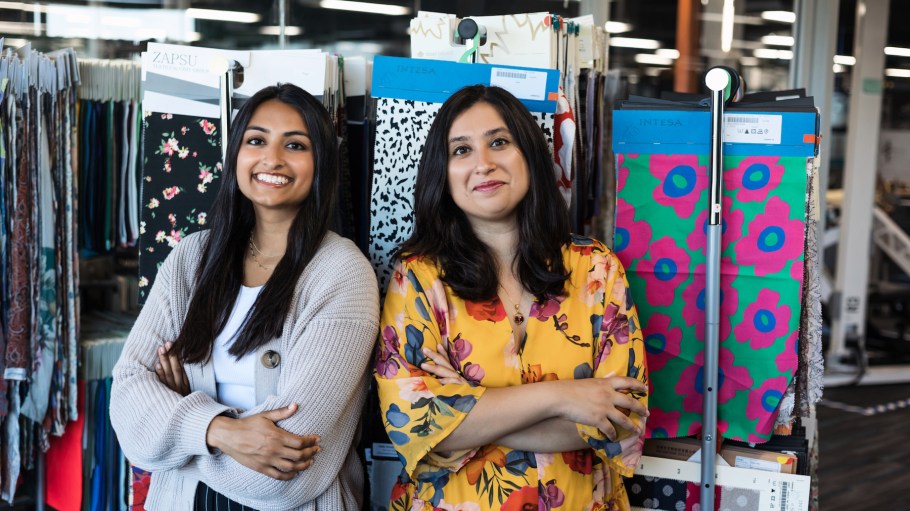
And with 93 million tons of textile waste generated annually—representing nearly 6 percent of all solid waste in the US, according to the Environmental Protection Agency (EPA)—co-founders Sarika Bajaj and Tushita Gupta have their work cut out for them.
Related Stories
Since launching in 2020, the duo is off to a strong start, having amassed awards from SXSW Pitch, Fashion for Good and the H&M Foundation, not to mention raising $3.4 million in funding, all within three years.
“I think we’ve been very lucky to have great investors and mentors and were taught since we started that VC funding is a tool to achieve something. But don’t forget, it’s a tool,” Bajaj said. “It’s not the achievement itself; the achievement is everything else.”
Meet Refiberd: the (allegedly) first and only textile recycling system that converts unsorted, used textiles into new, 100 percent recycled thread. It utilizes artificial intelligence-based hyperspectral imaging, which detects how light interacts with material. Since different materials absorb and reflect light differently depending on their chemical composition, hyperspectral imaging allows for identification across various materials.

A textile is placed underneath the hyperspectral camera and the line light source. The camera measures lines of hyperspectral data from the moving material at a quantified framerate while the computer stitches together lines of that data to create a hyperspectral cube. That cube is then processed by a machine learning model, with the model outputting a prediction of the material composition of the textile. The result is more detailed detection across all types of fabrics, including blended and layered fibers.
To put it into perspective, one camera unit will—eventually—be able to sort up to seven million pounds of material annually. And, according to TechCrunch’s math, 4,000 Refiberd units would be enough to solve America’s textile waste problem.
“Our first goal is to get our technology in the hands of existing sorters and recyclers to have as much of an impact as possible,” Bajaj continued, stating that Refiberd is more interested in utilizing a plug-and-play methodology instead of spending the time and money building its own facility. “Let’s leverage systems that people already have and help the really great players already collecting a ton of textile waste [but] can’t sort it due to material challenges.”
Though Bajaj cannot speak to any of the brands Refiberd is piloting with, she can say that they fall into one of two categories: waste aggregators or resellers. Rather than competing with the likes of Renewcell or Recover, Refiberd is meant to be supplementary to them. The company is focusing on North American and European partnerships for now but will happily shake hands with other countries if the opportunity presents itself. “At this point, it’s just targeting people who are the most motivated to use this technology,” she said.
While the use of AI in recycling isn’t novel, the way Refiberd utilizes it appears to be unique.
“What you’re then using the AI for is like, we have all this data; can we get a high confidence guess on what this material is? And you just keep running that over and over until you get hyper-accuracy,” Bajaj said. “I think it’s helpful to think we get an image of material data and the computer does the math; we feed it all it needs to know, and then it does the thinking and guesswork for us.”
That uniqueness has garnered much attention for Bajaj and Gupta, who met as college freshmen nearly a decade ago while studying mechanical engineering at Carnegie Mellon.
In 2021, Refiberd won the SXSW Best Bootstrap Company, aka the business that’s done the most with the least. Last March, the startup was selected for Fashion for Good’s Global Innovation Program, which nurtures fledgling companies.
“Refiberd’s pioneering innovation excels in accurately identifying fiber composition and contaminants, effectively tackling complexities like trace elastane and diverting feedstock to fiber-to-fiber recycling,” said Dolly Vellanki, innovation associate at Fashion for Good. “Their innovative technology has the potential to revolutionize the industry by addressing a pressing need: the development of efficient and effective sorting capacity aligned with circular economy principles.”
Refiberd won the H&M Foundation’s Global Change Award in June, an early-stage innovation challenge pursuing “bright minds” to transform the industry.
“Refiberd’s AI sorting technology could be one of the critical keys to transforming the industry and close the loop of textile waste in an unprecedented way,” Christiane Dolva, strategy lead for the H&M Foundation, said. “If we, through solutions like Refiberd, can sort in an efficient way and ensure recycling of textiles at scale, this will not only solve a waste problem, but reduce the industry’s dependence on virgin materials, and by default also the resource uses and emissions.”
In mid-August, Refiberd won the 2023 Green Arrow Award from the California Product Stewardship Council (CPSC), a non-profit coalition supporting shifting California’s material economy to a circular one. The award is given to an organization demonstrating an innovative approach that removes or reduces problematic attributes present in products, the CPSC said, and Refiberd “demonstrates these principles with a novel sorting technology that directs an otherwise landfill-bound textiles waste stream back into recycling processes to create a large-scale circular economy for textiles.”
But Bajaj isn’t celebrating these wins quite yet.
“In many ways, [the success] has been a relief,” she said. “I think my very honest answer is it’s like, all of this is great, but it feels like a lead up. I will feel very good and very relieved when we can see the tangible percentage of textile recycling increase. We celebrate the small moments, but we want to make sure we’re laser-focused on actually making the change we set out to.”