About three-quarters of surveyed Americans think global warming is happening, per a 2023 climate report out of Yale University. Yet only 20 percent understand how the greenhouse gas effect works. As indicated by this report, among other sources, the gap between consumer intent and behavior remains significant.
“Sustainability is a word that means everything and nothing, right? People are anxious about global warming and want to do something, but they don’t know what to do, nor do they really understand the ins and outs of how to be better humans on this planet,” circularity consultant Liz Alessi said to a room of industry players. “As much as we are all probably interested in this—and a lot of us who know a lot about it are talking about it—we have to keep educating people.”
Related Stories
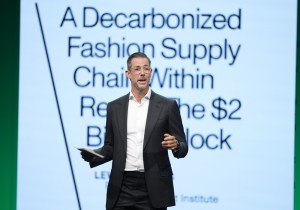
The self-proclaimed Ellen MacArthur superfan presented the third “chapter” of her supply chain-focused series, “The Crisis of Stuff,” during Première Vision New York on Jan. 14, held at Tribeca 360° in Manhattan. For this installation, Alessi focused on value hierarchy, scaled post-consumer opportunities and innovative technology, among other sustainability-minded subjects.
The product value hierarchy—something Alessi is “extremely passionate about,” she said—is a good place to start when educating the consumer.
“Most of the time when we talk about value, we’re talking about dollars. And that’s important—I like dollars myself, in fact—but there are other values, too,” Alessi said, highlighting life-span and emotional value. “So, if you’re a brand and you’re creating products, think about how you can tap into all three of these things to help your customer understand how to be more sustainable.”
With that in mind, Alessi discussed several “service provider innovators” found throughout that hierarchy and their corresponding “superpower.”
Up first was Bank & Vogue. The used clothing purveyor works with suppliers, retailers and social enterprises (like the Salvation Army and Goodwill) to buy 3-5 million items a week. Annually, 750,000 of those garments are “rehomed” through Bank & Vogue’s B2C brand, Beyond Retro. The group also sorts, grades and cuts components based on design specifications at scale, as shipping directly to the brand partner factory removes tiers 2-4 of the supply chain from the equation—resulting in a carbon footprint reduction of at least 80 percent, Alessi said. Lastly, Bank & Vogue supplies feedstock to textile recyclers—historically, the broker sends these fiber-to-fiber recyclers 4 million garments a month—and is the largest post-consumer supplier to Renewcell.
“When we donate our clothes, 75 percent of what we donate doesn’t get sold in the store. Where does it go? People like Bank & Vogue come in and buy it,” the Beyond Retro consultant explained. “Then they follow the value hierarchy.”
Another relevant client of the Canadian company? Tapestry. Bank & Vogue teamed with Coach on the denim iteration of the Jennifer-Lopez-backed Soho bag.
“Tapestry sponsored a life cycle analysis. Those are not cheap, but they sponsored it. Why? Because they want the data. What did they do with the data? The put it in their corporate responsibility report,” Alessi said of her alma mater. “The numbers are staggering. If anyone’s ever read through a boring LCA before, the numbers are never that big—this is insane.”
Meanwhile, the other side of the first solution in this pyramid-shaped value system is downcycling.
ReCircled’s superpower is disassembly, though the takeback solutions provider has since evolved to leverage data to find financial value in what brands were once willing to absorb, and use it to create new recycling streams, per Alessi.
“ReCircled is paid by the brands to take their excess merchandise. As opposed to [Bank & Vogue], who gets their feed stock from charities, ReCircled gets their feedstock from brands,” she continued. “Whether it’s pre consumer, post-consumer, returns, excess, whatever it is.”
Teaching brands about this previously untapped revenue stream yields a takeback program tailored to the most money on the given brand’s table, considering brands are “good at designing and making and selling things” but not so great with the product’s life—and eventual death—post-sale.
“Data collection is becoming increasingly important; different brands care about different things,” Alessi said.
On that note, Debrand’s superpower is rooted in transparency and trust. The next-life logistics firm offers services like sorting and grading as well as circular-centric consulting, as the Canadian company’s allocation engine gives brands relevant feedback on improving recyclability.
“Brands trust them,” Alessi said. “They do their very, very best to always tell the truth and be totally transparent [about] if they can do something, if they can’t do something…that kind of feedback is incredibly important, and Debrand is excellent at this.”
Refried Apparel’s superpower is upcycling deadstock into dollars. The Massachusetts manufacturer taps the local labor force to “rescue” surplus inventory and unsold swag—from the likes of the Girl Scouts of the USA and Fenway Park—and into new, one-of-a-kind pieces—like scrunchies and bucket hats—that cycle back into the marketplace, in the effort of benefiting both the company and the community.
“Refried is going to make the brand money from the brand’s deadstock,” Alessi said. “They’ve proven—over and over again—that, whatever the brand thinks is trash, that’s sitting in their warehouse, is actually not trash so if they upcycle it and give it some aesthetic love, some additional value, you’re going to be making money.”
At the top (aka bottom) on the product value hierarchy is repair. As circular economy darlings may know, the sector is swimming upstream.
“One of the reasons that repair is expensive is because the repair shops, the tailors, are not working in any automated way; they don’t really have systems to help them track the last time you had your shoes fixed,” Alessi said. “If we can create more efficiency at the actual repair shops, and help customers understand how to connect with those local tailors, that’s going to help the whole system flow.”
That is Alternew’s Alessi-assigned superpower. The tech platform effectively digitizes the entire after-sale journey, she said, successfully negating the need to scour Yelp reviews while also feeding brands data on consistent fit challenges.
“When we’re feeling despair about the climate crisis and we feel like there’s nothing that we can do, there are things you can do; every single thing I showed you [here] are things you can absolutely employ in your organization, today, and it’s going to make a difference,” Alessi said. “We have to give each other a bit of grace in this arena—some of these things I showed you have never been done before, okay? We’re going to try things, we’re going to fail, and then we’re going to learn, and try it again.”