How well does the fashion industry consider its water risks? Less than you might think, a new Planet Tracker study asserts.
The nonprofit financial think tank used natural language processing to plow through 3,900 annual and sustainability reports, regulatory filings and investor meeting transcripts, finding that fewer than 10 percent flagged water-related risks related to its consumption, pollution, sanitation, scarcity or potential inundation. Many companies failed to mention any such risks at all, indicating a disparity in disclosure practices.
Related Stories
Part of this has to do with what’s known as “carbon tunnel syndrome,” said Richard Wielechowski, senior analyst of textiles and a co-author of the study. Businesses understand greenhouse gas emissions. Less so subjects such as water and biodiversity.
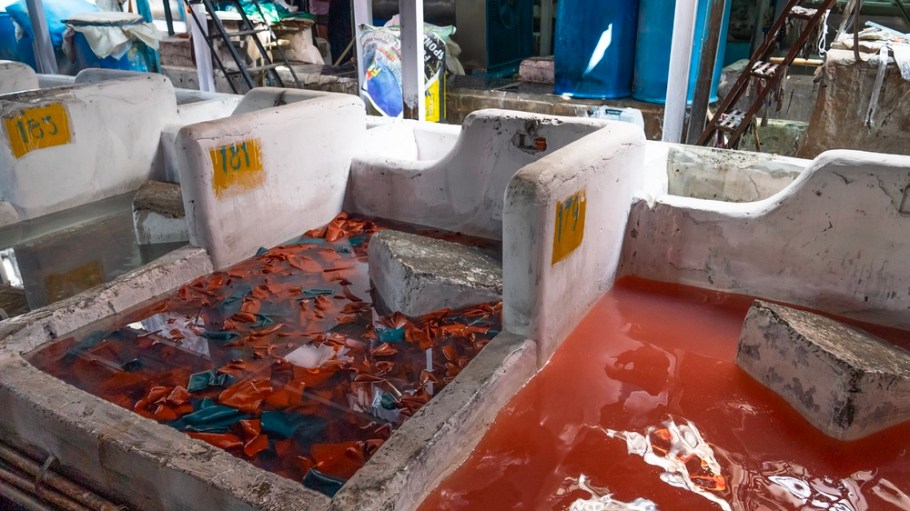
But fashion cannot cope without H20. From irrigating fields to dyeing and finishing fabric to promoting factory hygiene, water is fundamental to every stage of textile production. At the same time, it can present a threat, for instance when there’s too little of it because of environmental stress or untreated disposal or, conversely, too much due to coastal or riverine flooding, perhaps exacerbated by extreme weather. As water-sensitive operations increasingly butt up against the “existential risk” of climate breakdown, water will be nothing if not material, Wielechowski said. In fact, its effects are already writ large: Just take a gander at the drought-besieged Panama Canal, which has resulted in massive shipping delays, or the “monsoon on steroids” in 2022 that destroyed a large proportion of Pakistan’s cotton.
There’s also reputational risk to consider. “You can’t really make green claims about your apparel if you’re a major polluter of water,” he said. “Water is necessary for life. If you’re using a liter of water and polluting it, it’s no longer suitable for drinking—that’s water that might otherwise have been accessible to local populations. And a lot of this production is going on in areas of poor sanitation. You’re looking at countries where if you study the growth rate of the children, they sort of fall off the curve at about the age of two or three because they’re getting parasites all the time from dirty water.”

That’s not to say fashion is ignoring water completely. According to Planet Tracker’s estimates, attention on agua has grown from roughly 2,000 disclosures in 2018 to more than 9,000 in 2022. And of the 29 companies that the organization looked at, among them Adidas, Gap Inc., H&M Group, Zara parent Inditex, Kering, Levi Strauss & Co., Nordstrom and Zalando, 15 reported to CDP on their water use. It’s the quality of these revelations, however, that Wielechowski describes as “broadly flat” over the same period. Many brands and retailers home in on one of two targets—water expenditure, say, or efficiency. What’s necessary, however, is a “truly robust” approach that covers a wide range of metrics across the supply chain, in line with the Science Based Targets Network’s new freshwater guidance, such that “we’re talking apples to apples [and] we can say, ‘You’re a laggard, you’re doing well, your starting point is x and you’re trying to get to y,’” he said.
Wielechowski isn’t so much surprised by the findings as he is disappointed. While some brands and retailers are “leading the way” in terms of talking about their water risks—among them Hanesbrands, which topped everyone with a disclosure quality grade of 16.5 percent, Kering, the next highest with 11.6 percent and Gap at No. 3 with 13.6 percent—most elide the liquid’s impacts on the bottom line. Some of the lowest scorers included Capri (1 percent), Zalando (0.3 percent), Burlington and Nordstrom (0.2 percent), Victoria’s Secret and Skechers (0.1 percent) and Under Armour (0 percent). H&M Group and Inditex earned a middling 2.5 percent and 4.1 percent, respectively, while Uniqlo owner Fast Retailing clawed a mite 1.2 percent.
On average, non-luxury brands divulged the most water-related risks, followed by luxury brands. Multi-brand retailers, on the other hand, made “very few” water-related disclosures. Asian companies also appeared to lag behind their counterparts in Europe and North America. Not a single one, however, doesn’t have work to do.
“These are not small mom-and-pop shops that haven’t got the means to do this,” he said. “The best-case scenario is they’re all busy working on water impacts and water management behind the scenes but just don’t feel the need to tell anyone about it. I find that very hard to believe.”
Wielechowski said that the lack of disclosures in transcripts also suggests that investors are either unaware of water as a risk factor or don’t think it’s important, yet it’s critical that the industry examine Scopes 1 to 3 for water as it does greenhouse gas emissions.
“There are investors for whom sustainability is nice but it’s not a priority,” he said. “But once you start saying, ‘Actually, this could mean you’re over-valuing your investment or insurance risk or operational risk,’ that’s when they start to focus. So I think investors need to start thinking about water, incorporating it into the way they talk to management teams, pressing them on having a strategy.”
Shariful Hoque, water impact lead at H&M Group welcomed Planet Tracker’s report, agreeing that companies in the fashion industry should talk about water risks. He said that the Swedish retailer’s new water strategy for 2023-2030 will “increase its ambition” by setting “further goals and actions that will spread across our full value chain, with a clear focus on water reduction and water quality improvement.”
“We believe ‘doing’ is as equally important as ‘telling,’ meaning that transparency should go hand in hand with a robust water strategy showing concrete action and progress,” Hoque added. “One of our main goals is to reduce by 30 percent absolute water consumption reduction in our value chain by 2030 with a context-based targets approach. To reach such an ambitious target, we support our direct business partners to make sure water is managed in a responsible way in the factories where our products are made.”
Other brands and retailers either declined or did not respond to requests for comment.
Wielechowski recalled seeing conversations at New York Climate Week last year split between the “climate” camp and the “nature” camp. He said that they need to come together instead of being siloed in their own categories.
“We are basically the way we were on greenhouse gas emissions 10, 15 years ago, which is it’s not something people have been thinking about; it’s difficult and costs money to sort it out and so it’s just not happening,” he said. “And you can see where we’ve got to today, most of the brands are setting to start to set science-based targets. They’re reporting Scope 1, Scope 1, Scope 3 on greenhouse gas. We’re just not there yet on water. We’ve got a long way to go yet.”