The backlash came almost immediately.
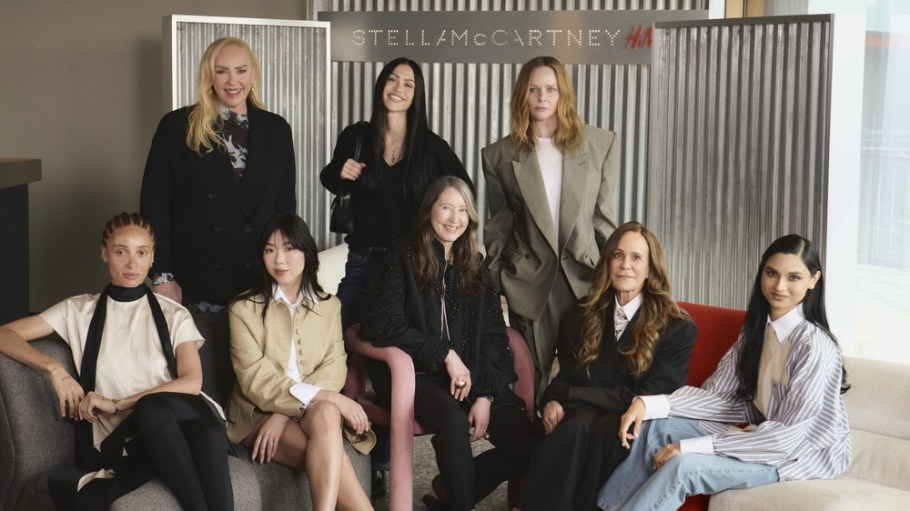
Days after H&M Group and Stella McCartney unveiled a so-called “Insights Board” to “bring together different voices and perspectives,” “create a space for curiosity and listening,” and “ensure sustainability remains something fashion talks about,” the Clean Clothes Campaign fired off a scathing indictment of its exclusion of the workers who form the fashion industry’s backbone.
A slide in an Instagram carousel juxtaposed two images: one of protesting workers in Bangladesh with the words “The sustainability board we wanted,” and another of glossy-maned, made-up women, McCartney included, gathered around a comfortable couch, captioned “The sustainability board we got.” Another slide quoted McCartney on the importance of “listening and learning” not only from the “voices around the table” but also the “communities they represent.” Next to it, under the text “The represented communities,” was a Photoshopped meme of Paris Hilton wearing a tank top that read “Stop being poor.” A third showed a car swerving off a highway called “Embrace sustainable fashion” toward an exit labeled “Blame it on the consumers.”
Related Stories
“We will let H&M’s recent greenwashing lawsuits, take-back-scheme sham scandals and the failure to support Bangladeshi garment workers’ demands for dignified wages speak for themselves,” wrote the garment industry’s largest consortium of trade unions and civil society organizations in the accompanying text. It was clear that the Swedish retailer’s ballyhooed second collaboration with the famed British designer, known for her strong ethical stance, had struck a false note. But how much of one?
“The appointment of H&M’s new Insights Board is not much more than a desperate PR move designed to disguise the brand’s failure to fulfil its commitments to ethical production practices,” Bogu Gojdź, the Clean Clothes Campaign’s campaign and outreach coordinator, told Sourcing Journal. “Not a single worker representative was invited. This is completely unacceptable, especially considering that many of the workers in H&M’s supply chain are located in countries particularly vulnerable to the devastating effects of the climate crisis, which brands like H&M help to accelerate. There is no sustainability without workers’ rights.”
The members of the board cut a glamorous swath, including sustainability innovator Kiara Nirghin, model Amelia Gray, fashion editor Susanna Lau, actress Adwoa Aboah and artist-activist Anitta.
But the nearly 1,000 likes the post had received as of April 10 didn’t seem especially enthused by the selection, suggesting, if not a crisis of credibility, then at least a sense of unease over the cognitive dissonance. Among them was Livia Firth, the eco-fashion crusader who co-founded the now-defunct Green Carpet Challenge with British journalist Lucy Siegle in 2009, when her then-husband Colin received a Golden Globe nomination for Tom Ford’s “A Single Man.” (He didn’t win.)
“I am SO tired of this endless BS and greenwashing and I am surprised they get away with it considering it’s been at least 15 years they have been repeating the same crap,” Firth wrote.
A spokesperson for H&M said “customer centricity” is the focus of the Insights Board, which comprises “topic experts” and “opinion formers” representing a “broad cross‑section” of the fashion community. The brand is also part of other organizations and initiatives that promote industry‑wide collaboration in areas such as industrial relations, wages and responsible purchasing practices.
“We see this collaboration as a starting point—to learn and gather perspectives, with the intention to build on it over time,” the spokesperson added. “It has always been H&M’s ambition to make it easy and accessible to make better choices, and we believe that transparent communication about a product’s and a brand’s sustainability performance is key to empowering customers.”
H&M has always been a study in contradictions. In some ways, it’s been a sustainable fashion frontrunner, initiating one of the first major global brand-backed take-back programs in 2013—albeit not long after one of its Manhattan stores was accused of slashing unsold garments and dumping them in garbage bags on the street—and immediately signing the watershed Accord on Fire and Building Safety in Bangladesh following the deadly collapse of Rana Plaza that same year, which spurred many other European buyers to follow suit.
The company was among the first to publish a supplier list when transparency was still a novel idea, invested in circular fashion innovations when few were doing so, and remains one of the only major brands actively working to purge coal from its supply chain, including by providing low-interest loans to factory owners for electric boilers or biomass burners.
Yet at its core, H&M remains a fast fashion business that thrives on a model of high volumes and low prices, just as susceptible to the sourcing squeeze as its less “conscious” competitors. Supporters argue that because the brand is far more transparent than the likes of Shein and Temu—in terms of public disclosures, Fashion Revolution has consistently ranked it near or at the top of 200 brands—it’s easier to criticize. Still, there are limits to how much it will actually share: H&M, for instance, declines to reveal how many items of clothing it puts into the world every year, though estimates place the figure at around 3 billion.
“I’m honestly stunned by the audacity of the Insights Board,” said Venetia La Manna, an online content creator and fair fashion campaigner. “If they actually want to ‘find new ways for brands—and for the industry as a whole—to influence and drive change,’ then why won’t they address the biggest elephant in the fashion changing room? Oversupply. Why isn’t there a community organizer from the frontlines of the textile waste crisis on the board? Which begs the question, what do they have to hide?”
La Manna is the U.K. representative of The Or Foundation’s “Speak Volumes” campaign, which urges fashion companies to declare their annual production volumes—and, in so doing, be held publicly accountable for the excess clothing inundating communities such as Accra’s Kantamanto Market in Ghana. The environmental nonprofit’s cleanup crew found H&M’s clothing tags 148 times on Jamestown’s trash- and textile-strewn beaches between June 2024 and May 2025, making the brand the area’s 15th biggest polluter.
“This board feels like a slap in the face to those of us who have continued to organize for fashion justice over these years when H&M realized they could no longer get away with—and profit from—their greenwashing,” she said. “The Insights Board announcement felt like an excuse for a bunch of wealthy people with no connection to fashion justice organizing to shift the blame from big fashion brands like H&M that are responsible for the fashion polycrisis back onto the consumer. A bit gross in 2026.”
The ‘devil in the data’
When H&M Group’s 2025 annual and sustainability report crossed Lubomila Jordanova’s desk last month, the sustainability practitioner was impressed by how the brand managed to lower its Scope 3 emissions by 34.6 percent against a 2019 baseline. In fashion, where the bulk of emissions lies within the supply chain, that’s a hard number to move without “offsetting tricks,” she said. Even the fact that a sustainability report came out at all was commendable; many businesses are shying away from the “woke” backlash, especially in the United States, which could make them political or cultural targets.
Nevertheless, Jordanova said, certain things didn’t add up. Take H&M’s claim of using 91 percent recycled or sustainably sourced materials. Even with 32 percent recycled content, she said, the brand still consumes “enormous amounts” of virgin materials—especially as it opens new markets like Brazil.
The report, she said, pointed to a decrease in total material weight, which H&M attributed to a change in “assortment mix” rather than an explicit reduction in production volume. Missing data, Jordanova said, makes the numbers harder to justify. And another thing: if unsold items are not reported, the brand is essentially reporting “50 percent less of the reality” of its total emissions. Meanwhile, H&M’s resale efforts account for only 0.8 percent of total net sales, which Jordanova called “absolutely marginal.”
“The devil is in the data,” she said. Fashion’s systemic challenges, too, are “not solved by one annual report.”
H&M released its annual report alongside a white paper it wrote with EY on accelerating fashion decarbonization. Maxine Bédat, executive director of the “think and do” tank New Standard Institute, had a few doubts. This prompted her to turn to an unlikely source to express them: ChatGPT.
While Bédat appreciated the company’s push to frame supply chain decarbonization as a strategic investment in business resilience rather than a philanthropic cost, she said the paper conflated mitigation with adaptation—and reached “the wrong conclusion, which is why the industry isn’t following their lead.” ChatGPT backed her hunch: decarbonization isn’t the same as mitigation and when H&M says decarbonization will “protect operations from climate-related disruption,” that is “too loose.”
“I think what H&M is doing is commendable, but it also ignores the broader system in which the industry operates,” Bédat told Sourcing Journal. “If they reduce emissions while their competitors continue to grow theirs unabated, their accomplishment amounts to very little. They developed an open source system map, so they clearly think in systems. It would be encouraging to see that their actions align with that thinking.”
Adaptation isn’t a buzzword either. With the effects of climate breakdown already writ large in garment sourcing hubs like Bangladesh and Vietnam, staving off extreme heat and flooding is not only a matter of worker wellbeing; it’s also a hedge against the type of supply chain shocks that threaten long-term business viability.
The H&M spokesperson said while the retailer cannot unilaterally eliminate “physical risks” like storms, droughts and heatwaves, it views decarbonization as its primary tool for mitigating “transition risks” like carbon pricing and energy volatility. They also underscored 2025 progress—including whittling supplier coal units from 118 to just 10 in three years and sourcing 20 percent of supplier electricity from renewables—as tangible proof it’s de-risking its supply chain. The company admitted, however, to “significant exposure” to fossil fuels, since 41 percent of the energy it uses still relies on fossil gas, which it is “continually working to reduce” through collaborative financing efforts such as the Future Supplier Initiative.
But experts say that no number of low-interest loans can repair the underlying mathematics of unceasing churn, just as no amount of de-coalification can change the fact that a “just transition”—something H&M Foundation, the philanthropic arm of H&M’s founding family, constantly drums on about—involves the people at the lowest rungs of the supply chain.
It’s why the Clean Clothes Campaign is putting the finishing touches on “Fashioning a Just Transition Manifesto,” a document to be launched on Labor Day in September that “combines sets of principles and visions for the future of the fashion industry,” Gojdź said.
“The manifesto emerged from a year-long public input-gathering process, which consulted consumers, workers, activists and experts on a vision for a transition to a more sustainable fashion industry that truly includes workers’ rights,” she said. “There is clearly a gap in understanding that true progress can only be achieved through worker inclusion, not celebrity clout.”