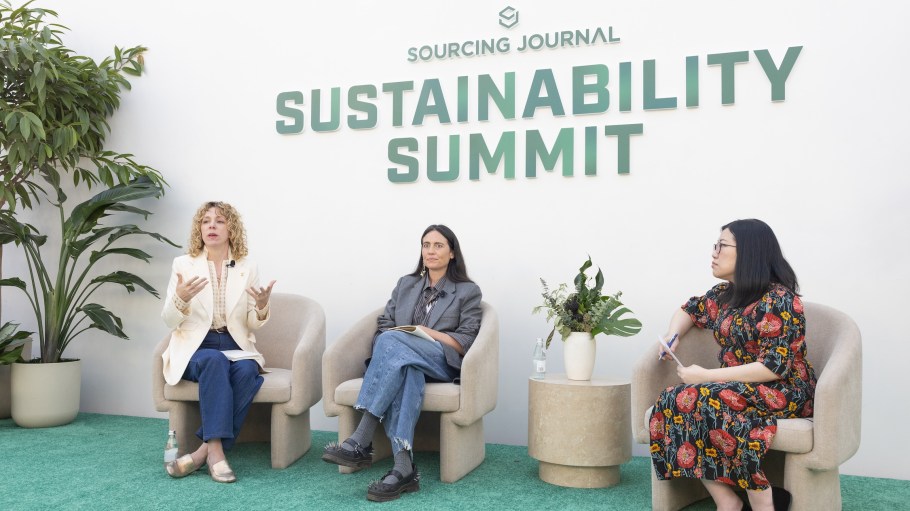
In the wake of fires in Ghana’s Kantamanto Market and Los Angeles that devastated local communities and resulted in the deaths of at least two people, Liz Ricketts made a plea to the audience at the Sourcing Journal Sustainability Summit—“We have to stop romanticizing.”
Ricketts, co-founder and executive director at The Or Foundation, called the Kantamanto fire “a supply chain disaster” with more than 60 percent of the secondhand clothing market having been destroyed, directly impacting 10,000 vendors working the trade.
Related Stories
The nonprofit Or Foundation has already distributed more than $1.5 million in direct relief to individuals impacted in Kantamanto. The firm works heavily with the community surrounding the market and carries a mission to identify and establish alternatives to the pitfalls plaguing fashion’s current business model including overproduction and greenwashing. But even with the assistance the foundation provides, the fashion industry needs to pay more attention to the health of these markets, she said.
“It’s unfortunate that we still don’t view secondhand markets and the secondhand economy as part of the supply chain, because it is essential to the transition to circularity,” said Ricketts in a panel discussion moderated by Jasmin Malik Chua, sourcing and labor editor at Sourcing Journal.
The panel itself was focused on the topic of overproduction, which IE New York College (IENYC) program director Michelle Gabriel noted had a “fraught” relationship with overconsumption. Since growth ultimately determines the success of American businesses, the industry is now too dependent on consumption-driven factors like trends, she argued.
“We have entire extremely profitable portions of the sector, businesses like Ross or T.J. Maxx that monetize that overproduction. So we’re reinforcing these feedback loops that are predicated on these growth models,” Gabriel said. “Consumers are purchasing overwhelmingly to craft identity, to belong, to satiate desire. Companies are obviously incentivized to produce and drive consumption because they need to be profitable.”
Gabriel said there was a glaring case for a new approach to the speed of fashion production. She channeled Harvard Business School professor and economist Michael Porter, who created the “five forces” framework for businesses analyzing competition, saying that if there isn’t one entity that wins the low-cost game, ultra-fast-fashion brands are effectively incentivized to overproduce goods to compete to make sales.
“We’re all living in that reality. If we are pursuing the same business models, we cannot compete with that race to the bottom,” Gabriel said. That race to the bottom is undermining our ability to exist.”
The current market conditions necessitate a return to degrowth, or ideating that concept within the retail business model, according to Gabriel.
Ricketts pointed to a fatal human flaw in the “volumes over value” business model, noting that its current problems aren’t just impacting places like Kantamanto.
Bluntly, she pointed the finger at one problem: the overproduction business model is successful if everyone along the value chain is not paid enough.
“We are exploiting people all along the value chain to make this possible, garment workers, people who are making the clothes, as well as the communities that I work with in Kantamanto,” said Ricketts.
She argued that the low pay means there is no longer enough embedded value in product, an example which has led to the collapse of Kantamanto over the past 10 years.
“A ‘volumes over value’ business model means that a shirt that is purchased here no longer has enough value for someone to think it’s worth it to put a button back on it. So how does that garment have enough value to fund the collection, repair, sorting, export, resorting, preparation for reuse, resale? It does not,” Ricketts said.
As a result, more workers are feeling the adverse conditions, further calling into question the sustainability of overproduction in fashion.
In Kantamanto, there is no longer enough funding to subsidize the rehabilitation of the lower quality items, which is resulting in many of the sellers, namely single mothers going into debt to importers, banks and family members.
To close the panel, Ricketts expressed her disillusionment with the general attitude outsiders may have to supply chain disasters such as those in Kantamanto and Los Angeles, even if much of the sentiment may be coming from an empathetic place.
She noted how people often refer to people as resilient in the Global South, “as if it is a character trait.”
“I am retiring the word resilience. I am sick of hearing that word,” said Ricketts. “we’re judging how well someone struggled in a way that made us not have to be uncomfortable…We have to stop excusing things that are systemically challenging, and yes, we can focus on resilient structures, which is what we’re doing. But let’s stop judging how someone who is in a difficult position survives a crisis like this.”