Material World is a weekly roundup of innovations and ideas within the materials sector, covering what’s changing in how fashion is made, scaled or engineered from emerging biomaterials and alternative leathers to sustainable substitutes and future-proof fibers.
Polybion

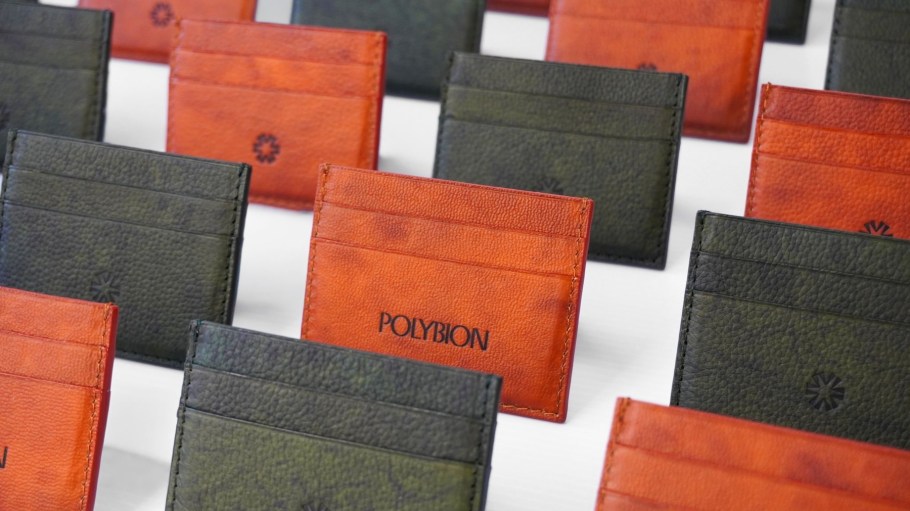
Polybion has celebrated a “milestone venture” last month. The new-generation biomaterials firm completed a full-cycle production of 350-plus corporate kits crafted with its cultivated bacterial cellulose.
The kits were made for Afore Azteca, “one of Mexico’s largest and most influential retirement funds, managing billions in assets and shaping the financial future of millions across Latin America,” per Polybion.
“At a moment when many ESG investments are being paused or delayed, this project moved in the opposite direction,” Polybion said. “It demonstrated that responsible production is achievable when design, science, and manufacturing remain aligned under a single vision.”
Each kit included a notebook cover, a toiletry bag and a cardholder, though all three pieces were conceived as a unified collection—and produced at scale.
“What is often fragmented across several suppliers became, in this case, an integrated workflow handled within the same ecosystem,” Polybion said. “Biology, material science, design and craft, aligned under one vision.”
Backing up a bit: to make Celium, the 2023 Fashion for Good Innovation Program innovator feeds bacteria a steady diet of agro-industrial fruit waste, converting the sugar contents into a cellulose structure as a metabolic by-product. Once this structure is formed, Polybion said, its cell-based membrane undergoes a sustainable stabilization process.
As a result, Celium develops positive performance traits, like strength and breathability. And, given the way bacteria grow, they form cellulose sheets with unique patterns—not unlike snowflakes or fingerprints. Because Celium is cultivated and finished individually, natural variations in texture and translucency make every output unique.
The cultivated bacterial cellulose offers scalability with minimal infrastructure, leveraging existing fermentation technology to produce a versatile, vegan, and organic textile. In the case of Afore Azteca, the design brief requested a “refined and functional corporate gift that would reflect both modernity and responsibility,” the company said.
“Corporate gifts often serve a symbolic role. In this case, they became a material statement,” Polybion continued. “For a leading institution in the financial sector in Latin America, choosing Celium meant placing next-generation materials in the hands of their most senior leaders.”
While the design work for the Afore Azteca collaboration took place at Polybion, its actual production “unfolded” with local manufacturing partners.
“Afore Azteca’s decision to commission a fully traceable, ultra-local collection underscored a growing appetite for materials and products that embody both innovation and responsibility,” Polybion said. “Keeping the process close allowed rapid iteration between sampling and adjustment, direct quality control and a significant reduction in unnecessary transportation.”
Related Stories
Lilysilk x TerraCycle
Gwyneth Paltrow-approved brand Lilysilk has announced the fourth anniversary of its partnership with international recycling firm TerraCycle. Since launching in January 2022, the collaboration has helped recycle nearly 1,680 pounds of otherwise un-donatable silk and cashmere pieces—totaling over 2,800 garments downcycled to date. As of November, the program recycled 425 Lilysilk products in 2025.
“As we mark this four-year milestone, our commitment to the planet grows stronger with every item given a second life,” said David Wang, CEO of Lilysilk. “Our partnership with TerraCycle reflects a shared belief that true luxury lies not only in exceptional quality, but in responsible stewardship.”
The recycling process works like this: users register online, pack up their Lilysilk and send it to TerraCycle using a prepaid shipping label. The textiles are then cleaned, sorted, and recycled into raw materials for products (such as insulation, mattress fillers, and pet bedding). Each recycling shipment yields customers “Lilysilk points” and a discount on their next order.
“Together with our community, we are weaving a future where beauty and sustainability are inextricably linked,” Wang said.
Drip By Drip x Eco Age
“Fashion. Water. Justice.” organization Drip By Drip and sustainability consultancy firm Eco Age have partnered to tackle the ongoing water crisis caused by textile production.
The former is a Berlin-based nonprofit and the first non-governmental organization (NGO) focused exclusively on a water-just fashion system. Since its founding in 2018, Drip By Drip has implemented 114 community water projects, reportedly impacting over 280,000 individuals across the Global South and providing 87,000 with access to clean water.
The relaunched latter is now operating under UK agency Higginson Strategy with the “Fashion. For A Future” vision. Though with founder Livia Firth at the helm, Eco Age developed the Green Carpet Fashion Awards in 2020 as an evolution from its inaugural Green Carpet Challenge a decade earlier.
Now, Drip By Drip has brought on Eco Age to support its next phase—which includes mobilizing engagement and “elevating water justice within the global fashion conversation,” per the partners. The crux of their collaboration aligns with the international NGO’s goal of providing one million people with access to clean water.
“To do that, the work needs to travel further; Eco Age understands how to bring deep issues into the mainstream fashion conversation without losing integrity or impact,” said Amira Jehia, the executive director of Drip By Drip.
Eco Age said the effort is already delivering results.
“Our role is to help ensure their impact is understood, shared and supported across the fashion ecosystem, so it can reach the people and communities it is intended to serve,” said John Higginson, CEO of Eco Age and founder of the aforementioned (and eponymous) “purpose-led” communications firm. “We’re proud to support Drip By Drip with the experience and industry reach needed to help their impact scale.”