Material World is a weekly roundup of innovations and ideas within the materials sector, covering news from emerging biomaterials and alternative leathers to sustainable substitutes and future-proof fibers.
Woolmark

Following a four-year research program by North Carolina State University, Woolmark’s study confirmed that 100 percent Merino wool base-layer garments deliver superior thermal and added performance benefits during stop-and-go sports. The concept, known as dynamic breathability, the Australian Merino wool marketer said, reflects how well the material adapts to changing conditions.
Related Stories
“This is about the ongoing transition from activity to recovery. With wool’s structure designed by nature to enhance wearer performance, it responds in real time to changing physiological needs,” said John Roberts, Woolmark’s managing director. “It automatically keeps athletes close to their comfort zone, allowing 100 percent focus on the challenge—especially in unpredictable and high-output activities, such as cycling or rock climbing, where a base layer is often all they wear.”
Overall, the research found that Merino wool has better performance in real-world conditions.
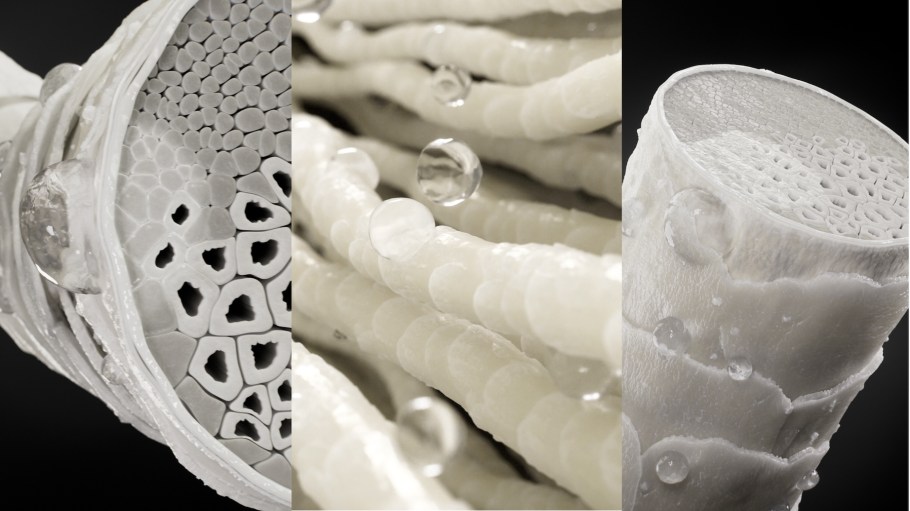
In human trials conducted in a climate-controlled chamber, all fiber types exhibited similar performance during exercise. But only wool maintained its performance during both activity and rest, the key findings indicated. Merino wool’s structure—water-repellent on the outside and water-absorbing on the inside—means it can absorb up to one-third of its weight in moisture vapor without feeling damp, Woolmark said, which helps move moisture away from the body. It also performed
Merino wool was shown to better maintain a consistent microclimate (aka the layer of air between skin and fabric) during stop-and-go activity. This thermal regulation reduces the amount of energy the body uses to maintain its comfort.
Woolmark noted that, although wool’s ability to regulate temperature and respond to ambient moisture is well-documented, standard testing methods often overlook this dynamic capacity “despite its profound implications,” according to a 2023 study published in the international refereed publication Ergonomics.
That said, the research found that wool garments conserved greater thermal comfort and minimized after-chill, the drop in body temperature athletes often experience during resting phases. Compared to other fiber types, wool provided 96 percent better moisture buffering than polyester, 45 percent better than cotton and 26 percent better than viscose.
Wool’s ability to regulate the microclimate next to the skin (meaning Merino can enhance next-to-skin comfort) also contributed to the fiber’s improved comfort, per the marketing arm of Australian Wool Innovation (AWI).
“What this study shows is what athletes have been telling us anecdotally for years,” Roberts said. “That wool breathes, buffers and performs better across a range of real-world conditions.”
Mizuno
Japan-based brand Mizuno announced plans to phase out kangaroo leather, according to a statement circulated by the Center for a Humane Economy.
The Kangaroos Are Not Shoes campaigner referenced reporting by the Financial Times before receiving confirmation a letter from Mizuno on the athleticwear brand’s gradual exit from the controversial trade’s supply chain.
The news comes on the heels of parallel promises from Asics and Adidas. Jennifer Skiff, the director of international programs for the Center for a Humane Economy, confirmed she had “been pressing” brand president Akito Mizuno to “act with deliberate speed” following competitor’s swift sourcing shifts.
“We recognize the concerns raised by your organization regarding kangaroo leather,” said Tomoyo Matsuda, Mizuno’s manager of sustainability issues, in the letter. “At the same time, it is also true that this material has been valued by athletes and consumers for its unique combination of lightness, strength and flexibility. That said, we are currently planning a gradual phase-out of kangaroo leather in our products, although a specific timeline has not yet been finalized.”
Without this timeline on the horizon, the Center for a Humane Economy has requested the “immediate end” of purchasing new skins (and halting the manufacture of any shoes made from kangaroos) by the end of 2025.
“This appears to be a tremendous victory for animals and for the global movement toward ethical business practices,” Skiff said. “Mizuno and its major competitors could no longer deny our stark analysis that their sourcing practices, tied to the inhumane commercial slaughter of native wildlife, were out of alignment with their animal welfare and sustainability policies.”
Carbios
French biotechnology firm Carbios has inked its first multiyear offtake agreements with L’Oréal and L’Occitane en Provence.
“The signing of these two initial commercial contracts with…two demanding leaders marks a key milestone for Carbios,” Vincent Kamel, CEO of Carbios, said. “Validating the brands’ demand and confirming the existence of an established market for rPET derived from enzymatic recycling.”
The beauty brands’ commercial contracts secure Carbios rPET from the green chemistry company’s future commercial plant in Longlaville. Production was paused last December; however, it was anticipated to resume within six to nine months, pending an influx of additional financing.
But with these now-signed contracts, Carbios said, the company has “moved forward in the execution of its strategy,” thereby achieving its objective to sign its first contracts in the first half of 2025 as announced.”
“Today, we have strong momentum to achieve our sales and supply targets, which makes us confident in signing further contracts for our future Longlaville site soon,” Kamel said. “Our commitment to the success of our future plant is stronger than ever.”
The future facility has been touted as the world’s first industrial-scale enzymatic PET recycling plant—and it would have the ability to process PET waste not currently recyclable through traditional means, such as polyester textile waste.
eVent Fabrics
Weatherproof fabric laminate producer eVent Fabrics has dropped a “plant-based and purpose-built” circular fabric collection.
Featuring 11 different laminate configurations across the Kansas-based company’s StormST and WindstormST technology platforms, the collection was “engineered” for recyclability and created to champion closed-loop product systems.
“Circularity starts with design,” said Chad Kelly, president of eVent Fabrics. “With these stormST and WindstormST fabrics, we’re giving brands the building blocks to create products that are easier to recycle at end-of-life—without sacrificing technical performance.”
Featuring 11 different laminate configurations across the Kansas-based company’s StormST and WindstormST technology platforms, the collection was “engineered” for recyclability and created to champion closed-loop product systems.
The resulting monomaterial laminate fabrics are more easily recyclable in textile-to-textile streams. The method uses just one fiber or polymer—a solution that should make mechanical recycling “more feasible” while retaining the breathability and performance expected of eVent.