Material World is a weekly roundup of innovations and ideas within the materials sector, covering news from emerging biomaterials and alternative leathers to sustainable substitutes and future-proof fibers.
Ganni x Ambercycle

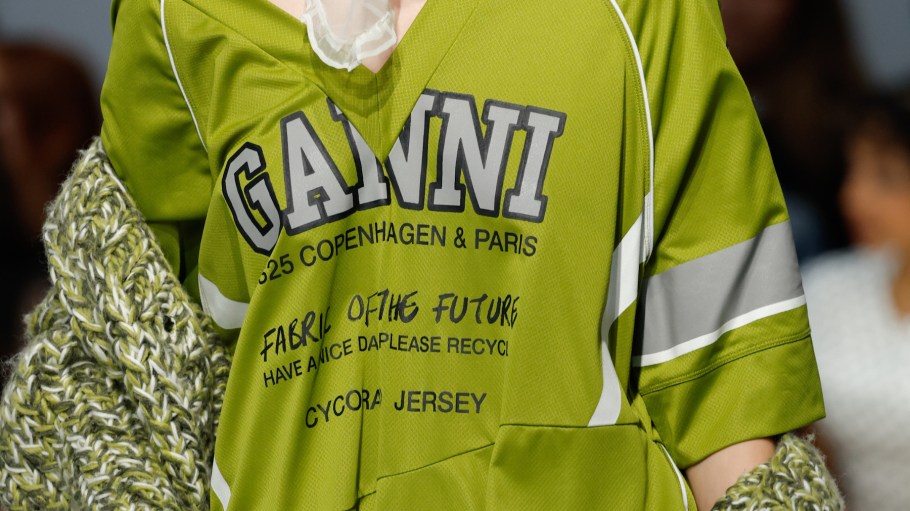
Cult-followed Danish label Ganni has signed a four-year offtake agreement with Ambercycle to secure access to the Los Angeles material science company’s regenerated polyester, Cycora, effectively becoming the “first progressive luxury brand to integrate the innovative material at scale.”
Related Stories
Per the offtake agreement, Ganni agreed to purchase Cycora before Ambercycle has produced it; effectively ensuring the womenswear brand a steady supply of its regenerated polyester from Ambercycle’s first commercial facility once up-and-running. While the facility’s whereabouts remain unknown, its commercial operations are expected to kick off in 2026, following the $10 million investment from polyester partner Shinkong Synthetics.
In turn, Ganni promises to increase the amount of Cycora featured in its collections, starting by swapping 20 percent of its annual budget for virgin and recycled polyester with the Ambercycle alternative: upcycled polyester. Zara’s parent company Inditex brokered a similar commitment in October 2023 with a 70 million euro, three-year offtake agreement. And last October with Arc’teryx.
“At Ganni, we’re always looking for ways to improve and take responsibility for our impact. Partnering with Ambercycle on an offtake agreement for Cycora is a natural step in our commitment to circular, low-impact solutions,” Ganni’s co-founder, Nicolaj Reffstrup, said. “Agreements like this are vital to scaling innovative materials and reducing the fashion industry’s carbon footprint.”
Ganni has been experimenting with Cycora since partnering with Ambercycle in 2021, culminating in November 2023 when the textile-to-textile recycled material joined the “Fabrics of the Future” initiative. This, among other early efforts, “validated Cycora’s high quality and ease of supply chain integration,” the duo said, “laying the foundation for its adoption at scale.”
“There’s an urgent need to support innovators and drive long-term collaboration while holding ourselves accountable for transitioning to better material choices,” Reffstrup said. “We’re excited to see the impact this collaboration will have in the years ahead.”
It seems like a win-win. Ganni gets that much closer to making good on its commitment to have “Fabrics of the Future” account for 10 percent of its material matrix.
“By securing access to Cycora early, Ganni is strategically refining its material library to prioritize solution providers, like Ambercycle, that drive impactful decarbonization,” the company said. Ambercycle, meanwhile, receives validation for its molecular regeneration technology.
“Collaboration is the cornerstone of building a circular future,” Shay Sethi, co-founder and CEO of Ambercycle, said in a statement. “Working with forward-thinking brands like Ganni allows us to take collective, incremental steps toward transforming the fashion system. This partnership is an example of how shared commitment and action can cultivate sustainability achievements.”
SaltEye Studio
Contemporary New York City-based SaltEye Studio brought some environmental edge to the ready-to-wear brand’s first Art Basel.
For an anniversary dinner co-hosted with the Untitled Magazine, an artist local to Miami crafted bouquets of tropical flora local to South Florida. SaltEye Studio, in turn, supplied deadstock leather straps to hold the Flamingo flowers and Lace leaves together. The dinner’s guests were then invited to repurpose the leather straps into wearable accessories—bracelets, necklaces, garters—as to “encourage styling exploration with a nod to bondage.”
“The goal [was] to create something reusable and multifunctional,” founder and designer Prao Leeswadtrakul said. “The leather strap acts as both a gift and an experience that invites guests to play, explore their creativity—and perhaps their sexuality—by slipping the leather straps off the bouquets and onto their bodies.”
The secondhand straps were sourced from the Brooklyn-based textile recycling service FabScrap before SaltEye’s atelier recrafted them into 45 upcycled bands.
Operating “primarily” on a pre-order basis, the female-owned-and-operated brand prioritizes “thoughtful and intentional production and a commitment to ethical labor practices and transparency.”
Reformation
Los Angeles label Reformation has added Circulose to its material matrix.
Working with mills that already have Circulose in supply, Reformation plans to use next-gen cellulosic fiber to help reduce its reliance on resource-intensive materials, specifically silk and traditional viscose. Together, those two materials make up over 12 percent of Reformation’s fiber uptake but nearly 30 percent of Ref’s material carbon emissions.
In fact, Circulose has already been incorporated into a few Reformation pieces: the Zephyra Dress, Susie Skirt, Reishi Dress and Elani Top. The garments, ranging between $128-$278, are described as lightweight, crepe de chine (CDC) fabrics made from 70 percent viscose and 30 percent viscose made with Circulose recycled from textile waste—which is one of two fabric qualities the RefRecycler is using to test against.
The other is called “crepe,” which Ref described as a more one-to-one swap for its current viscose recipe. It is made from 55 percent viscose and 45 percent viscose made with Circulose. The plan is to introduce the recovered cellulose in two or three core fabrications this year, in support of the It Girl brand’s more holistic goal to reduce its reliance on virgin materials and successfully become Circular by 2030.
“We are developing and testing a number of alternatives for both, knowing that there isn’t a one-size-fits-all substitute for either given how widely we use them across our product assortment,” the company said. “Our goal, though, is to eliminate both virgin fibers from our sourcing altogether in the long term.”
Coyuchi
Organic home textiles maker Coyuchi announced its expansion into new categories with the debut of its first-ever mattress.
The resulting, USA-made-to-order “natural REM mattress” consists of organic and recycled materials, used instead of blended fabrics for their reduced environmental impact. Those “greener” materials—like cotton, wool and Dunlop latex—then “come together to deliver exceptional comfort, durability and temperature regulation.”
“At Coyuchi, we believe that luxury and sustainability can—and should—coexist,” said chief digital officer Vicky Grahan. “Our new mattress exemplifies this philosophy. We’ve created a product that prioritizes comfort and support while respecting the planet, offering a healthy sleep experience that’s as thoughtful as it is restorative.”
The mattress’s 100 percent wool padded layer is a natural flame retardant, negating the need for additives. Its dual-coil design system (2,420 individually pocketed coils in a queen size) promises “restful sleep for all sleep styles.”
“The average person spends one-third of their lives asleep, so it’s important for us to know that the materials we’re sleeping on are safe, natural, and chemical free,” Grahan said. “Customers can sleep soundly knowing that our mattress prioritizes organic materials for clean rest.”
The mattress retails between $1,400-$2,400.