Material World is a weekly roundup of innovations and ideas within the materials sector, covering news from emerging biomaterials and alternative leathers to sustainable substitutes and future-proof fibers.
Fashion for Good

Global initiative and collaborative platform Fashion for Good has launched the Next Stride: Bio-Based Materials for Footwear Soles. The 12-month project will work to renovate the $400 billion footwear industry, per SkyQuest Technology’s calculations, by reimagining one of its most essential components: the sole.
Related Stories
“The Next Stride is a critical, collaborative intervention to de-risk the widespread adoption of high-performance biobased alternatives for footwear soles,” said Katrin Ley, managing director of Fashion for Good. “By transforming the very foundation of the shoe, we address the most impactful component in its lifecycle and open the door to systemic change in the footwear industry.”
The Next Stride is in partnership with Adidas, Target and Zalando, alongside material innovator firms Algenesis Labs, Balena, Evoco, Kuori and Yulex.
Adidas, for one, will work with the next-gen innovators on that exploration, said Gudrun Messias, a sustainability director for the German giant—on one hand, determining whether or not biobased inputs have an eco-impact on footwear sole production and, on the other, measuring how they perform and prevail in comparison to the company’s standards and its consumers’ expectations.
The initiative will test, and later validate, how biobased polymers perform as alternatives to the hydrocarbon-based ones. These fossil fuel-based polymers—more commonly known as polyurethane (PU), thermoplastic polyurethane (TPU) and ethylene-vinyl acetate (EVA)—are generally what’s used to make soles. And the sole is what drives the shoe’s carbon footprint—some 40 percent of its total mass.
“As we have recently confirmed in our sustainability attitude-behavior gap report, consumers aspire for more sustainable choices,” said Pascal Brun, vice president of sustainability and D&I at Zalando. “We believe innovation in materials is key to meeting that demand. The Next Stride brings together the right partners to reimagine the sole—the foundation of every shoe—and set new benchmarks for the industry.”
Collectively, the project will examine how the innovators’ biobased materials perform, as to match the various performance standards required by partner companies, the Amsterdam-based initiative said. That process begins with material assessment, performance mapping and testing—resulting in a prototype. After that validation phase, the prototypes will be tested in collaboration with SATRA. The independent research organization with over a century of experience in the footwear field will examine the next-gen input’s performance and environmental impact against that of traditional inputs.
Ideally, the findings will lead to future developments for larger-scale adoption of making soles with biobased materials.
TomTex
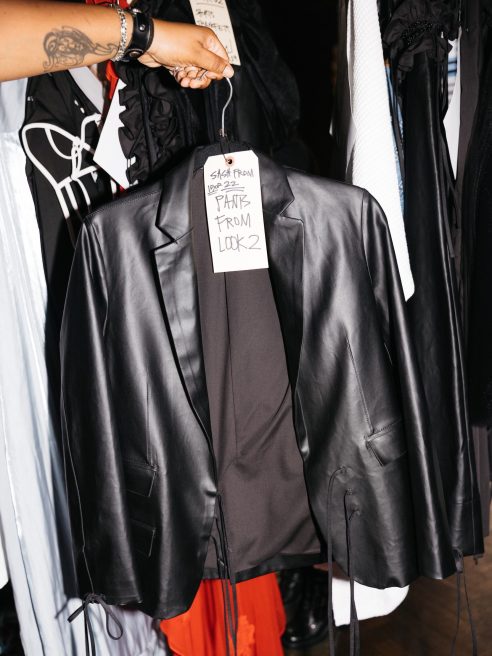
Leather alternative firm TômTex unveiled its latest biomaterial innovations at New York Fashion Week, in collaboration with womenswear line Allina Liu and Providence-based textile artist Gabe Gordon for their respective SS26 collections.
Engineered through a proprietary process that mirrors nature, the new material is derived from biological foundations—resulting in a next-gen textile that drapes and feels on par with natural fibers.
At Allina Liu, TômTex was cut and tailored into a black suit jacket, leather-like pants and a mid-length skirt with intricate details showcasing both structure and drapability. Gabe Gordon presented two variations of moto-inspired trench coats—a midi length for women and a cropped version shown with men’s styling—to highlight the textile’s durability and edge.
Made with zero fossil carbon content and completely biodegradable, the plug-and-play material features luxury tactile properties matching premium leather with programmable texture, finish and form capabilities.
Refiberd x GenuTrace
Forensic supply chain verification firm GenuTrace has inked a strategic collaboration with textile recycling startup Refiberd to deliver a dual-layer validation system. That system combines forensic science and artificial intelligence to verify the authenticity and origin of fiber, yarn and fabric.
“We ask one question: ‘If you claim it, can you prove it?’ Verifying fiber and yarn composition before fabrication means that sustainability claims are not just aspirational; they’re scientifically proven,” said MeiLin Wan, founder and CEO of GenuTrace.
The collaboration calls on brands and manufacturers to “trace it before you make it,” which can be done using the baseline for virgin and recycled materials developed by GenuTrace and Refiberd. The partnership combines Refiberd’s AI-enabled hyperspectral imaging technology—capable of classifying fibers, yarns and fabrics by their spectral fingerprints—with GenuTrace’s forensic stable isotope analysis that verifies the geographic origin of cotton. The resulting two-step system works to provide confidence in feedstock claims before the fabrics are produced.
“To manufacture effectively, you must first know what you’re working with—down to the fiber. With our AI-enabled hyperspectral system, we can precisely verify cotton-based materials before they’re made into fabric,” said Sarika Bajaj, Refiberd’s co-founder and chief executive officer. “It may seem simple, but this validation is the critical foundation for making textile processes scalable and reliable.”
DSC
Performance foam manufacturer DSC just dropped a next-generation foam technology for the sustainable footwear manufacturing sector. Durapontex L-TAC is engineered to mold at lower temperatures—at 120 degrees Celsius as opposed to the industry standard of up to 190 degrees Celsius—in turn, reducing energy usage and carbon emissions.
“With Durapontex L-TAC, we’re proving that sustainability and design innovation can go hand in hand,” said Mei-Fen Wei, chief operating officer of DSC. “By reducing energy by up to 50 percent and giving designers the freedom to work with materials that were previously off-limits, L-TAC represents a real step forward for the footwear industry with a smarter, greener approach to manufacturing. Every pair truly counts.”
DSC’s internal testing lab shows up to a 50 percent reduction in energy usage and carbon emissions per pair without sacrificing performance, compared to traditional closed-cell foam. Traditional closed- or open-cell foams require high processing temperatures that can limit the use of delicate fabrics such as leathers or specialty synthetics. Durapontex L-TAC prevents such heat distortion. Its technology requires no new machinery or retooling, easily integrating into existing production lines and ready to deploy into high volumes.
Nilit
Nilit’s first Sensil brand, dedicated to modern, conscious luxury, was previewed during Première Vision Paris. The global manufacturer showcased a selection of fabrics made by European manufacturers using Sensil nylon 6.6 fibers.
“Sustainability is as important to us as performance, longevity and aesthetics,” said Ilan Melamed, Nilit’s general manager. “Truly premium products like the Sensil Signature program must deliver on all these aspects to be appreciated and embraced by today’s luxury market consumers.”