Material World is a weekly roundup of innovations and ideas within the materials sector, covering news from emerging biomaterials and alternative leathers to sustainable substitutes and future-proof fibers.
Bluesign x Black Pearl

A 2019 Censuswide study found that people buy about 7.5 million outfits each year for music festivals and only wear them once. The UK consultancy reported that the single-use fashion market for festivals alone is worth about $307 million.
Related Stories
These findings pushed the Los Angeles-based, female-founded startup Black Pearl to look for real solutions. The company started the No Single Use Fashion campaign with Bluesign to “shift the needle on sustainability” and challenge the habit of wearing festival outfits only once.
“Fashion and music shape how we see the world, so they also shape how we impact it,” said Samata Pattinson, founder and CEO of Black Pearl. “No Single Use Fashion is about shifting culture as much as shifting habits. When fans, artists and makers choose to rewear, customize or cherish what they already own, they’re proving that creativity doesn’t depend on disposability.”
Merging fashion and music, the initiative seeks to redefine fashion norms at live events by encouraging sustainable choices. Its objectives are to inspire fans, artists, and event organizers to wear, rewear, or customize outfits, replacing single-use fashion with creative, lasting alternatives. Partnering with Bluesign helps tie personal sustainability choices to responsible production.
Building on the Coachella collaborator’s recent series of sustainable fashion city maps—designed to guide fans along Billie Eilish’s “Hit Me Hard and Soft” tour toward standout secondhand solutions—Black Pearl is now shifting from inspiration to activation. As a result, participating artists will promote the campaign before and during shows, encouraging their audiences to pledge and share sustainable looks. Each event will be able to track its collective impact, giving fans tangible insight into the difference their choices make.
“Music moves people; fashion should, too—just not toward waste,” said Barbara Oswald, chief commercial officer at Bluesign, which acts as a third-party partner to assist companies in achieving sustainable progress. “We partnered with Black Pearl because this campaign proves that sustainability doesn’t kill creativity, it amplifies it.”
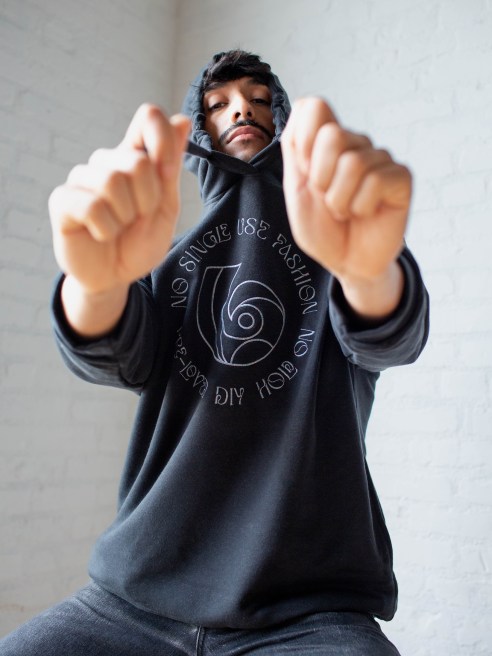
The campaign asks fans to take one of three pledges: wear secondhand clothes, get crafty with their closet or hold on to the final fit for at least nine months to reduce waste and extend garment life. Designed in collaboration with Bluesign, the campaign merchandise “demonstrates a cleaner, safer way forward using the system’s certified-responsible chemistry,” per the partners. The capsule includes an organic cotton T-shirt and a regenerative hemp hoodie, with a portion of proceeds to support organizations connecting music and sustainability.
“Clean chemistry, conscious choices and cultural influence all have the power to shift the fashion industry from disposable to responsible,” Oswald said. “When artists, fans and manufacturers unite around that message, we turn concerts into catalysts for change.”
Fulgar x The Lycra Company
The Lycra Company and its partner and distributor, Fulgar, hosted the Prato Textile Summit last month in Italy. The event focused on securing the “future of one of the most representative industries of Made in Italy” by highlighting innovations and technologies for the sector.
“The choice of Prato is no coincidence: a production ecosystem where manufacturing tradition meets digital transition, local roots meet global openness, giving life to products recognized worldwide,” the partners said in a statement. A strong focus on the uniqueness of the Italian supply chain and a systemic approach define this initiative.”
These same principles also inspire The Lycra Company’s “All In” positioning—its “continuous commitment that goes beyond any single project,” the global fiber manufacturer said of its vision, which is equally embraced by Fulgar, too. While Lycra emphasizes creating shared, collective (covering partners and local communities) value through innovation, Fulgar—moored by its eco-innovation industrial strategy—can “strengthen the link” between research and regions for a more “circular textile supply chain.”
Lycra said it chose Prato as it “represents the heart of Italian textile excellence.”
“Presenting our innovations here, such as the renewable Lycra EcoMade fiber, means engaging with those who set the industry’s standards and can transform technologies into products,” said Ettore Manfrotto, brand and retail account manager at The Lycra Company.
“The new fiber requires no changes to existing processes and reduces carbon dioxide emissions by 44 percent, while maintaining the performance that has made Lycra a global benchmark.”
Fulgar, too, found Prato to be a crucial, collaborative district.
“Here, expertise, tradition and a strong capacity for innovation come together, enabling the transformation of sustainable yarn research into concrete, high-value applications,” said Daniela Antunes, marketing manager at Fulgar. “Collaborating with this ecosystem means taking part in a virtuous process that combines technical excellence and responsible vision, generating solutions that strengthen the entire Italian textile chain and its international competitiveness.”
Balena x Stella McCartney
Stella McCartney’s S-Wave Sport Sneaker, made with Balena’s proprietary BioCir Flex, has been named by Time Magazine as one of the Best Inventions of 2025 for Time 100 Climate 2025.
“This collaboration with Stella McCartney marks a milestone not just for Balena, but for the future of materials,” said David Roubach, founder and CEO of the materials science company. “Being featured in Time’s Best Inventions showcases the global momentum behind circular innovation and validates the work we’re doing to redefine what’s possible with next-generation materials.”
The shoe’s sole is made from Balena’s BioCir Flex: a non-toxic, compostable, recyclable and biobased alternative to traditional plastics. BioCir Flex absorbs impact, responds to motion, is as durable as TPU and as flexible as rubber. It is also dyed with natural cinnamon. Made from sustainable sources—like castor beans, oils and polysaccharides—BioCir Flex biodegrades into renewable biomass when composted in industrial facilities or can be recycled for continuous use.
“Every part of it incorporates conscious materials,” Stella McCartney said. Engineered from biodegradable polymers and plant-based components, it’s as durable as polyurethane and as flexible as rubber, but “can be recycled or composted—leaving no waste or negative impact on Mother Earth.”