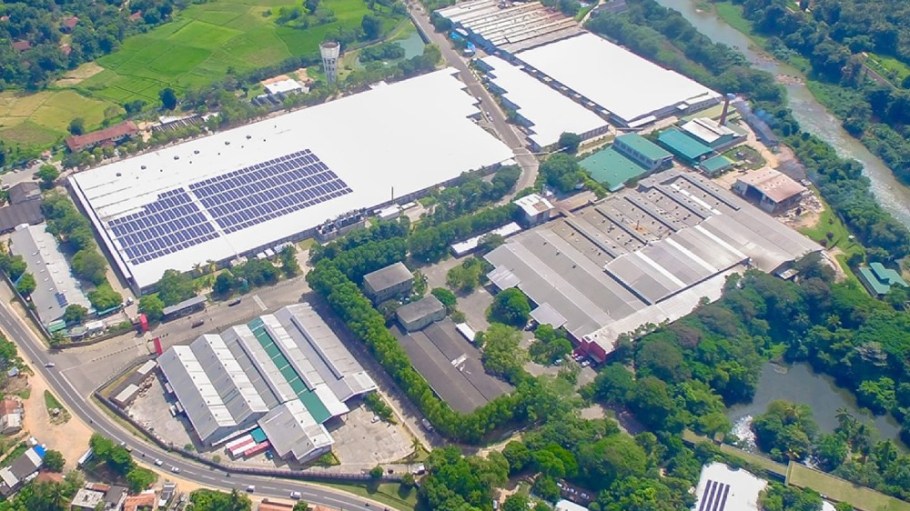
MAS Holdings, the largest apparel manufacturer in South Asia has committed to making 75 percent of its revenue from sustainable products by 2030.
Sharing highlights of its new five-year Plan for Change that runs from 2026 to 2030, Nemanthie Kooragamage, director Group Sustainable Business at MAS Holdings told Sourcing Journal said that revenue from sustainable products has been a growing focus in recent years, rising from 28 percent in 2023 to an approximate 42 percent this year. This is just short of the 2025 target of 50 percent.
Related Stories
“The main focus of the 75 percent goal through sustainable products is scaling textile-to-textile circularity, recycling efforts across fiber types, focusing on materials of the future made from non-finite resources which are comparable in feel and performance, and increasing the use of natural fibers sourced through regenerative or equivalent business models,” she said.
Mahesh, Ajay, and Sharad Amalean founded MAS in 1987. Now, with a turnover of approximately $2 billion, 53 manufacturing facilities globally and 100,000 employees, the company operates in 13 countries including India, Indonesia, Bangladesh, Vietnam, Kenya, Jordan and the United States. Partnering with brands such as Nike, Speedo, and Victoria’s Secret, MAS produces a wide range of products, from intimate wear to sportswear and swimwear.

Sustainability has been a growing focus. Suren Fernando, chief executive officer of MAS Holdings, observed: “During the good times and the hard times, doing the right thing has been a principled, strategic choice that has been championed by our shareholders and senior leadership. The fact that our business strategy and sustainability strategy have always been intrinsically linked has been a prominent contributing factor leading to our success as well as many other peers in our industry.”
Included in the 2030 objectives are new measures to meet the urgency of climate, social, and industry-wide challenges. This measurable framework is aligned to three focus areas—Product, Lives, and Planet—and functions as a business transformation strategy that applies the same rigor as MAS’s core operations. With 70 percent of its workforce being women and operations spread across multiple geographies, the new commitments prioritize addressing women’s disproportionate care responsibilities by providing support for childcare and eldercare, while emphasizing climate adaptation in vulnerable communities.
MAS’ supply chain initiatives will target Scope 3 emissions and deepen traceability. On biodiversity, the company will align with the globally recognized Science Based Targets for Nature, ensuring accountability, setting clear ecological boundaries, and transparently tracking impact beyond its own operations.
“We spent almost 12 months developing our 2030 commitments and our strategy keeping up with what’s happening around us, but also in the industry. Forum for the Future was engaged as our thought partner—we know the space well, but having an organization from the outside looking in also helps keeps things very objective. Part of the process was to conduct a very comprehensive stakeholder engagement, with our suppliers, customers, peers, and organizations like the United Nationas and the International Labour Organization (ILO). We also did a future horizon scan—to understand where stakeholders will be in 2030, including consumers. Based on that, we’ve come up with 10 commitments that are fundamentally similar to what we had before, but pivoted for greater impact,” said Kooragamage.
She explained that when Plan for Change was launched in 2020, the Product pillar was an important addition to the two other pillars which included Social and Environment.
“We had 10 commitments under different pillars and have spent the last five years in driving these. While each pillar was driven with enthusiasm earlier, but bringing them together holistically made a big change in the mindset of the organization in driving the plan together,” she said, while adding that although there were hiccups, and not all innovations came through it was clear that ‘a lot of progress was made toward very ambitious targets’.
Some of the highlights of the past five years include growth across all three pillars—Product, Lives, and Planet. “We have a lot of confidence in how we can get different parties to think out-of-the-box,” she said.
Under the Lives category is the important issue of labor.
“For the first time, we are putting a stake in the ground in terms of a roadmap—not only in Sri Lanka but across 10 other countries, looking at our entire manufacturing footprint and how we address wages. This also includes the physical, mental, and economic impact on women,” she said. “There is a lot of ambiguity in the conversation on wages. We will work to cut through the noise and focus on what’s best for our teams. That’s the biggest shift we are making for 2030. It’s not something we’ve spoken about a lot before, but we are doing it internally, and this time we will take that stance.”
On the environmental front, the 2030 goals are equally ambitious—80 percent emissions reduction, 30 percent of raw material waste converted into circular loops, and ecosystem restoration. Microfiber emissions remain an important area where knowledge still needs building, along with biodiversity and ecosystem rejuvenation, and community resilience.
“We are addressing climate mitigation, but climate breakdown is all around us. We see how often climate disasters occur, so a big new area we’re taking on is working with our communities on adaptation — through education, awareness, and capacity building,” Kooragamage explained.
Among the challenges ahead is the alignment of external factors. For example, emissions remain one of the biggest challenges, even after the Sri Lankan government’s management of the energy crisis in recent years, she said. “There are still unknowns, and what we’re looking for in Sri Lanka is more consistency in terms of policy—country policies have to evolve at the same pace. In terms of opening up for investors and allowing them to take up investments without government risk. Those are risks you have to deal with when making targets.”
There is also the impact of how the rest of the stakeholders hold up their end of the bargain. “If you look at our top 10 to 12 customers, they represent almost 75 percent of our business. Their 2030 targets are very aligned with ours. Brands are also very selective about who they work with, as are we, and there has been careful selection on both sides to ensure similar value systems,” Kooragamage said. Adding that the other part of it was the connections with many tiers of suppliers. “So, it is a mix of supply chain partners and our brands. Supply chain decarbonization isn’t something one vendor can do alone, however big they are — the supply chain has to come together,” Kooragamage said.
Acquisitions and alliances will be important on this road ahead too. “We are closely working in the nylon space to see who we can partner with. It might not be an acquisition but an investment in technology or a meaningful alliance where we become the development partner. That will be key. There will eventually have to be some consolidation to make partnerships meaningful. Alongside that, we are focusing on traceability and closer connections with our alliances to drive innovation and transparency,” she said.
Reflecting on her own role in steering this transition, Kooragamage said the shift from her earlier roles leading the PVH and European businesses had been significant. “This has really been a shift from what I was doing earlier, but one of the things that has defined this journey s is the fact that sustainability is integrated into the entire system—we are not competing for innovation or struggling to get funds. The founders and the entire team understand that innovation and sustainability are not competing priorities but inseparable drivers of progress.”
What makes this role so fulfilling is that you engage with team members, the community, and the environment,” she said “It’s personally fulfilling because you are empowered to drive an agenda that positively impacts all these areas. For me, that’s what makes it meaningful. Those of us working in sustainability get to walk the talk—and that gives real purpose. I don’t feel helpless because this isn’t a personal agenda, it’s one owned by the leadership and the wider community that wants to stand behind it,” she said.
Given the ambition and scale of change in the plan to 2030, as the world itself realigns its sustainability targets and agendas, including the European Union which accounts for 25 percent of MAS exports, the plan appears to be driving a challenge that sets the goal for the industry in the region.