Sourcing Journal’s second annual Los Angeles Sustainability Summit will take place on Nov. 13, bringing together the West Coast’s most prominent innovators and fashion stalwarts, from brands to manufacturers and those at the forefront of the industry’s material and component breakthroughs.
2025 hasn’t been a normal year for the industry, or for sustainable initiatives. Discourse has been all but overtaken by geopolitics and the economy, with many in the sector wondering how to keep their businesses afloat, much less champion social and environmental advancement. In recent years, sustainability has gone from a “nice to have” to a “must-have,” and now, it’s boomeranged back to an “if we can.”
Related Stories
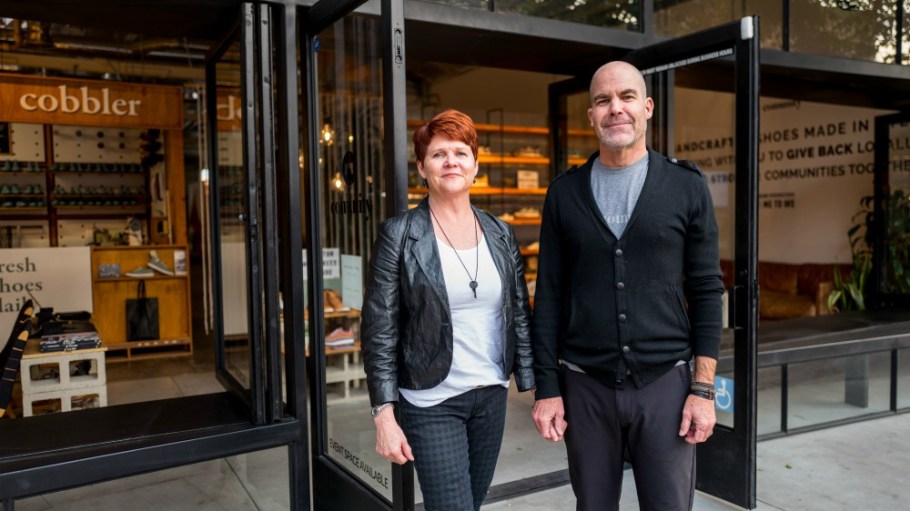
Sourcing Journal caught up with the husband-and-wife team, Sean Scott and Shannon Scott, at the helm of L.A.-based footwear manufacturer ComunityMade, to talk about how these shifts are impacting the onshoring and nearshoring movements and brands’ appetite for sustainable production.
Founded in 2017, the company focuses on small-batch production using high-quality and bio-based materials. As its name would suggest, ComunityMade has become a nucleus for a growing network of producers looking to join forces in providing an alternative to the status quo of offshore sourcing: overproduction, cheap, low-quality wares, and a supply chain that has become impossibly disconnected from its end market.
“For ComunityMade, I think we tend to focus more on the root causes rather than the quick fixes,” Sean Scott, the company’s CEO, told Sourcing Journal, referring to the issues at the heart of the fashion industry’s issues with waste. “We reduce, reuse, recycle—and that’s in order of priority. We build for longevity and durability, making the best use of materials, and then we actually execute the repairs.”
Located in the heart of Downtown near the Arts District, the small factory has made an outsized name for itself in less than a decade with some of the biggest brands in the game. The Scotts, both veterans of the shoe industry and household name brands like Toms and Asics, have the experience to back up the expertise they’ve been doling out over the past eight years. Much of it centers on a singular theme: There’s a better way.
After witnessing (and ultimately being driven away by) the sheer volume of waste created by the industry and the harm it leaves in its wake, the Scotts are dead-set on creating a new American supply chain that allows for closer-to-home production in smaller volumes. Because of the agility of their operation and their proximity to the end market, they operate basically on demand. “A lot of it is about reduction of quantities; we’re not mass-producing, we hold minimum stock,” so there’s not much product languishing on shelves or relegated to discount piles, Shannon Scott said.
“At first, it felt awkward to be telling these established, experienced people how things should be done here and why they should be doing it this way,” Sean Scott said. “Shannon always talks about managing up, which is something she’s very strong at. Now, I think we’re pretty comfortable that they’re coming to us to help understand these things, since we’ve been steeped in this environment, this project, this movement, for eight years now.”
But there’s still often some cajoling and some cheerleading goes into discussions about moving toward more sustainable operations, even if it’s just for a single shoe or a capsule collection.
“To give them credit, they’re interested in doing the right thing as well. Some of these are public companies and they have shareholders to answer to,” he added, but more recently, there’s an understanding of the upsides of doing business in L.A. “They’re coming to us for the sustainability advantages, the speed advantages.”
According to Shannon Scott, it’s often the out-of-the-box thinkers at brands that take the first step toward working with ComunityMade, which has in recent years been at the forefront of incorporating new circular and bio-based materials into its creations, from Natural Fiber Welding’s (NFW) Mirum to Blumaka’s regenerated midsole foams. “It’s usually their innovation teams that we work directly with, so they’re maybe less encumbered by the numbers,” she said. “We’re still managing that part of it—giving them all the tools to explain to their product teams why this is such a benefit for them.”
The untrodden road they’re traversing is riddled with obstacles, both when it comes to bringing brands into the fold and amassing a stable of, well, stable production partners. NFW, for example, made the decision to wind down operations on its production of alt-leather last month, which sends ComunityMade back to the drawing board for a vegan alternative to traditional leather.
“They had fantastic products, and we’ll keep looking for the next NFW,” Sean Scott said. While the Scotts extoll the virtues of animal hide leather—its durability and biodegradability among them—they are constantly on the hunt for new solutions that offer parallel performance with a smaller carbon footprint and broad consumer appeal.
“The latest we’re working on involves additive manufacturing and 3D-printing,” he added, initiatives they’re carrying out with local partners. Rather than die-cutting the foam needed to execute a midsole, leaving excess cuttings unused, the factory is working to “replace that wasteful foam midsole with something 3D-printed and tailored to the exact right size.”
Such projects and partnerships are key to the factory’s continued success, he believes. Evolution is, at this point, existential. “We don’t want ComunityMade to be traditional Made in America; if local manufacturing and domestic manufacturing is going to take off, it’s going to have to be innovative,” he added.
With Trump’s tariffs as a backdrop, though, the Scotts and their network are dealing with new and nuanced problems. While the duties were meant to drive companies to produce more in the U.S.—some have, and some are exploring—there’s also deep anxiety among consumers and the private sector about the state of the economy, and experimenting with new materials or moving production to a labor market where costs are exponentially higher (L.A. boasts one of the highest minimum wages in the country) isn’t a strategic imperative.
“They’re more focused on a bottom line than ever before,” Shannon Scott said of the firms they’ve spoken to. “You have to imagine the tariff impact; that’s just dollars straight off the top of their margins. Does the brand have to raise prices to recoup that? Probably. So yes, sustainability has fallen a little lower on the priority list.”
It’s understandable that that’s where people’s energy is focused, she believes. “They are dealing with fires on the daily; they get it sorted and then something changes and they’re back to the drawing board again. It’s uncertainty that’s creating a lot of the chaos,” she added.
Watching sustainability departments being dismantled and the industry miss its environmental goals has been tough to stomach, though. Sean Scott said he’s also been disappointed about the lack of discussion about human rights and sustainability alongside the talk about tariffs.
“Most favored nation status and the easing of tariffs is supposed to be given to countries as a benefit of having good human rights and sustainability practices,” but over recent decades, trade policy has been used more to benefit the American economy than to support diplomacy and economic growth in developing nations, he believes. Now that Trump’s tariffs have arrived, the transactional nature of these dealings has increased tenfold.
With that situation as a backdrop, Shannon Scott said she believes that for many brands, sustainability has reverted back to “a nice to have—not mandatory.”
But pulling back is not a choice for ComunityMade. “Our whole business was set up to benefit people and planet over profit. Of course, profit has to be there; you don’t exist if you can’t keep the machines oiled,” she said. “It’s a little disheartening, but there are enough of us out there that are still very committed to figuring it out.”
For more information on the Los Angeles Sustainability Summit, click here.