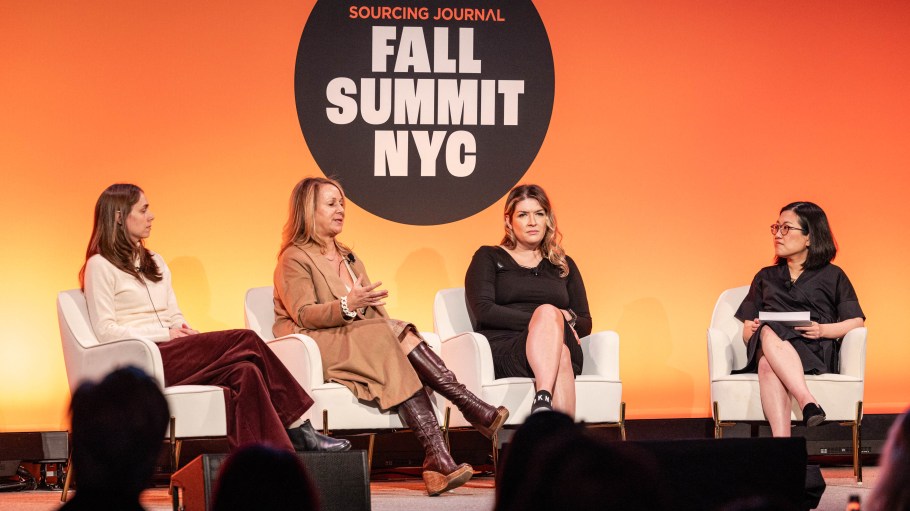
Regardless of a company’s position in the supply chain, everyone has a role to play in building a more sustainable fashion system. During the “Sourcing: Sustainable Foundations” panel at the Sourcing Journal Fall Summit on Nov. 2, moderated by Jasmin Malik Chua, sourcing and labor editor at Sourcing Journal, speakers discussed the critical need for collaboration—from external partnerships to internal mobilization—to advance sustainable investment and innovation.
“You have to have a commitment from the top down. And if you don’t, then you really can’t get anything done,” said Liz Hershfield, senior vice president, sustainability at J.Crew Group and senior vice president, sourcing, Madewell, about the importance of an organization-wide shared purpose. “With that commitment, you have to have collaboration within the company; it has to be everyone’s priority.”
Related Stories
One program that has united the company is J.Crew’s Re-imagined collection, which features goods made with sustainable materials such as organic cotton, produced by eco-friendly, Fair Trade Certified factories. This initiative touches design, product development, manufacturing and social responsibility. “It’s really a North Star for us to work towards and allows us to think about how we innovate and push the envelope on things and really challenge each other to do better,” Hershfield said.
External partners should also be on the same page when it comes to sustainable objectives. Although Lenzing sits upstream in the supply chain as a raw material supplier, it has its own suppliers for wood pulp. The company adheres to a stringent wood sourcing policy and stipulates certifications such as Forest Stewardship Council (FSC). “Everyone who is entering our production practice also has to meet a very high standard that falls in line with our sustainability commitments,” said Ashley Buchalter, business development manager at Lenzing. “And that’s the kind of partnerships that we want to keep practicing.”
Brands’ requests don’t always align with a manufacturer’s own targets. Katie Tague, vice president, denim marketing & sales at denim mill Artistic Milliners, said that she has never witnessed a brand be “too ambitious,” and the mill’s role is “bridging the gap” to help clients do more than they initially considered possible. “I always like to work with my brands and make sure that we don’t keep from taking that first step just because the marketing story isn’t 100 percent,” she said.
Consumer demands also cause a disconnect. Stretch denim remains popular, but conventional elastane does not biodegrade, and it complicates denim recycling processes. Artistic Milliners is working with fiber scientists to develop sustainable solutions that will resonate commercially. “I want to work with [clients] and try to meet the needs of the end consumer, what they want, but also not forget what the planet needs,” Tague said, adding that a “bright spot” is that the discussions are happening.
Shoppers often say they want sustainability, but Hershfield sees purchase decisions being led first by “great product.” Eco-friendly, ethical practices can, however, impact customer loyalty. “The customer will come back and repeat, because you have the product they want but also they really trust you because they know that you’re actually doing things that are contributing positively to the environment and to people,” she said. “But unfortunately, it’s just proven that it just doesn’t sell product.”
Collaboration between brands and manufacturers should also encompass knowledge sharing. Buchalter said that if brands communicate their assortment goals and target customer profile, Lenzing could set aside fibers or assist companies in plan their merchandising strategy to help products resonate with shoppers. Also stressing the importance of information, Tague mentioned that understanding customers’ needs helps Artistic Milliners decide to make investments, such as its in-house recycling facilities.
Creating sustainable change comes with costs, and often the investment falls to manufacturers. “Infrastructure is never sexy,” said Buchalter. “People don’t really want to foot that bill, but somebody has to do it.” When it comes to filling in the holes in the circular infrastructure—including around take-back initiatives and sorting—she said it is going to take collaborative research and development due to the amount of capital needed.
According to Hershfield, downstream companies also have a part to play in supporting manufacturers’ sustainable improvements. “Long-term commitments are really important, knowing that we’re not going to ask you to do this and then walk away from you,” she said. “We as an industry have to coalesce to make sure we take care of the suppliers because they can’t do it by themselves.”