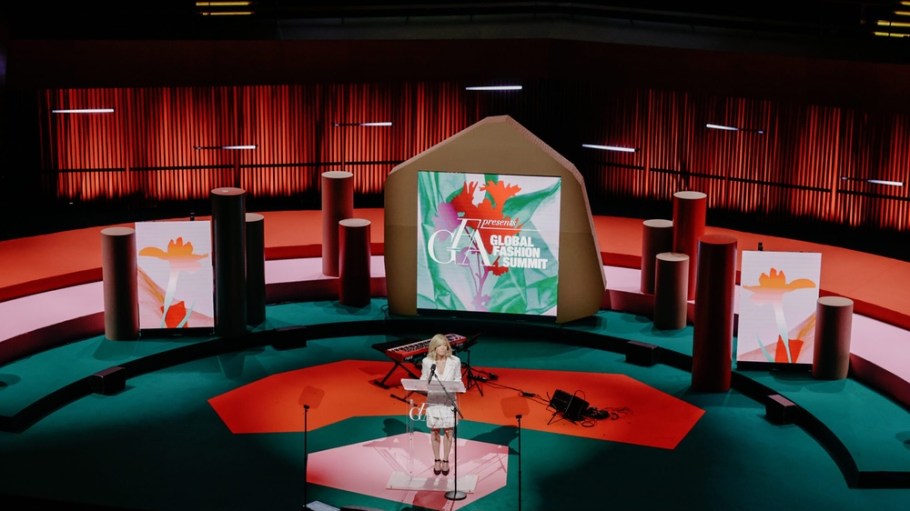
If Federica Marchionni, CEO of Global Fashion Agenda, sometimes feels like a broken record, she tries not to show it.
But she admits that her cheery and seemingly indefatigable demeanor wobbled at the start of the year, just as her team was putting the finishing touches on the latest Global Fashion Summit in Copenhagen. In fact, part of her wondered if they would be able to throw the event at all when it felt like the industry’s sustainability momentum was being derailed by one geoeconomic shock after another.
Related Stories
“I felt daunted as never before,” she said. “It was so difficult to find voices that wanted to lead the way. But then what I started to notice was that, well, maybe people are not as loud as they used to be, but they’re working very hard to make things happen, to keep the long-term perspective. And I felt like my own leadership could be a catalyst for bringing the community together.”
Marchionni said that the only certainty amid the widespread volatility caused by wars and tariffs is climate change. Broiling temperatures aside, extreme weather events like drought, flooding and wildfires are becoming frighteningly common, resulting not only in the loss of human life but also completely upending supply chains. It’s why she sees repeating herself not as a waste of time but as an investment. Global Fashion Agenda has likewise continued to tout the need for greater corporate ambition with the semi-annual publication of its CEO Agenda, which entered its seventh edition in the middle of an especially heady Climate Week in New York City.
The paper’s five priority areas—respectful and secure work environments, better wage systems, resource stewardship, smart material choices and circular systems—have “continued relevance” in creating meaningful systems change, Marchionni said. Equally familiar to longtime skimmers of the report are her exhortations for why more tangible action is needed: the pace of progress is still too slow, sustainability cannot be viewed as a siloed function and the cost of inaction is greater than any expenditure to keep sustainability in motion. Most of all, time is running out. 2030 might as well be tomorrow.
“It’s definitely much sharper in terms of urgency,” she said of the latest CEO Agenda. “Even if you know where to go, you have to act now.”
What’s different about this edition, however, is the addition of what she describes as “cross-cutting accelerators” that, leveraged well, can promote industry-transformation beyond incremental change. They were also the themes that the Copenhagen summit organized itself around: innovation, capital, courage, incentives and regulation.
Those with defined frameworks, like capital, innovation and regulation, are more or less self-explanatory. Advanced technologies, financial investment and well-designed policies are all major unlocks that can break through the status quo paralysis. So can aligning rewards to drive the motivation to reshape behavior and “make sustainability not just aspirational, but operational.”
And courage? As conceptual and amorphous as it may be, it could also be the most important lever of all, Marchionni said. It takes a certain amount of defiance, she said, to resist short-term pressures and continue to champion sustainability through bold decisions that demonstrate genuine commitment to workers’ rights, help scale preferred production systems or significantly reduce absolute finite resource use. Conversely, it’s the lack thereof that results in what has come to be known as “greenhushing” or rolls back social and environmental objectives in favor of a fleeting boost to the bottom line.
The need for the top of the org chart to buy into that strategy is also why the paper is called a CEO Agenda and not a Corporate Agenda.
“Sometimes within a company, the CEOs are the ones who need to be more convinced, because even when their team is convinced, there is a tension between what they need to pursue in terms of results, growth and shareholder values,” she said. “But stakeholder values are more important. And the CEO is the one who can really implement and operationalize sustainability with the support of the CFO and with the approval of the board.”
Marchionni said for every dozen readers of the report, there will be 10 who “already know everything” and two who won’t. As far as she’s concerned, she’s doing this for the two who aren’t yet on board but could be. The CEO Agenda, she said, is not just a laundry list of what can be done but also a toolkit that drills down to what’s most essential. It’s then up to companies to decide if they have the will to tackle longstanding issues such as purchasing practices or overproduction.
“So, yes, unfortunately, we have to repeat,” she said. “But I hope we will see a lot of progress with that—not just words, but also action. I couldn’t do this job if I were not an optimist, because otherwise you really cannot inspire change.”