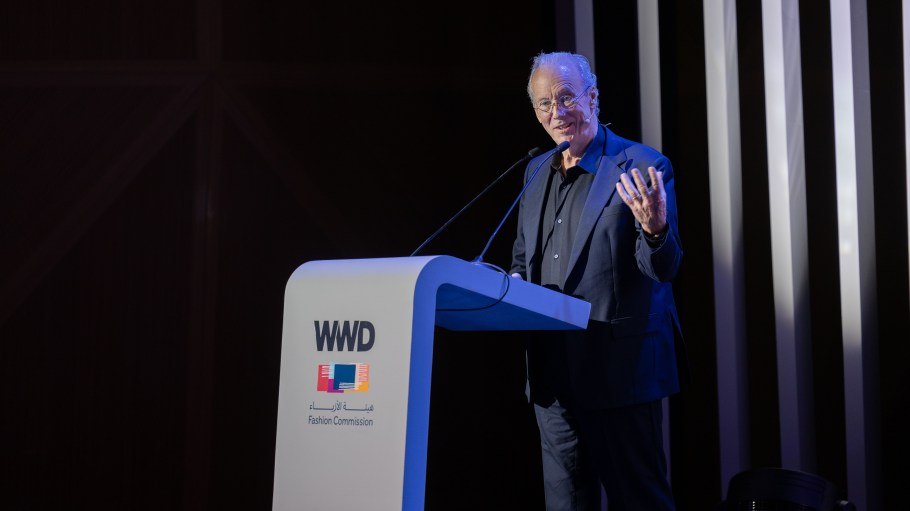
During the WWD Global Fashion Summit in Riyadh, William McDonough, chief executive officer of McDonough Innovation, presented a thought-provoking speech on sustainability, emphasizing an urgent need to rethink the industry’s approach to design and consumption. McDonough’s words resounded as a call to action, urging attendees to consider the impact of consumer choices on the environment and on future generations.
McDonough began by listing critical environmental concerns affecting human health that are caused by a variety of pollutants such as bioaccumulation, endocrine disruption, mutagenicity, reproductive toxicity and cancer.
Related Stories
“We can address these things,” he said. “But Gandhi said, ‘There is no beauty in the finest cloth if it makes hunger and unhappiness.’ Indeed. So, the question I like to ask when I start designing, is, ‘How do we love all the children of all species for all time?’” Starting the design process with love is critical, but McDonough said there are a lot of attendant issues.
“We have polyesters,” McDonough said. “We have polymers. We have new attendant issues. There are 258,000 bits of microplastic from the first washing of a fleece jacket. One washing, 258,000 of these escape and go fugitive. It’s been said that we all now have microplastics in our bodies. Is that our plan? It’s like climate change. Is that our plan? I’m a designer. It’s not my plan, but it’s our de facto plan because it’s a thing that’s happening because we have no other plan. So, who has the plan? We do.”
That plan, McDonough said, needs to reject the notion of designing for “end of life.” Instead, he advocates for a truly circular economy — a paradigm shift. Products should be designed for their next use, not their demise. Plant-based materials, such as technical nutrients, can return to the soil, closing the loop. McDonough’s book, “Cradle to Cradle,” explored this concept back in 2002, and emphasized regenerative design that aligns with natural cycles.
McDonough also discussed recent research that showed that the global human-made mass now exceeds all living biomass. He said human creations such as buildings, technology and more now outweigh the natural world. McDonough challenged the audience to recognize that nature provides sources, not resources and it is people’s responsibility to transform these sources into sustainable solutions.
McDonough also said we need to rethink how we measure and define things, especially toxins. He gave the example of fugitive carbon, or atmosphere carbon, “which if we think about it, it fits the definition perfectly of a toxin. The way we define toxin is that it is the wrong material in the wrong place at the wrong dose at the wrong duration. Toxic. Remember, water is highly toxic. Wrong dose, wrong duration, wrong place. If you find yourself surrounded by water for six minutes, it will kill you. If you jump out of an airplane at 30,000 feet and hit the ocean at terminal velocity, very big dose, very short duration, but it’s lethal. So, what is the question of fugitive carbon in the atmosphere that’s causing all these problems with our climate? It’s the wrong material in the wrong place at the wrong dose for the wrong duration. So, we’ve got to move on this. Same with plastics in the ocean.”
McDonough then closed with a clear directive, which is to reimagine design with love and embrace circularity while prioritizing next use. Whether it’s converting an office building into housing or upcycling various materials, people hold the key to a more harmonious relationship with the planet. The children of all species deserve nothing less, he said.