The Global Recycling Foundation (GRF) wants the “reduce” piece of the age-old “reduce, reuse, recycle” slogan to have dual meaning—the ability to minimize waste while simultaneously reducing barriers to recycling.
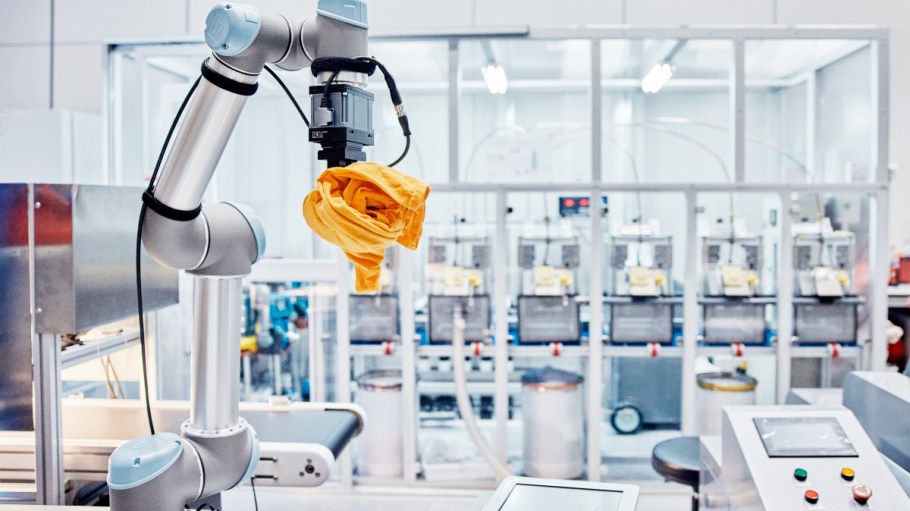
Ahead of World Recycling Day on March 18, the GRF released a statement noting that artificial intelligence should be used to more accurately and efficiently to sort mixed materials in arenas like textile recycling.
“AI-supported automation in our sorting systems will boost the quality of recycling materials by enhancing operational efficiency as sorting and processing of recyclables will be done with more precision and at a higher speed,” Ranjit Baxi, founding president of GRF, said in a statement.
Related Stories
Some companies and organizations have already stepped up, beginning to leverage machine learning and AI to aid the process of textile sorting.
Combining hardware and AI systems for better textile sorting
Constanza Gomez, co-founder of Sortile, said the company combines hardware with proprietary AI systems to help optimize the sorting process for textile-to-textile recycling.
The company’s hardware, operated using AI algorithms, allows users to understand whether the apparel, textiles or scraps they have fit with recyclers’ needs.
“[Our device] is basically tailored to who your fiber-to-fiber recyclers are. For example, if your cotton fiber-to-fiber recycler says they have a spec, but they’ll take anything that’s 95 [percent cotton], 5 [percent other materials], so anything 95 percent or more cotton, then the model is tailored for that,” Gomez explained “We tailor it depending on who your market is.”
She shared that once the device has been configured to a user’s specific needs, all the user has to do is place the garment on top of it. From there, the device can determine in less than one second how the garment should be classified by the user.
Constanza said the clients Sortile works with have buckets that correspond to certain characteristics. For instance, green might indicate that a garment contains at least 95 percent cotton, while red may indicate it has a high concentration of acrylic fibers.
“It’s super easy for the operator to use; everything’s color coded. [The system will say], it goes into the green bucket, or it goes into the blue bucket. The operator doesn’t really care if it’s cotton of quality; they just need to know where it’s going,” Gomez said.

Gomez said the startup has a three-pronged system for training the machine learning models that enable the algorithms. It uses high-fidelity samples from trustworthy sources; clothing tags, which it considers less accurate and daily data from all users of the devices for unsupervised learning.
The New York-based startup continues to innovate on the East Coast. On the West Coast, Refiberd has come into the picture to help with the sorting problem.
The technology the Cupertino, Calif.-based startup has developed differs from what Sortile has developed in several ways. Refiberd uses hyperspectral cameras, paired with AI systems, to detect materials present in textiles that need sorting.
Like Sortile, the startup has been working intensively to create a robust, accurate data set by training the model on thousands and thousands of samples.
“We’ve always been leaning into the accuracy component, and so really it needs to be able to detect differences better than a human can, and catch mistakes that a human can’t,” Bajaj told Sourcing Journal.
The company announced it had raised $3.4 million in funding last year, and it won the H&M Foundation’s Global Change Award in June 2023.
The H&M Foundation’s commitment to bettering textile recycling and sorting efforts with the help of AI shows that while small players have already begun to make a difference in the industry, major entities also have an interest in advancing the technology, which both Gomez and Bajaj said has a ways to go before it will be widely adopted.
The Hong Kong Research Institute of Textiles and Apparel (HKRITA) inked a partnership with the H&M Foundation in 2016, focused on accurate, speedy categorization of end-of-life textiles with tools like artificial intelligence.
The project, called the Smart Garment Sorting Project, created the infamous Green Machine to separate polyester from cotton, a problem that previously prevented larger-scale textile recycling. The work falls under the umbrella of the foundation’s Project Planet First initiative. The partners re-upped their collaboration in 2020, and unless it is renewed again, it will end in 2024.
Christiane Dolva, strategy lead at H&M Foundation, oversees the project. She said the rapid gains in efficiency prove out the efficacy of the project as it continues to improve.
“Using AI is a way to develop solutions that can make the sorting—which is a prerequisite for further recycling—more efficient. Currently HKRITA has built a dataset [of] 150,000 garments and material, ranging from type to construction recognition, which can recognize color, material and construction,” said Dolva. “Sorting made by humans generally has an accuracy of 95 percent. Our aim with this project has been to exceed that number, and the highest accuracy we have achieved so far is 96 percent.”
Crunching the data
GRF said AI, which the industry has been scrambling to implement in a number of ways, could help create a network of parties involved in recycling to optimize the sharing of recyclable materials.
“AI is a powerful tool which must be harnessed to strengthen the seamless exchange of recyclable raw materials connecting recyclers, manufacturers and suppliers of raw materials worldwide, helping to deliver a carbon friendly ecosystem,” Baxi said in a statement.
But before that can happen, companies and entities working together on textile recycling and sorting will have to aggregate a huge amount of accurate data, Bajaj said, noting that she expects larger-scale adoption of textile sorting technology to begin in the next three to five years.
Though Sortile is still a young company, Gomez and her co-founder, Agustina Mir, made the choice early on to share data with two of its competitors.
“There are so many silos here and everybody’s trying to put guardrails around like, ‘Oh, this is the technology that I have developed.’ The reality is, if we want this to actually scale, you need this data to be widely available,” Gomez explained. “In terms of sustainability and climate, the clock is against us, and so I think this is a space where collaboration can actually help a lot of us.”
Bajaj said though Refiberd would be interested in data sharing in the future, it has not collected enough data yet for it to be viable to the industry. She said before the company begins sharing its internal data externally, it wants to validate its trustworthiness.
Once data sharing begins, companies selling sorting technology solutions may quickly become a catalyst for connection, Bajaj said. She noted that she expects that, in the future, Refiberd will have the capability to introduce recyclers to brands and manufacturers that consistently have the type of materials particular textile recyclers are most apt to work with.
“It might be like, ‘You need a supply and we know that these guys work with polyester, and these guys work with cotton; let’s make sure we direct that [accordingly],” Bajaj said. “That is actually a lot of work that sorting technologies are going to have to take on. We’re kind of that middle boat, so let’s stitch our connections on one side to the connections on the other side, and make this all actually happen.”