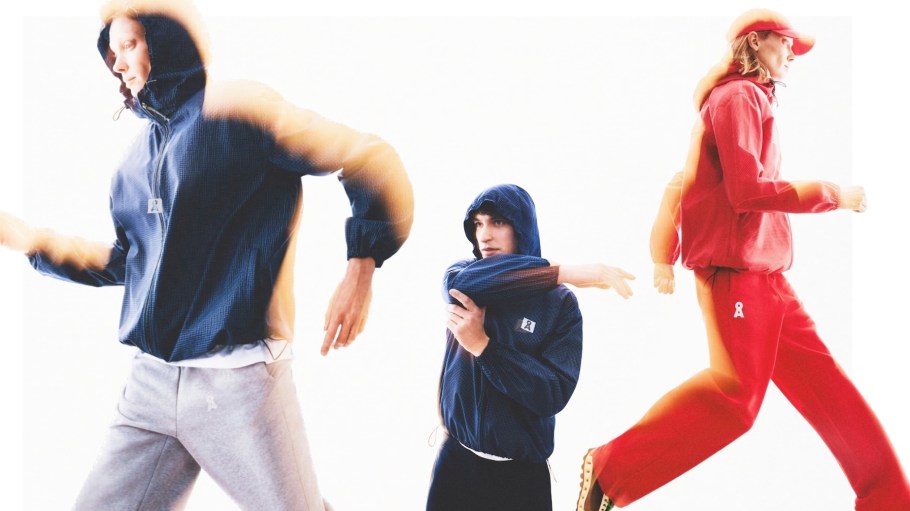
Armedangels is targeting one of the apparel industry’s most synthetic-reliant categories with a unisex windbreaker—and the first 100 percent Tencel Lyocell Ripstop constructed performance piece.
The German eco-fair brand positioned the “naturally engineered outwear” effort as a “market-ready proof of concept” for building functional protection without dysfunctional inputs: petroleum-based synthetics, membranes or PFAS-linked chemistry.
The Armedangels Tencel Windbreaker was developed through a strategic collaboration between the Cologne-based brand and several specialized international partners. Armedangels considers the collaboration as the “first step into a new category of everyday performance and as a foundation for the further development of a synthetic-free outerwear future.”
Related Stories
The Lenzing Group provided the wood-based Tencel Lyocell fibers from Austria, while textile consultancy Montebelo guided the project’s material innovation and sustainable supply chain strategy. Hermin Textile in Taiwan engineered the specialized dense ripstop fabric. Artifex, a manufacturing partner in Romania, handled the final garment production.
To achieve performance “unheard of for a natural, cellulosic material,” the development team replaced the synthetic membrane with a mélange of “advanced textile engineering” production processes. Fiber-wise, it’s almost wholly Lenzing. Ultra-fine, high-tenacity Tencel Lyocell microfibers were woven into an “exceptionally dense” ripstop construction.

The material matrix is designed as a “proof of concept” to address the fiber gap. While global fiber demand is rising, cotton availability has peaked; the partners placed cellulosics (like Tencel) as a viable performance alternative to the synthetic polymers (like polyester and polyamide). The construction “demonstrates a pragmatic approach,” according to Armedangels: curtailing plastic “wherever possible while maintaining product quality” and duration.
By eliminating the membrane—historically, a thin plastic layer laminated to the fabric—Armedangels seemingly solved one of circularity’s common concerns: conventional membranes are a weak point for garment recyclers. By removing them, the windbreaker becomes a cellulose-based mono-material (aka one that’s easier to return to Earth or a circular loop). And despite its membrane-free construction, the jacket’s compacted weave delivers up to 97 percent wind resistance—as tested according to internationally-recognized standard ISO 9237.
Because there’s no solid synthetic barrier, the fabric can breathe; in turn, letting the wearer’s body breathe, too.
“From day one, I have believed that fashion should not come at the expense of the planet,” said Martin Höfeler, founder and CEO of Armedangels. “In performance outerwear, however, synthetic materials are still widely seen as the only viable option.”
The all-gender garment features a “significantly reduced plastic footprint,” per Höfeler—demonstrating that the functional requirements of outerwear can be met through material innovation rather than the addition of petroleum-based synthetic membranes. It was developed with the Lenzing Group, along with Montebelo and Hermin. That’s what made the project exceptional, per Höfeler—the depth of collaboration and traceability behind it; the trio built full transparency across the entire value chain, he continued, from certified wood sources to the finished garment.
“This is a market-ready proof of concept that demonstrates how outerwear can be engineered differently,” Höfeler said. “We believe the future of outerwear is material-led, traceable and engineered to perform, without compromising responsibility.”
For Lenzing, the launch serves as a “powerful example of what true value‑chain collaboration can achieve.”
“By bringing together the expertise of Armedangels, Montebelo, and Hermin with our Tencel lyocell fibers, we showed how cellulosics can play a new role in outerwear,” said Manuela Gesslbauer, head of global brand partnerships at the Lenzing Group. “From fiber to fabric to windbreaker, this effort shows wood-based Tencel fibers can deliver performance without synthetics. We’re proud to raise industry awareness and inspire consumers with a product proving responsible innovation and functionality can coexist.”
The project’s success stems from what Johannes Fürst, managing director of Montebelo, described as a carefully orchestrated process—a multi-year R&D effort involving fiber selection, specialized spinning and innovative finishing with a dedicated and thoughtful R&D team.
“This collaboration demonstrates that it is genuinely possible to produce functional outerwear without synthetics,” Fürst said. “This project not only speaks to end consumers but also shows retailers and other brands that real, market-proven alternatives to petroleum-based products exist.”
Armedangels tapped Clo Virtual Fashion for a fully digital-first design and perfect-fit prototyping process. The “form follows function” windbreaker was developed using the garment simulation company’s “CLO3D” technology, which was equally (actively?) reducing the need for physical samples and minimizing waste.