Denim heroes of the past and future are coming to New York—or, at least, to Soorty’s SpaceD creative hub and showroom in Manhattan.
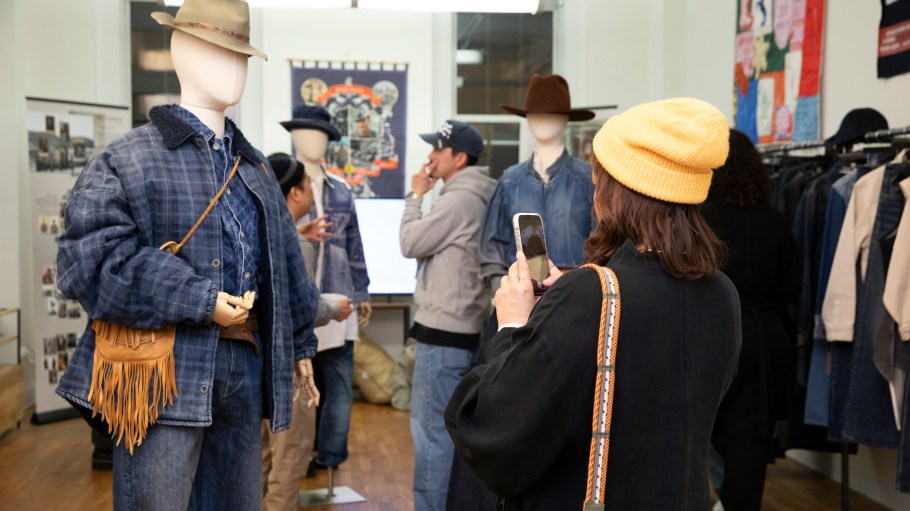
Last week, the vertically integrated denim manufacturer presented “Heroes of the Past & Future,” an exhibition and collection created in collaboration with design consultant Miles Johnson. The collection is the culmination of studying the history of four occupations—fishers, loggers, miners and cowboys—and why they wore what they did in the past and how the uniform has evolved.
Related Stories
Research for the project led to numerous questions about the purpose of workwear, uniforms and the people who wore them.
“Even just really simple things, like what we call the back spade pocket—why is it that shape? Well, because it’s the shape of our hand,” Johnson said. “It’s so many little things—you can ask the question, why does workwear look the way it does; it’s all for a reason.”
The exhibition-style presentation emphasized the enduring influence of heritage workwear on today’s denim design and manufacturing.
Soorty discussed how its internal teams use proprietary artificial intelligence (AI) tools to develop and refine denim concepts, allowing human creativity to guide technology to deliver faster, more tailored designs.
Think about Naked & Famous Denim NYC, suggested Melissa Urbina, Soorty’s design and product development manager, referencing the Japanese selvedge, made-in-Canada company’s flagship store on Grand Street and its denim display.
“When you walk in you see all of these jeans that are worn out and everyone’s pair looks different because we’re all different,” she said. “Obviously, we can’t go into such detailed situations with AI.”
But Soorty can go into specifics with Midjourney, specifically using its editing tool. On topics like cowboys, for example: an adventure Urbina said took “a lot of saddle work” that generated great stories. “If you’re on a farm or you’re on a ranch, what does that look like? What are the wearing patterns that we could derive from it?”
While the effort originally debuted in Amsterdam, the New York edition was reworked, featuring new garments and sporting a more commercial lens—highlighting how the Pakistani manufacturer’s concept-driven innovation translates into wearable, scalable product.
Johnson worked with Soorty to match the mill’s fabrics with sturdy, structured garments for each occupation. The space served as a reflection on the history of workwear; something he said denim has always had a place in.
“If you look at earlier designs, like Levi’s original riveted four-pocket jean design in—how much has the product changed from 1873 to today? It’s not actually very much,” Johnson said.
The showcase equally examined how AI is being used as a creative design alongside traditional craftsmanship. The partners examined the male and female forms to understand why they wore what they did; Johnson noted how the details of their garments were shaped by occupation. This was so inspiring that the duo decided to do a historical reproduction—something that “honored the way it was originally in the past” while also dialing up its details into something “quite modern,” becoming less for trade and more for trend.
“In the last couple of weeks, we peppered in a few more accessible, easy-for-anyone wear pieces; carpenters, work fatigues—all kinds of simplified workwear bottoms that fit into these four occupations,” Johnson said. “We played quite a lot with the whole essence of the workwear, of course, but also Western workwear.”
To that end, meet Lumberjill: a woman who was cutting down trees throughout World War II. She’s wearing two-plus knee-length breeches, short barrels with a long vest. The cowgirls of yore, meanwhile, wore enormous skirts in great style—in both the side and split saddle fashions—while horseback riding.
“She was really a quite strong character; in this country, of course, we know a lot about the history of cowboys. But really, look at how stylish that was, considering how rugged her lifestyle was; again, it was so important that she had form and she had some style of her own.”