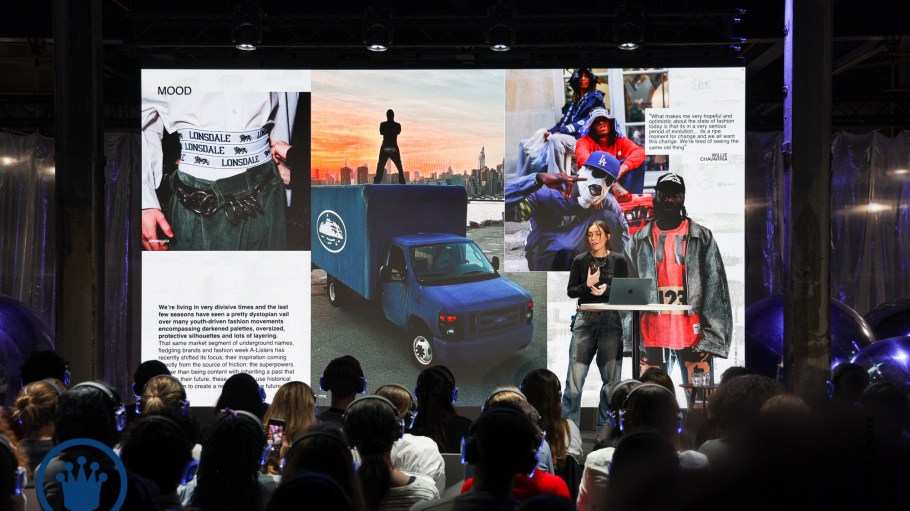
Denim Dudes’ 360-degree approach to trend forecasting was fully displayed at Kingpins Amsterdam last week as the Los Angeles-based consultancy presented four stories for Spring/Summer 2026. Sharing commercial and directional, youth-driven themes, Shannon Reddy, Denim Dudes trend forecaster, said there is something for everyone in the new season.
Here’s a closer look at what’s next in denim.
Superpower Pivot
Everyday sportswear and basics coupled with young generations reclaiming patriotic symbols of the U.S. and U.K. are at the core of Superpower Pivot. This theme Reddy said is more optimistic than cynical despite complicated conversations about colonialism and capitalism.
Related Stories
“We’re really seeing a new breed of creatives subvert and commentary casualwear, and their work is dripping in symbolism and political commentary using fashion as a tool for positive change. So even though it may look dark esthetically, the end goal is positivity,” she said about the trend.
The Americana trend that struck fashion during the Paris Summer Olympics is an example of consumers’ changing mindsets around patriotism and superpower nations. Reddy said designers are shifting the “dystopian veil over many youth driven trends” that encompass darker palettes and oversized protective silhouettes to using historical symbolism to create a new vision of the future.

Sporty styling, she added, has evolved into something more meaningful that connects people across class and cultural boarders.
“This next generation is really questioning blind patriotism,” she said. “Someone my age would never want to wear an American flag because we’re not proud of what we’ve been doing around the world. But instead, now people are starting to adopt these tropes from the far right and reclaim their history.”
The theme calls for layered destruction that mixes hand-drawn surfaces with plaids, jeanswear and workwear, recognizable sport jersey silhouettes with art motifs, dark and moody “gym rat” style, moto jackets and subverted darker rodeo style.
“Rodeo and Western wear have been sticking around for a number of years and instead of totally trending down, we’re seeing new iterations of [the theme] each season,” Reddy said. “We’re really seeing it become more of a staple element to design and styling.”
Designers can be creative with dark plaids, traditional woodland camouflage (ditch the oversaturated Realtree) and typography and slogans that riff on something nostalgic and familiar, she said. Jersey treated like denim, paneled workwear jeans and unraveled surfaces are also part of the theme.
No Barriers
No Barriers is about hyper-individualism and the ability to change up fashion aesthetics on a whim. Dress “tradwife” on a Monday and “rat boy” on a Tuesday—anything goes, Reddy said. Mindsets about gatekeeping are also changing as more consumers want to keep their “personal discoveries” a secret versus making them available for everyone to consume.
“Consumers are leaning deeper into an ‘anything goes attitude’ toward dressing, and it’s really resulting in a mash-up of aesthetics and era play as well. The trend cycle continues to catch up with itself—it’s not necessarily the designs or the brand, but it’s the energy. It’s the aura. It’s what you stand for behind a brand, a retailer or a collection that is attracting today’s consumer,” she said.
The women leading “girly pop summer” like Chappell Ronan, Charli XCX and Sabrina Carpenter are examples of this shift. “They’re really championing radical self-acceptance and individuality. But it’s interesting because they’re mostly catering to a female and queer audience, and it’s leading to more free-spirit and self-expression. It’s interesting, because they all aesthetically, are very different, but hit a very specific part of pop culture,” Reddy said.
Denim is a building block for the theme, which Reddy described as “today’s indie sleaze,” in addition to layering and ironic styling—even trashy, imperfect and chaotic styling. Twisted seams, draped silhouettes and “pretty jeans with delicate details, florals and lace” cohabitate with more androgynous workwear.
Finishes span raw shine, localized bleaching and sprays to photo-real laser artwork, digital prints and artful laundries. An eclectic color palette of dark and edgy colors, brash and bright bold pop colors and girly lilacs live here and are meant to be worn together.
Expect to see more chunky hardware and oversized belt buckles. “Make statements with your trims,” Reddy said.
Beyond Borders
Beyond Borders explores how the current socio-economic climate is unearthing more South Asian and Middle Eastern brand recognition and celebration, as well as exploring the relationship between people and the planet, Reddy said.
Regional fashion is especially important, she said, as “individuals are striving to foster unity by celebrating true cultural diversity” in an increasingly fractured world.
“There’s a deeper focus on the global South right now. With this new acknowledgment comes a greater responsibility to find solutions to the climate crisis, especially considering many of these countries serve as manufacturing hubs for Western brands and are most at risk when it comes to climate-induced weather disasters,” she said.
Whereas near nostalgia ramped up Y2K-inspired trends since the pandemic, she said Beyond Borders looks at far nostalgia styling tropes from the ’60s and ’70s but with a modern lens. Lightweight outerwear laundered and dyed like denim, elevated utility details, natural dyes, unbleached cottons, linen mixes, artful destruction and open weaves help tell the story.
The idea is how collectibles and crafts inspire embellishments, including charms, handcrafted appliques, travel badges and unique brooches. Print mixing and stripes are muted and antiqued. “The big takeaway here is that quality and authenticity are key. It’s not enough to just slap this aesthetic into your line without proper craftsmanship and cultural acknowledgment,” Reddy said.
Brand New Retro
With its “perpetual summer” vibes inspired by Southern Italy and Southeast France, Brand New Retro has the most commercial appeal.
“Political unrest and the cost-of-living crisis are amplifying the struggles of the average person. And these sort of elitist lifestyles and their styling tropes are being adopted, not only as an aspiration but as a form of appropriation and therefore protest,” Reddy said.
The travel-inspired theme features nods to the past. While retro themes have cropped up periodically throughout fashion history, all roads lead back to the ’70s, which Reddy said is “arguably the last time we saw truly unique design.”
“It’s no surprise that this period is being idolized as we search for stability and feel a lack of control in our lives as we see the last half century of progress slip away, especially in the States,” she added. “The ’60s and ’70s made great strides forward in equality, collective action and social justice.”
The theme comes together through sporty stripes, reimagined shirting, peplum silhouettes, capri pants and denim tunics in fluid and soft fabrications. Mid-casts, retro hues and clean wash-downs are key, while fabrics span structured rigid fabrications, loose, fluid Tencel blends, and jacquards with retro prints and plaids.