Pakistani mill Naveena Denim Ltd. (NDL) turned to nature for a new collection of fabrics with moisture management properties.
The Spring/Summer 2024 collection, called Swift n’ Sway, combines the inherent breathability and wicking capacity of cotton and Tencel, a cellulosic fiber that can absorb twice as much liquid as its natural companion, resulting in fabrics that are cooling, comfortable and sustainable.
“Nowadays every brand and every consumer want to have more natural-base materials with some functionality,” said Zeeshan Ahmed, NDL’s general manager of product development. “So, we came up with the idea of developing that kind of natural-base material with moisture management.”
Related Stories
Swift n’ Sway fits in with the current consumer taste for low-impact natural products. Spanning 15-18 fabrics with 10-12 oz. weights, the constructions are comprised of mostly cotton, a minimum of 10 percent Tencel and 1 percent Lycra for comfort stretch.
Ahmed noted that the weft—the side of the fabric that touches the skin—contains about 40 percent Tencel for enhanced softness and maximum moisture management. He added that the right composition of Tencel and cotton maximizes the cooling effect. The Tencel used throughout the collection is matte, a variation launched in 2021 that’s designed to scatter light and permanently diminish sheen in denim applications.
Moisture management in jeans is complicated, said Tuncay Kılıçkan, head of global business development, denim at Lenzing Group. He added that denim requires different moisture management expectations than a tennis top or biker shorts.
For example, after a short bike ride or sprint to the subway in jeans, the wearer’s body wants to release heat. When skin pores open and release water vapor, if this moisture “is not being absorbed by the textile covering your skin, then this water becomes liquid and you feel wet,” Kılıçkan said. The addition of Tencel makes Swift n’ Sway fabrics super absorbent so the body doesn’t feel any moisture-related discomfort.
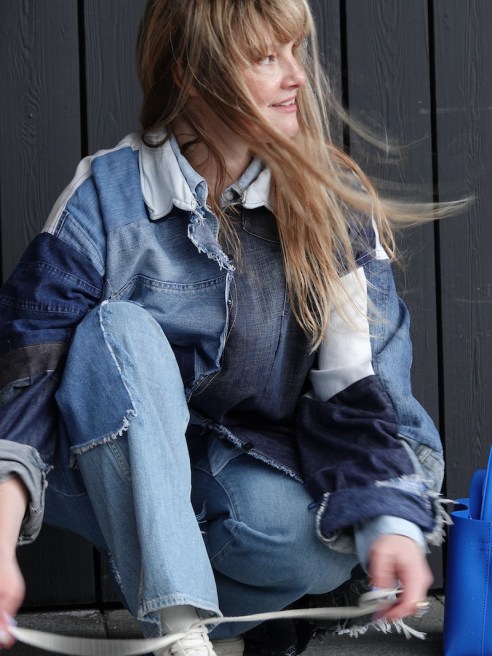
To bring the collection to life, NDL teamed with denim influencer and archivist Kelly Harrington to create a range of patchwork jackets, jeans and shirts.
The industry is responding positively to the collection so far. Though it will take time to adopt, Ahmed said clients understand the concept and what Naveena is trying to achieve with it. Some have requested yardage to create samples to compare to their conventional stretch products.
Though there are plenty of petroleum-based options that give consumers the same moisture management benefits, these are not kind to the environment, Ahmed said. The plastic-based solutions are not biodegradable, and they often have an unpleasant synthetic hand feel.
The market is driving change, however.
Ahmed said most denim brands are starting to reduce their use of polyester-based materials in their products, and consumer awareness of the environmental disadvantages of polyester has never been higher. Natural fibers are also more compatible with other sustainable solutions like laser finishing than fabrics that contain plastic.
“In all combinations, polyester is not going to help us down the line,” he said.
Additional reporting by Angela Velasquez.